- Impending safeguard duty keeps buyers wary
- China’s shipments drop to over 2-year low
- India emerges as net steel exporter in Feb’25
Morning Brief: India’s steel imports (excluding stainless steel) declined for the second consecutive month to reach 502,402 tonnes (t) in February 2025, as per provisional data maintained with BigMint. Notably, imports were down 32% from 739,172 t in January and 30% from 716,453 t in February 2024.
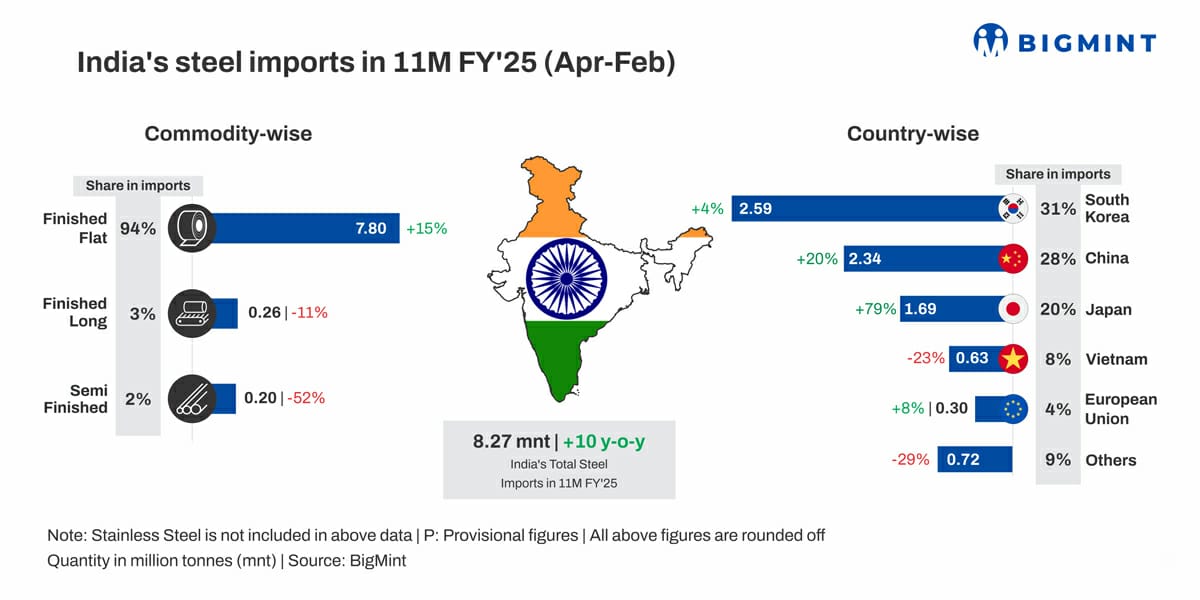
Additionally, in 11MFY’25, steel imports touched 8.3 million tonnes (mnt), a 10% increase from 7.5 mnt recorded in 11MFY’24. The rate of growth has moderated, given that in 10MFY’25, volumes were assessed at 7.76 mnt, an increase of 14% y-o-y.

Commodity-wise highlights
Finished flat steel imports, constituting 94% of the total, plummeted by 33% to 0.47 mnt in February from 0.70 mnt in January. Hot-rolled coil (HRC) volumes almost halved to 0.18 mnt in February from the previous month’s 0.35 mnt. Other commodities such as cold-rolled coils (CRCs), electrical steel and galvanised steel also dropped.
Interestingly, the share of HRC imports in India’s total dropped to 36% in February compared to 47% in January.
Semi-finished imports declined to 0.01 mnt from 0.02 mnt, while finished longs rose to 0.03 mnt from 0.02 mnt.
Key steel exporting countries
South Korea emerged as the leading exporter with 156,398 t, a steep 56% decrease from 355,705 t last month. Japan followed, shipping 137,710 t, 5% lower than January’s 144,856 t.
China suffered a 48% drop in its exports to India. Shipments totalled 62,344 t in February against 120,542 t in January. Arrivals from the EU climbed up by 23% m-o-m to 29,844 t compared to 24,182 t previously.
Factors impacting imports in Feb’25
Safeguard duty keeps buyers wary: Speculation regarding the safeguard duty was the primary driver behind the sharp drop in arrivals.
The steel industry had been expecting the safeguard duty to be announced at the time of the Budget. While those expectations were left unfulfilled, the market remained on its toes, as Trump’s announcement of 25% tariffs on US steel and aluminium imports threw the commodities markets into panic and disarray. Concerns also emerged about trade diversion India, and the leading steelmakers renewed calls for protective measures. The resulting uncertainty led buyers to focus on sourcing domestic material.
BIS licences of Chinese mills not renewed: The non-renewal of BIS licences of certain Chinese steelmakers was another contributing factors that helped suppress imports.
At the start of FY’23, China’s steel exports to India had been well within the 100,000-t mark. However, as the country struggled to revive its debt-ridden realty sector and domestic steel demand, its shipments to India increased exponentially, pressuring domestic mill margins and pulling down prices to four-year lows. However, this month, imports from China nosedived to their lowest since January 2023.
Domestic prices remain level or cheaper: Indian HRCs were priced at INR 48,400/t exy-Mumbai in February, while the landed cost of imported HRCs from FTA countries was INR 48,100/t. The same for Chinese material was INR 48,800/t.
Domestic prices were, therefore, largely level or slightly higher than imported material. Therefore, there was no incentive to source material from overseas.

South Korea’s exports fall amid domestic struggles: Flagging steel consumption has adversely affected the South Korean steel industry. Additionally, the US steel tariffs are expected to further pressure the market, given that South Korea is the fourth largest exporter to the US.
As a result, to minimise costs, steelmakers have adopted protective measures or undertaken production cuts. Lower steel output have led to lower exports from South Korea.
For example, Hyundai Steel has reduced output from its Pohang plant and, on February 24, suspended operations at its cold-rolled steel facility in Dangjin amid financial woes. Additionally, POSCO plans to raise $1 billion by selling off its non-performing assets as part of a widespread restructuring programme to tackle declining profits.
India emerges as net exporter in Feb’25
India recorded 0.54 mnt of steel exports in February, a 16% drop from 0.63 mnt in January. Despite the lower volume, exports exceeded imports, leading to India regaining its net exporter status in February, after a gap of 11 months.
Outlook
India’s steel imports seem poised to decline, with the Directorate General of Trade Remedies (DGTR) recommending a 12% safeguard duty on flat steel shipments for 200 days. While it would take the Finance Ministry’s ratification for the duty to get implemented, HRC imports will certainly fall due to unviability in comparison with domestic prices.
Leave a Reply