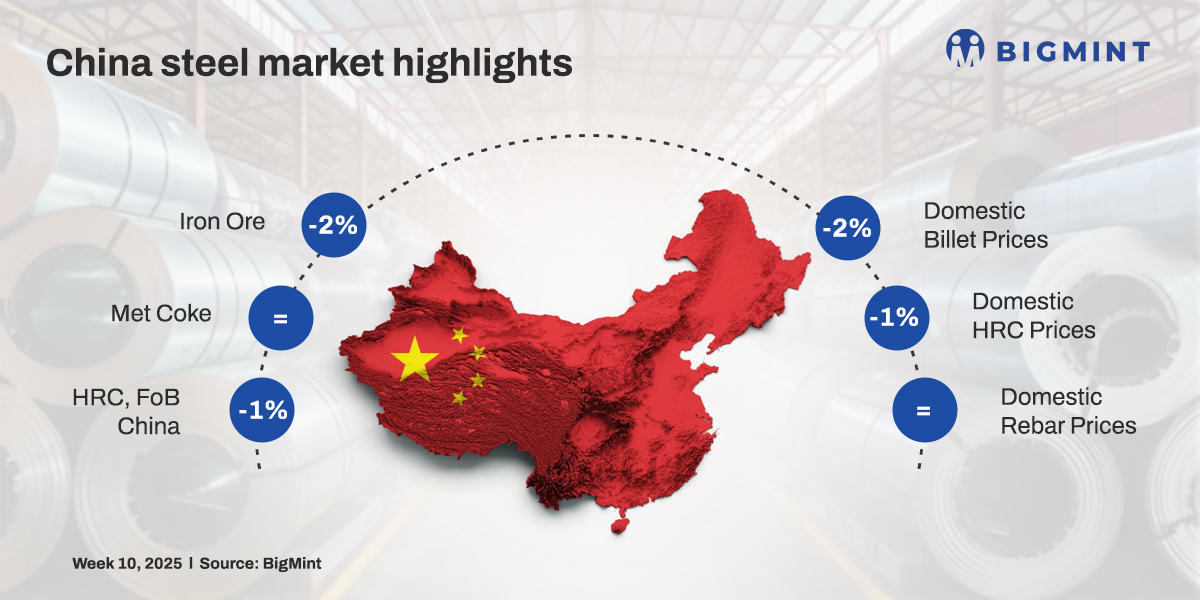
- Iron ore spot prices dip by $2/t w-o-w
- Tangshan billet prices plunge $50/t w-o-w
China’s steel market experienced a downturn this week. Shanghai Futures Exchange (SHFE) prices fell, with hot-rolled coil (HRC) and billet prices both declining w-o-w. Rebar prices held steady, while raw material costs also decreased, as spot iron ore and coking coal prices dropped.
The China Iron and Steel Association (CISA) revealed that the total steel inventory at key Chinese enterprises stood at 16.31 million tonnes (mnt) in late-February 2025. Inventory levels decreased by 420,000 tonnes (t ) or 2.5% against 16.73 mnt in mid-February 2025.
China’s cumulative steel exports for January and February 2025 stood at 16.972 mnt, up by 6.7% y-o-y against 15.90 mnt in January and February 2024, as per the General Administration of Customs.
1. Iron ore spot prices fall by $2/t w-o-w: The benchmark iron ore fines price decreased by $2/t w-o-w to $102/t CFR China on 7 March 2025. Tariff concerns on steel products influenced the raw material market, although some buying activity was reported. According to reports, miners recorded a few sales. Secondary market transactions remained limited as participants awaited updates from China’s Two Sessions. Deliveries scheduled for the second half of April may fetch higher prices.
a) Spot pellet premium fall w-o-w: Spot pellet premium for Fe 65% grade pellets decreased by $0.6/t w-o-w to $13.85/t CFR China on 5 March.
b) Spot lump premium inches up w-o-w: Spot lump premium edged up by $0.0025/t to $0.1525/dmtu on 7 March.
2. Coking coal prices inch down w-o-w: Australian coking coal prices fell marginally by $1/t w-o-w. PHCC was assessed at $183/t FoB Australia. Markets remained range-bound with limited trades amidst weaker sentiments. Chinese met coke prices remained stable. However, there are speculations about another round of met coke price cuts.
3.Chinese billet prices drop RMB 50/t ($7/t) w-o-w: Billet prices in China’s Tangshan sharply fell by RMB 50/t ($7/t) w-o-w to RMB 3,040/t ($420/t), including 13% VAT, on 8 March 2025 against 28 February. Volatily in raw material and finished steel prices, along with fluctuations in rebar futures and weak demand, exerted downward pressure on billet prices. Meanwhile, SHFE rebar futures (May 2025 delivery) dropped by RMB 58/t ($8/t) to 3,270/t ($452/t) on 8 March against 28 February 2025.
4. Domestic HRC prices drop: Chinese HRC offers inched down by RMB 20/t ($3/t) w-o-w to RMB 3,340/t ($462/t) as compared to RMB 3,360/t ($465/t) in the previous week, following a downward trend in SHFE HRC futures. SHFE HRC futures (May 2025 contract) edged down by RMB 33/t ($4/t) w-o-w to RMB 3,379/t ($467/t) against RMB 3,412/t ($472/t) last week. Chinese HRC export offers declined by $5/t w-o-w to $470/t against $475/t a week ago.
This decline in steel prices is driven by stimulus measures and escalating tariff threats. The government’s modest economic targets have failed to revitalise steel demand, which continues to struggle amidst a weak property sector.
5. Domestic rebar prices stable w-o-w: China’s rebar offers remained stable w-o-w at RMB 3,330/t ($460/t). SHFE rebar futures (May 2025 contract) stood at RMB 3,264/t ($451/t), down by RMB 54/t ($7/t) w-o-w from RMB 3,318/t ($459/t) in the previous week.
The rebar market initially showed price stability and a downward trend was anticipated. The NDRC’s decision to limit crude steel production generated a wave of optimism for price hikes, leading to fluctuating rebar futures. Nevertheless, weakening demand eventually resulted in a small price drop, breaking the market’s initial equilibrium.
China’s Shagang Steel has kept prices of its long steel products – rebars, coiled rebars, and wire rods – flat for early-March sales. Effective prices now stand at:
- Rebars (16-25 mm): RMB 3,500/t ($482/t)
- Coiled rebars (8-10 mm): RMB 3,610/t ($497/t)
- Wire rods (6-10 mm): RMB 3,520/t ($485/t)

Outlook
The outlook on China’s steel market shows mixed trend, with prices likely to be impacted by government policies and demand shifts. The “Two Sessions” meetings will provide crucial insights into infrastructure spending, economic stimulus, and environmental regulations.
Leave a Reply