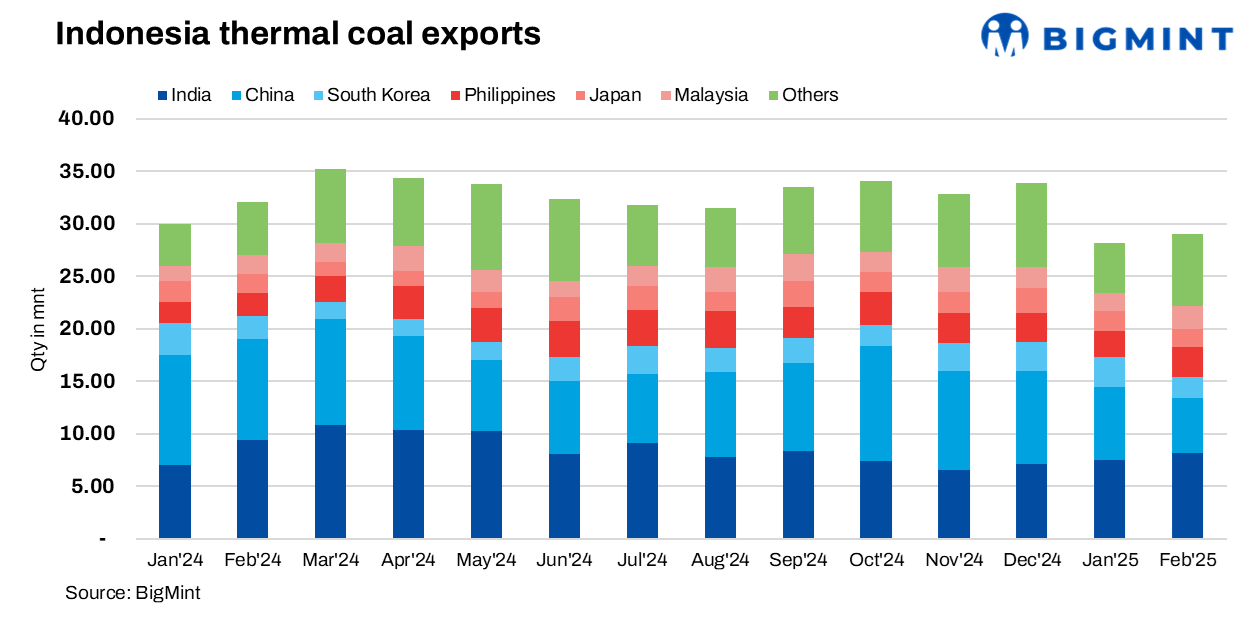
- Exports to India increase by 8% m-o-m
- China sees 24% fall amid reduced demand
Indonesia’s thermal coal exports saw a modest 3% m-o-m increase in February 2025, to 29.06 million tonnes (mnt) from 28.18 mnt in January. This slight growth reflects differing trends in key Asian markets, with some regions showing increased demand, while others experienced a decline due to changing energy dynamics and market conditions.
Performance of key markets
In February 2025, India increased its imports of Indonesian thermal coal by 8% to 8.16 mnt, driven by growing energy and industrial demand. Conversely, China saw a 24% m-o-m drop to 5.21 mnt due to reduced demand and a shift towards renewables. South Korea’s imports fell 30% m-o-m to 2.03 mnt as it moves towards diversifying its energy sources, while the Philippines saw a 16% rise to 2.83 mnt, fuelled by higher industrial energy needs. Japan’s imports decreased 11% m-o-m to 1.71 mnt, reflecting an increasing shift to LNG, and Malaysia’s intake surged 27% to 2.20 mnt, driven by strong demand for power generation and competitive pricing.
Indonesia’s coal exports in February 2025 reflect steady demand from India, while markets such as China, Japan, and South Korea appear to be shifting more towards greener energy. Future growth will depend on Indonesia’s ability to adapt to these trends, with emerging markets such as the Philippines and Malaysia presenting new opportunities.
Regional performance in Indonesia
In February 2025, East Kalimantan led Indonesia’s coal exports with a 4% m-o-m increase to 13.23 mnt. South Kalimantan saw a 3% m-o-m rise to 9.72 mnt, driven by steady demand from India and the Philippines. Sumatra’s exports grew 7% m-o-m to 5.05 mnt, reflecting strong demand. However, North Kalimantan experienced a 16% m-o-m decline to 1.05 mnt due to logistical issues and reduced demand from certain markets.
Outlook
Indonesia will require all thermal coal exporters to use the domestic benchmark pricing index, known as Harga Batubara Acuan (HBA), as the baseline price for transactions, effective 1 March 2025, the Ministry of Energy and Mineral Resources (ESDM) confirmed during a Zoom meeting on 26 February. The announcement has sparked concerns, particularly regarding the timing of the HBA updates, which often lag behind market conditions and may not reflect real-time trading dynamics, sources highlighted.
Leave a Reply