- Slight rise attributed to exchange rate increase
- Decrease across grades limits price hikes in India
Indonesian non-coking coal prices at Indian ports have seen a slight increase on a w-o-w basis, largely driven by the rise in the exchange rate. However, the overall market demand remains subdued, with limited domestic stock availability further exacerbating the situation.
According to BigMint data, non-coking coal inventories at Indian ports have declined by 2%, decreasing to 13.66 million tonnes (mnt) in the fifth week of 2025, compared to 13.34 mnt in the previous week. This drop in inventory levels reflects the tightening of coal supplies at key Indian ports, even though demand has not picked up significantly.
Breaking down the price movements at Indian ports, specific coal grades showed mixed trends. At Navlakhi, the price of 3400 GAR rose by INR 50/t, reaching INR 4,500/t. Meanwhile, 4200 GAR at Kandla remained stable at INR 5,850/t, reflecting limited volatility in prices for this grade. Likewise, the price of 4200 GAR coal at Vizag held steady at INR 5,750/t, and 5000 GAR coal at Kandla saw no change, remaining firm at INR 7,600/t. However, the price for high-GCV 5000 GAR coal at Vizag experienced a slight drop of INR 50, bringing it to INR 7,500/t, showing some downward pressure on this higher-quality grade.
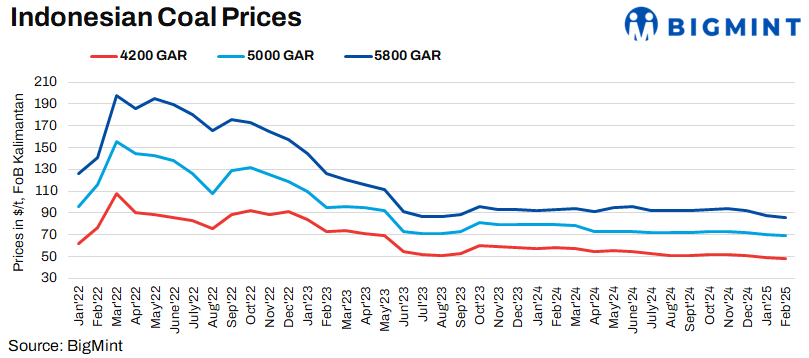
Globally, Indonesian indexed coal prices have been on the decline, with prices for various grades of coal seeing w-o-w reductions. The price of high-CV 5800 GAR decreased by $0.41/t to $86.42/t. Similarly, mid-CV 4200 GAR coal fell by $0.08/t to $48.48/t, while low-CV 3400 GAR saw a decrease of $0.20/t, bringing it to $29.50/t, all on a free-on-board (FOB) basis. This global price trend reflects weakening demand in key markets and signals a potential softening of coal prices moving forward, which may affect pricing trends at Indian ports.
Overall, while Indian port prices for Indonesian coal have seen a modest increase due to exchange rate movements, the slowing demand and declining inventories suggest that price fluctuations will remain relatively contained in the near term. On the global front, decreasing coal prices add another layer of uncertainty, indicating that any further price increases in the Indian market may be limited.
Leave a Reply