- Shipments to China rise 34% y-o-y
- Exports to India plunge 60% y-o-y
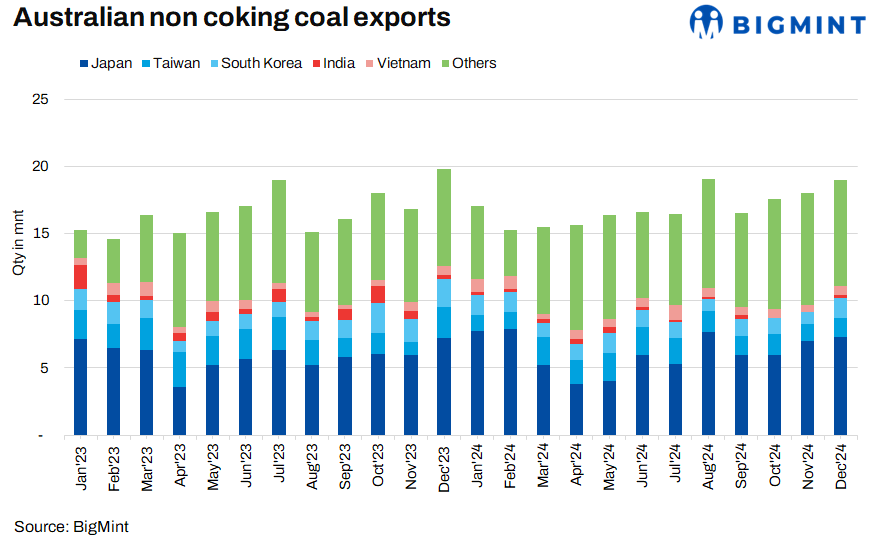
Australia’s bulk non-coking coal exports grew 2% in CY’24 to 202.84 million tonnes (mnt) from 199.48 mnt in CY’23. This growth was largely driven by a 34% surge in shipments to China, reflecting strong global demand for Australian coal despite market uncertainties.
Key export markets – shipments to Japan stable, to China surge
Japan remained Australia’s largest importer, with a modest 1% y-o-y increase to 72.74 mnt in CY’24 from 72.09 mnt in CY’23. China, the second-largest importer, saw a substantial 34% y-o-y rise in volumes to 67.24 mnt, compared to 50.25 mnt in the previous year, which reflects the country’s increased demand for high-quality coal.
Meanwhile, Vietnam saw a small 4% y-o-y increase in imports, which stood at 7.99 mnt compared to 7.55 mnt in the previous year.
However, some key markets experienced declines. Taiwan’s imports dropped 15% y-o-y to 20.03 mnt from 23.65 mnt in CY’23. South Korea also recorded a 19.3% y-o-y decrease, recording shipments of 14.16 mnt in CY’24 compared to 17.53 mnt.
The most significant change came from India, where imports plummeted 60% y-o-y to just 3.30 mnt from 8.31 mnt. This drop is attributed to India turning to alternative suppliers, such as the US and Russia, in an effort to diversify its imported coal sources.
Port-wise performance
Port-wise, Newcastle Port led with a 2.5% y-o-y increase in exports to 148.23 mnt from 144.62 mnt in CY’23.
Other ports had mixed results: Abbot Point Port saw a 7.3% y-o-y decline to 17.8 mnt from 19.2 mnt in CY’23, while Gladstone Port experienced a 3.3% y-o-y decrease, with exports totalling 17.4 mnt. On a positive note, Dalrymple Bay Coal Terminal (DBCT) saw a 4.3% y-o-y increase in CY’24, shipping 12.94 mnt.
A standout performer was Brisbane Port, which saw a remarkable 78% jump in exports in CY’24, to 4.06 mnt from 2.29 mnt in the previous year. This surge indicates shifting trends in coal export activities, with ports such as Brisbane benefitting from changing market dynamics.
Conclusion
Australia’s bulk non-coking coal exports in CY’24 reflect a resilient industry, which continues to meet global demand despite shifts in regional trade patterns. With strong performances from major markets such as China and Japan and shifting export flows through various ports, Australia’s coal sector remains a key player in the global energy market.
Leave a Reply