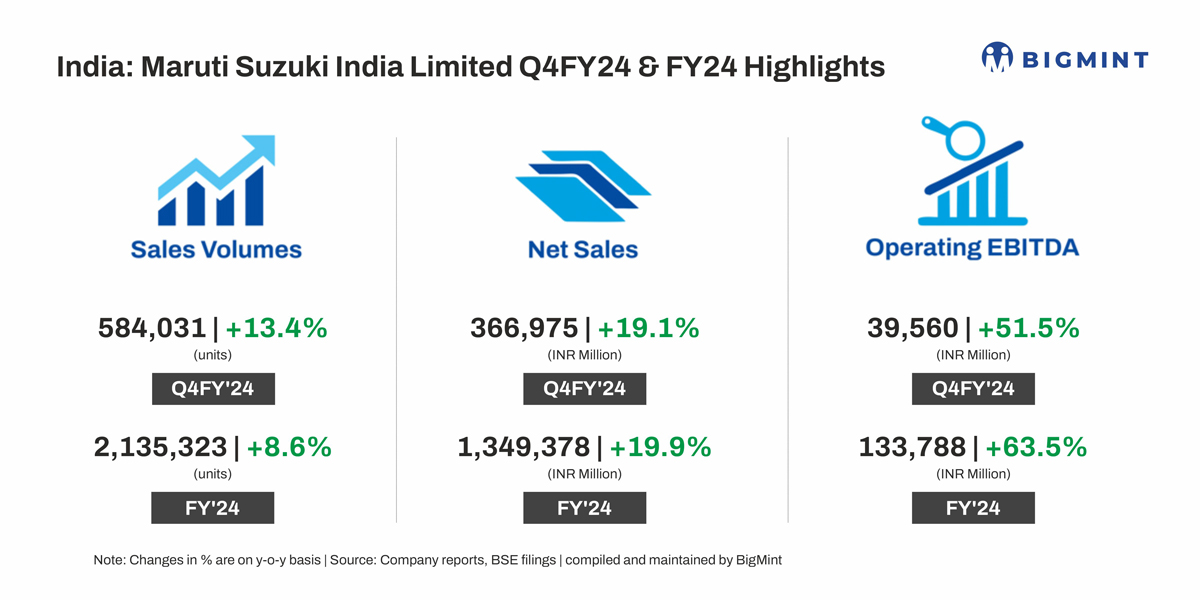
Maruti Suzuki India Limited (MSIL) posted its highest ever sales volumes of 2.13 million units in FY’24, up 8.6% against 1.96 million units in FY’23. The company increased its captive solar power generation capacity from 26.3 MW (megawatts) in FY’23 to 42.3 MW in FY’24 and is progressing to achieve the target of 48 MW by FY’25, BigMint learnt at the company’s investors call organised recently.
Market scenario
The Indian Passenger Vehicle (PV) industry achieved a significant milestone by surpassing the 4-million sales mark for the first time in FY’24, making the country the third-largest PV market globally.
The PV market witnessed growth of 8.4% y-o-y in FY’24, attributed to the introduction of new SUV models and improvements in semiconductor availability, which helped drive demand. The past 3-4 years have seen a significant surge in consumer preference for SUVs, now comprising over 50% of the market and driving substantial growth in the Passenger Vehicle (PV) segment. Demand for multi-purpose utility vehicles has also remained strong during this period. However, the share of the hatchback segment has steadily declined, dropping from 47% in FY’19 to 26% in FY’24.
The better availability of CNG vehicles coupled with increase in CNG infrastructure has helped to improve demand for those vehicles. Their share in the market grew to about 15% in FY’24 from 10.4% in FY’23. Additionally, the share of hybrid vehicles increased to 2%, while electric vehicle (EV) penetration also reached around 2%.
Projects
- The Greenfield project in Kharkhoda, Haryana represents a significant growth endeavour of the company. Construction is underway, with the first plant nearing completion and slated to commence operations in 2025, with an annual production capacity of 250,000 units.
- Additionally, the company has inked a Memorandum of Understanding (MoU) with the Government of Gujarat to establish a new automobile manufacturing facility. The expected annual production capacity of the facility will be more than 1 million units with a total investment of about INR 35,000 crore.
Performance highlights
- Highest ever annual and quarterly sales: The company achieved its highest ever sales of 2.13 million units in FY’24, up 8.6% y-o-y basis from 1.96 million units in FY’23. Exports accounted for 13.3% share in total sales, rising 9.2% y-o-y to 283,067 units, while domestic sales (86.7% share) increased 8.5% y-o-y to 1.85 million units during the year. The company achieved the milestone of highest ever dispatches of 4,50,000 vehicles by railways.
During Q4FY’24, total sales of 584,031 units was achieved, out of which domestic sales were 505,291 units and exports 78,740 units. - Net sales rise y-o-y: The company’s net sales registered an increase of 19.9% y-o-y to INR 1,349,378 million in FY’24 from INR 1,125,008 million last year, primarily driven by higher sales volumes, favourable commodity prices, and cost reduction initiatives.
During Q4, net sales rose 19.1% y-o-y INR 366,975 million from INR 308,218 million in FY’23. - Operating EBITDA up y-o-y: The company’s operating Earnings Before Interest, Taxes, Depreciation, and Amortization (EBITDA) registered significant increase of 63.5% on the year to INR 133,788 million as against INR 81,844 million in FY’23. The same rose 51.5% y-o-y to INR 39,560 million in Q4FY’24 from INR 26,111 million in Q4FY23.
- During the year, customer preference for green vehicles saw a notable increase. The share of sales from green vehicles, including CNG vehicles, smart hybrids, and strong hybrids, rose to 42% from 37% in the previous year.
- As part of its growth strategy, Maruti Suzuki 3.0, the company aims to ramp up its vehicle production to 4 million units by FY31, nearly double the current levels. However, in line with carbon neutrality requirements, the company anticipates the coexistence of various technologies such as electric vehicles (EVs), hybrids, and CNG-powered vehicles for an extended period.
- Inventories stood at 136,000 units in the end of FY24.