Silicon Demand Production Supply
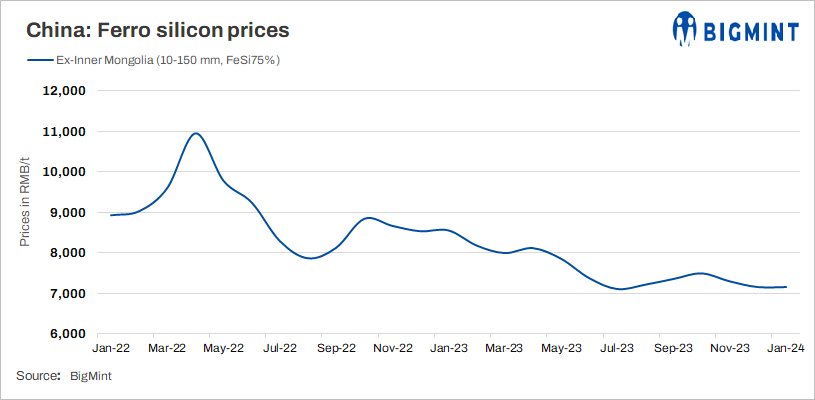
The oversupply of China’s ferro silicon will likely continue in 2024, with the availability of significant new Ferro silicon production capacities against limited increase in downstream demand, according to Mysteel’s newly-published forecast for the ferro alloy’s market of this year.
On the demand side, China’s crude steel production came in at 1.019 billion tonnes in 2023, almost the same level as the previous year, according to the latest data released by the country’s National Bureau of Statistics (NBS) on January 17.
As for this year, the national crude steel output can hardly see any improvement as domestic steel demand has plateaued in China. This is expected to restrain ferro silicon demand from stainless steel producers as well, Mysteel predicts in the report.
On the other hand, domestic ferro silicon demand is likely to be partially supported by an uptick in Magnesium production this year, with the anticipated resumption of some magnesium smelters in Fugu county in Northwest China’s Shaanxi province, the world’s largest magnesium producing region.
According to Mysteel’s survey, Chinese magnesium production tumbled by 18.04% on year to sit low at 740,000 tonnes in 2023, mainly due to the production suspension among magnesium smelters in Fugu to remove old semi-coke capacities there since last May. Yet, with the gradual resumption of some smelters from last November, China’s magnesium ingot production may bounce back to around 70,000 tonnes per month in 2024, Mysteel estimates.
On the supply side, about 500,000 tonnes of new ferro silicon capacities are expected to put into production in 2024, mainly in North China’s Inner Mongolia and Northwest China’s Gansu where smelters enjoy relatively low electricity costs, Mysteel predicts. This will add more pressure on the supply of the ferroalloy in domestic market this year.
For instance, an Inner Mongolian-based smelter plans to put eight 40,500-kVA ferro silicon submerged arc furnaces into operation at its production site in Gansu by May 2024, per the report.
As for the electricity costs, Mysteel notes that China’s National Development and Reform Commission and National Energy Administration jointly issued a notice on setting coal power capacity payment scheme in November last year, which aims to improve the country’s power consumption structure and boost the use of cleaner energy sources, though it may have a limited impact on ferro silicon smelters’ power costs this year, Mysteel predicts.
Note: This article has been written in accordance with an article exchange agreement between SteelMint and Mysteel Global.
Leave a Reply