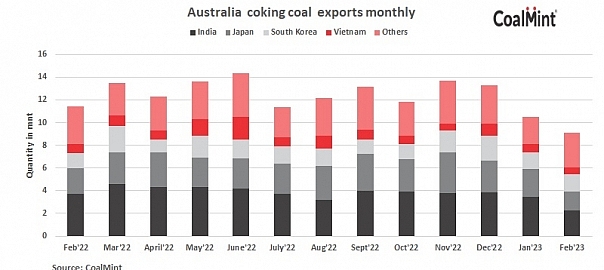
Australian coking coal exports fell by 13% m-o-m to 9.13 million tonnes (mnt) in February 2023, while shipments dropped 20% y-o-y, as per CoalMint’s vessel line-up data.
The decline in exports was the result of supply constraints in Australia. In Australia’s highest coking coal producing province of Queensland the key coal terminals had serpentine ship queues. In addition, Gladstone Port remained closed from 29 January-11 February.
Inclement weather and a train derailment incident in January had hindered supply, which led to lengthier ship lines at ports in February.
Significantly, this is the third month in a row that coking coal shipments from Australia have decreased. Exports have decreased by 33% since November.
Port-wise analysis

In February, none of the ports recovered from the supply disruption caused in January. Coking coal vessel dispatches from Gladstone witnessed the steepest decline of 42% compared with December 2022, while coking coal dispatches from Port Kemble fell by 14% during the same period.
However, coking coal shipments from Dalrymple Bay Coal Terminal (DBCT), Port Abbot Point, and Port Kemble cumulatively increased in February compared with January.
Company-wise exports

BHP-Mitshubishi Alliance (BMA), Australia’s largest coking coal exporter, exported 2.82 mnt in February, a decrease of 32% y-o-y. Jellinbah, the second largest exporter in 2022, saw its export volumes falling by 55% m-o-m to 330000 t during the month.
Exports from Oaky Creek CC and South Walker CC, however, more than doubled in February compared to the previous month.
Country-wise shipments

Australia’s coal shipments to key countries – India and Japan – declined while shipments to South Korea increased. Shipments to India fell by more than 50% m-o-m. Exports to Japan fell by 45% on the month in February. The decline in exports was because of a surge in Australian coking coal prices on supply issues.
Meanwhile exports to the EU surged 41% m-o-m in February amid restocking demand.
Australian coking coal exports to China increased from 75,000 t in January to 318,000 t in February following the lifting of China’s unofficial ban on Australian exports.
Outlook
Australian coking coal exports are expected to rise in March as there supply constraints such as in January and February are expected to ease. In addition, demand may rise as Australian coking coal prices have dropped 14% since mid-February.
Leave a Reply