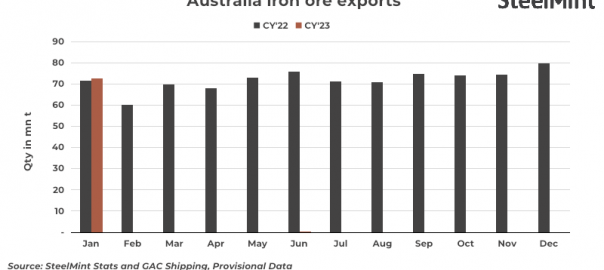
Australia’s iron ore (including pellets) export shipments decreased by 9% m-o-m to 72.58 million tonnes (mnt) in January 2023 compared to 79.99 mnt in December 2022, according to vessel line-up data maintained with SteelMint.
Exports to China decline 8%
Australia’s iron ore export shipments to the world’s largest importer, China, were recorded at 61.28 mnt in January, down 8.4% m-o-m against 66.89 mnt in December. Iron ore exports from Australia to China fell in January because most market participants were on vacation ahead of the Lunar New Year holidays.
South Korea and Japan were the second- and third-largest iron ore importers from Australia in January. The latter supplied 4.38 mnt to South Korea, down 8% m-o-m, while 3.99 mnt was shipped to Japan, down 34% m-o-m.
Shipper-wise performance
Rio Tinto’s iron ore shipments were the highest at 24.46 mnt in January, down 20% m-o-m against 30.41 mnt in the previous month. BHP and FMG shipped 24.02 mnt (largely stable) and 15.30 mnt (down 7%), respectively.
Exports from Port Hedland
Port Hedland exported 46.38 mnt of iron ore in January, down slightly by 3.2% m-o-m compared to 47.9 mnt in December followed by Port Walcott at 12.76 mnt (down 27%) and Port Dampier at 11.7 mnt (down 9%).
Price trends
Monthly average Australian-origin Fe62% iron ore prices stood at $111/t CFR China in December compared to $92/t in the previous month. Spot prices of iron ore in China increased in December-January as most seaborne buyers departed before the Lunar New Year in preparation for the upcoming holidays on positive market fundamentals after returning from the holidays.
Outlook
Australian iron ore exports in February are expected to rise amid positive buying interest and growth in iron ore demand, as Fe62% iron ore prices continuously improve in China.

Leave a Reply