- PSIC-related port delays restrict imported scrap availability
- Festive restocking to support trading activity ahead of Diwali
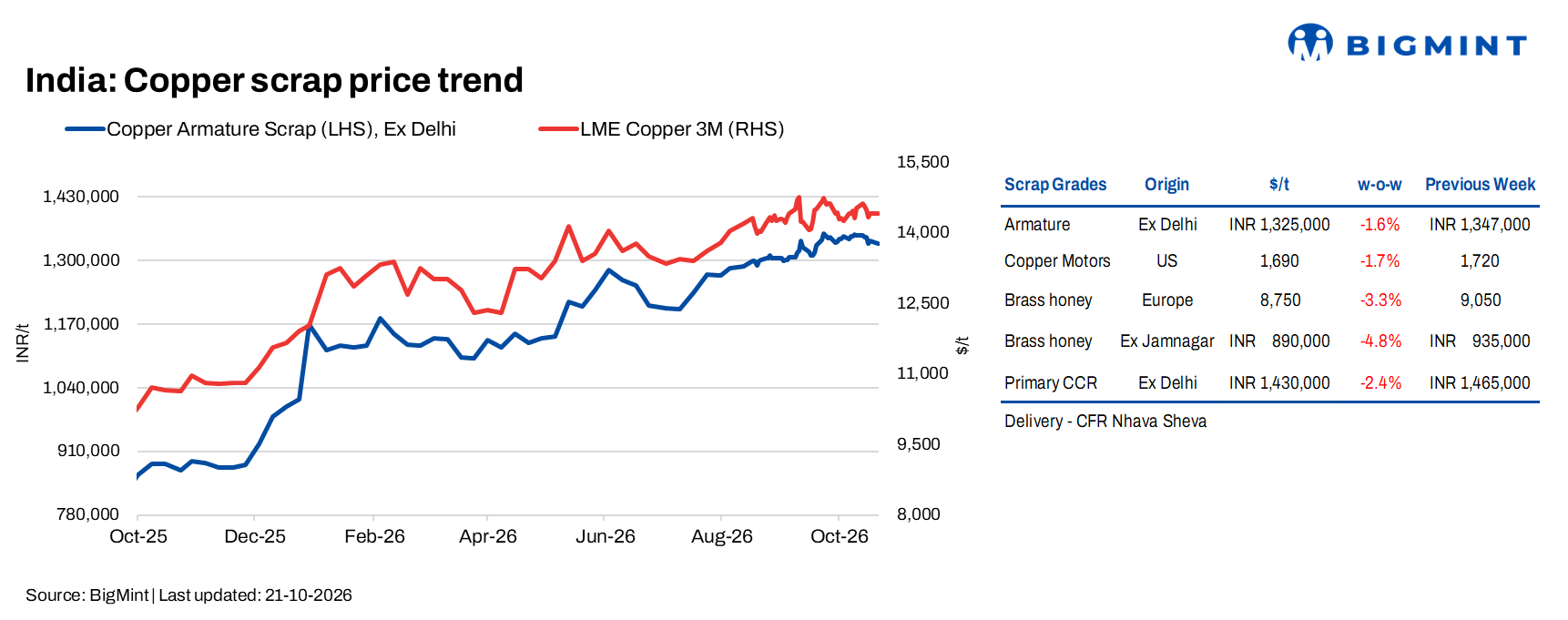
India’s copper scrap market showed bearish signals during the assessment week ended 21 October 2026. LME copper fell 1.08% w-o-w to $14,420.5/t from $14,578/t, while domestic copper armature scrap prices declined 1.6% to INR 1,325,000/t from INR 1,347,000/t in the previous week.
Despite the seasonal pickup in buying interest, weaker international prices and slightly higher LME inventories kept the broader market outlook uncertain. Competition for imported scrap also remained intense as suppliers favoured destinations offering stronger realisations.
Domestic market
India’s copper scrap market remains under pressure as declining LME copper prices weigh on domestic assessments. However, the ongoing Pre-Shipment Inspection Certificate (PSIC) issue has left imported scrap containers stranded at ports, disrupting clearances and limiting material availability for recyclers. With Diwali approaching, festive restocking could support buying interest, although most buyers continue to purchase hand-to-mouth amid price uncertainty.
Buyers are seeking lower prices in line with LME trends, while sellers holding ready stock remain reluctant to make significant concessions due to delays in replenishing imported material. Traders are avoiding large purchases and awaiting greater price stability. While improved demand ahead of Diwali may provide near-term support, domestic price movements will largely depend on LME trends and the resolution of port clearance issues.
Rising scrap supply, shifting trade flows cloud market balance
The International Copper Study Group (ICSG) expects the global refined copper surplus to widen to 368,000 t in 2027, from 104,000 t in 2026. Refined output is forecast to grow 3.4% in 2027, while demand is expected to rise 2.5%. Secondary refined copper production from scrap could increase 4.7%, outpacing the projected 3% growth in primary production. This may intensify competition among smelters for scrap feedstock.
Meanwhile, China’s demand recovery remains uneven. Copper cathode imports rose 21% m-o-m in September but remained 24% lower y-o-y. US copper inventories have exceeded 1.6 million tonnes (mnt) amid tariff-driven stockpiling, tightening availability in other markets. Anglo American’s Q3 copper output fell 5% y-o-y to 174,900 t, while BHP’s Olympic Dam expansion could support future supply. The US dollar index declined 0.25%, offering some price support. However, rising refined output, uncertain Chinese demand and shifting trade flows are likely to keep the market volatile.
Offers
The following trade indications were observed during the week:
US-origin Millberry: 99.5% of LME, CIF India
UK-origin brass honey scrap (6-7%): 61-61.5%
US-origin Birch Cliff: 93% of LME, CIF India
US-origin copper meatballs (21% Cu): $2,850/t, CIF Mundra
Outlook
India’s copper scrap market is likely to remain under pressure from declining LME prices. Diwali restocking could support domestic demand, while limited availability of imported material may help sellers maintain premiums. However, buyers are expected to remain cautious until international prices stabilise and cargo clearances improve.
Globally, record European copper premiums reflect regional supply constraints and tariff-driven inventory concentration in the US. However, the ICSG’s projected refined copper surplus of 368,000 t in 2027 could limit sustained price gains as production growth outpaces demand. China’s consumption trends, US inventory movements and Codelco’s upcoming China premium announcement will remain key indicators.
Leave a Reply