- India’s auto industry enters festive season on strong footing
- Improved affordability drives India’s auto sales growth
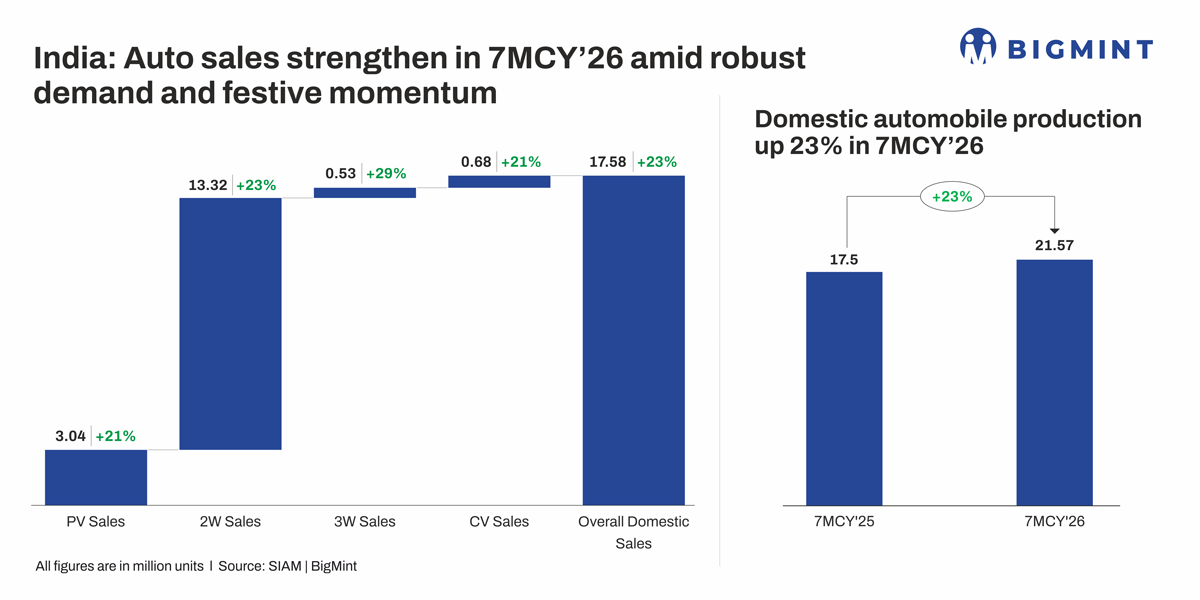
India’s automobile sector recorded strong sales growth in 7MCY’26, according to SIAM data, supported by healthy demand across all major vehicle segments. Passenger vehicle sales increased 21% y-o-y to 3.04 million units, while two-wheeler sales rose 23% to 13.32 million units. Three-wheeler sales also climbed 29% to 0.53 million units.
Commercial vehicle sales increased 21% y-o-y to 0.68 million units. Overall domestic automobile sales rose 23% to 17.58 million units, while total automobile production advanced 23% to 21.57 million units in 7MCY’26.
Retail automobile sales rise 20% y-o-y in 7MCY’26
Meanwhile, FADA’s retail data for 7MCY’26 reflected healthy y-o-y growth across all vehicle segments. Passenger vehicle sales increased 25% to 2.99 million units, while two-wheeler sales rose 23% to 12.91 million units. Three-wheeler sales also grew 15% to 0.83 million units.
Commercial vehicle (CV) sales increased 13% to 0.69 million units, while tractor sales rose 25% to 0.66 million units. Overall retail automobile sales increased 20% to 18.08 million units, indicating broad-based growth across all vehicle segments.
Strong demand, festive momentum drive broad-based sales growth
India’s automobile retail market recorded a historic performance in 7MCY’26, with all six major categories posting their best-ever July sales. According to FADA Vice President Sai Giridhar, the broad-based growth reflected the underlying strength of the Indian automobile market, supported by improved affordability, easier retail financing, favourable festival timing, new launches and a recovering monsoon. He noted that the performance was broad-based rather than driven by any single vehicle segment.
Echoing the positive outlook, Rajesh Menon, Director General, SIAM, said that India’s automobile industry delivered its strongest-ever July performance, with robust double-digit growth across passenger vehicles, three-wheelers and two-wheelers. He highlighted that the sustained momentum over recent months has positioned the industry favourably as it enters the festive season, with expectations of continued strength in consumer sentiment.
Two-wheeler demand remained robust, aided by improved affordability, the reopening of schools and colleges, better monsoon sentiment and accelerating EV adoption. However, erratic rainfall, floods, and the Aadi/Shravan period affected rural walk-ins sequentially, while limited availability of some high-demand models led to pending bookings.
Commercial vehicle demand was supported by strengthening goods movement, infrastructure activity, cement, steel, and mining-linked transportation, expanding e-commerce logistics and improved financing availability. Rural markets continued to outperform urban areas, indicating a broader recovery in economic activity beyond major cities.

Passenger vehicle sales benefited from improved affordability, new model launches and OEM schemes, with rural markets emerging as a key demand driver. Consumer hesitation around the E20 fuel transition also encouraged buyers to increasingly consider CNG, hybrid, and electric vehicles, accelerating the shift towards alternative fuels. However, elevated inventory levels remain a concern, with FADA highlighting the need for OEMs to maintain better dispatch discipline as festive stocking begins.
Three-wheelers, tractors, and wheeled construction equipment also recorded strong growth, supported by improving rural conditions, catch-up Kharif sowing and sustained infrastructure activity. Meanwhile, EV adoption continued to accelerate across vehicle categories, with overall electric vehicle retail reaching a record level.
Impact on aluminium ADC12 alloy demand
India’s ADC12 aluminium alloy market remained under pressure in August following a sharp correction in the leading automaker’s settlement prices. Prices fell to around INR 305,000-307,000/t in Chennai, INR 315,000-317,000/t in Delhi, and INR 305,000/t in Pune. Southern markets saw steeper declines amid lower scrap prices, ample availability, and competitive duty-free imports, while the northern market remained relatively supported by tighter scrap availability. Automotive demand stayed stable, but comfortable OEM inventories and cautious buying kept spot demand subdued.
In the near term, ADC12 prices are likely to remain under pressure amid weak buying and ample inventories. However, the medium-term outlook remains cautiously positive, as the proposed EU scrap export duty and a potential extension of the UAE’s scrap export ban could tighten global scrap availability and support prices.
Outlook
The near-term outlook for India’s automobile retail market remains optimistic, with dealer confidence strengthening ahead of the festive season. Demand is expected to be supported by upcoming festivals, new vehicle launches, improving monsoon-fed rural cash flows, favourable affordability, and a supportive base. Booking pipelines are building across key segments, while two-wheeler demand could benefit from improving rural sentiment. Passenger vehicles are likely to gain from fresh launches and festive buying, although elevated inventories and consumer concerns around the E20 transition remain key watchpoints. Commercial vehicle demand is expected to stay steady, supported by freight movement, infrastructure activity and e-commerce.
Over the next three months, the outlook remains decisively constructive, underpinned by festive demand, stable interest rates, GST-led affordability, improving rural cash flows and accelerating electrification. However, the industry will closely monitor monsoon conditions, festive demand conversion, crude and currency volatility and passenger vehicle inventory levels. FADA also cautioned that y-o-y comparisons should be interpreted carefully due to differing base effects and the shift in the festive calendar, making actual showroom demand the key indicator of market strength.
Leave a Reply