-
- Trading slows as traders avoid selling below procurement costs
-
- LME correction widens bid-offer disparities, restricting fresh deals
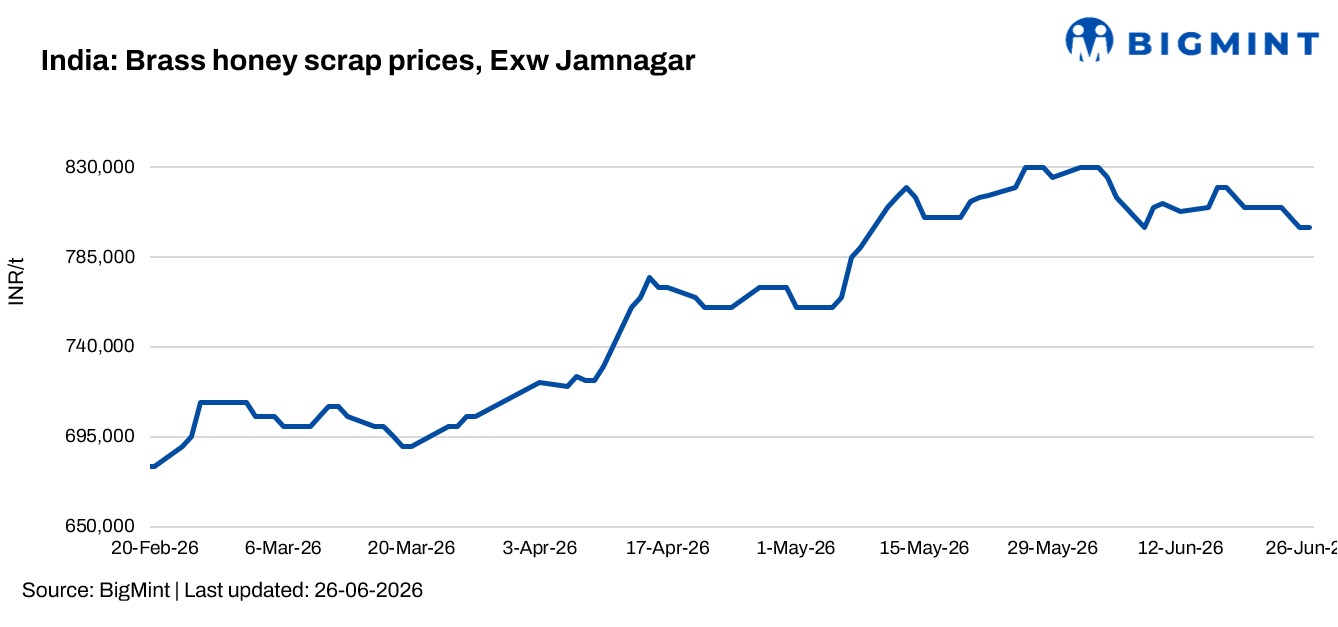
India’s brass honey scrap prices fell slightly w-o-w on 26 June 2026, pressured by subdued demand and softer global prices. BigMint’s assessment placed brass honey scrap prices at around INR 800,000/t exw-Jamnagar, down 1.2% w-o-w as comfortable imported scrap availability, slower buying activity, and softer global cues kept the market under pressure.
London Metal Exchange (LME) copper prices fell by around 4% w-o-w to nearly $13,150/t on 26 June 2026, which put slight pressure on imported scrap offers and domestic market sentiment. However, the impact was limited, as most participants were already cautious about fresh purchases.
According to traders, Jamnagar, India’s largest brass manufacturing and recycling hub, witnessed particularly weak activity during the week. One market participant noted that the previous week was “almost a no-work week” for many traders as the sharper-than-expected decline in LME copper prices significantly impacted market confidence. Since much of the available inventory had been purchased at higher prices, traders preferred to hold stocks rather than sell at a loss, resulting in slower deal closures and reduced market liquidity.
A wide bid-offer disparity also continued to restrict trading activity. Buyers remained reluctant to accept higher offers amid volatile LME copper prices, while suppliers were unwilling to reduce prices significantly after procuring material at elevated levels. As a result, most transactions were concluded only against immediate production requirements, with overall deal volumes remaining limited.
Market participants reported that downstream brass manufacturers continued to follow a hand-to-mouth procurement strategy, avoiding inventory build-up amid uncertainty over near-term price direction. The recent sharp correction in LME copper further dampened market sentiment, prompting several buyers to postpone purchases in anticipation of more attractive buying opportunities.
On the supply side, imported brass scrap arrivals from Europe, the UAE, and other major sourcing regions remained healthy, ensuring comfortable material availability across key trading hubs. Traders indicated that the steady inflow of imported scrap prevented any supply tightness despite slower trading activity, keeping the physical market adequately supplied. Previously, in May 2026, imported scrap arrivals rose to 8,668 t, up around 6% m-o-m from 8,200 t in April.
Current deal levels for brass honey scrap are reported at around 60% of LME in Europe, depending on quality and shipment terms, while US-origin material is heard trading at approximately 65% of LME. Market participants noted that these levels continue to reflect regional supply-demand dynamics, freight costs, and buyer competition across major consuming markets.
Looking ahead, market participants expect the domestic brass scrap market to remain cautious in the near term. While adequate imported scrap availability is likely to keep supply comfortable, a sustained recovery in trading volumes will depend on improved downstream order inflows, narrowing bid-offer gaps, and greater stability in LME copper prices. Until then, procurement is expected to remain largely requirement-driven, with buyers continuing to avoid aggressive inventory accumulation.
Leave a Reply