- Production rises 19% y-o-y on higher output from merchant, auctioned mines
- Limited availability of high-grade ore, competitive pricing lift imports by 40%
- Consumption grows 6% y-o-y amid 3% increase in crude steel production
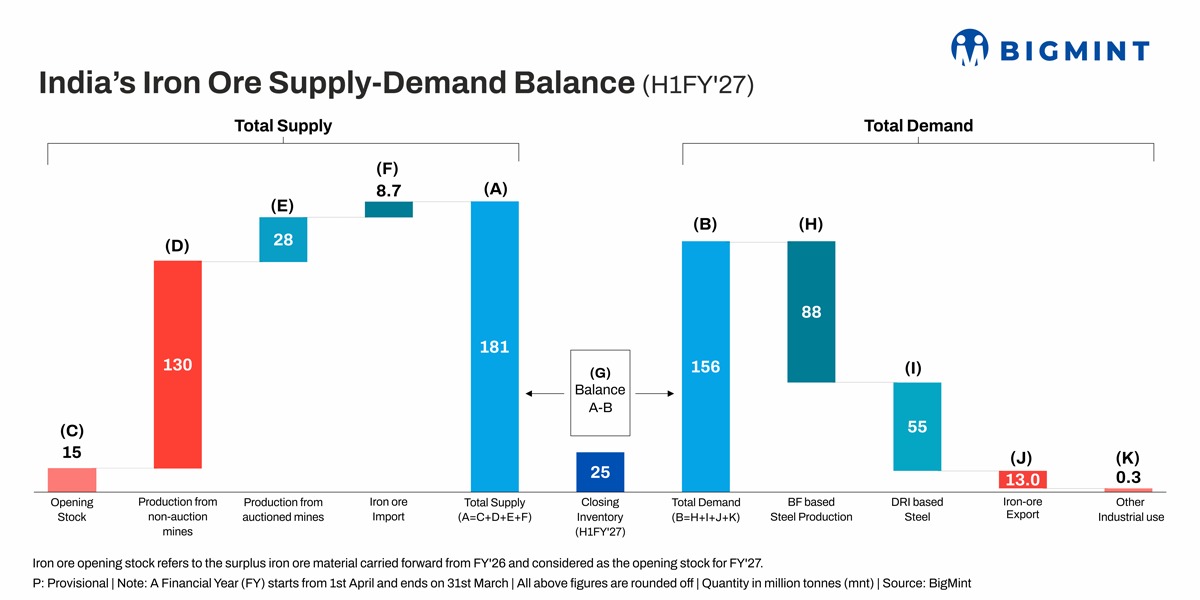
Morning Brief: India’s iron ore market recorded a sharp improvement in supply in H1FY’27 (April-September 2026), with the closing inventory shifting from a deficit of around 4 mnt a year earlier to a stock build of 25 mnt. Total supply rose 26% y-o-y to 181 million tonnes (mnt), from 144 mnt in H1FY’26, while demand increased by just 6% to 156 mnt from 148 mnt, according to BigMint data.
Notably, imports surged by 40% in H1FY’27 even as production increased by 19%. This indicates that higher domestic iron ore output has not fully met steelmakers’ requirements for high-grade, low-impurity ore.
Supply growth outpaces demand, reversing last year’s deficit
India’s iron ore supply balance improved substantially in H1FY’27 as domestic production growth exceeded the increase in consumption. Total supply, including opening stocks, domestic production, and imports, reached 181 mnt against demand of 156 mnt. This compares with supply of 144 mnt and demand of 148 mnt in H1FY’26, when the market recorded a deficit of around 4 mnt.
The 37 mnt increase in total supply was substantially larger than the 8 mnt rise in demand. Domestic production from non-auctioned and auctioned mines together increased 19% to 158 mnt from 133 mnt, while imports, which surged 40% to 8.7 mnt from 6.2 mnt, added another 2.5 mnt to supply growth. The resulting 29 mnt swing in the supply-demand balance indicates that the market entered H2FY’27 with a much stronger aggregate availability position than a year earlier.
However, it is important to note that a higher closing inventory may not indicate that all steelmakers have adequate stocks, as BigMint’s estimates of the national balance do not capture differences in grade, location, or individual mill inventories.
Steelmaking demand grows more slowly than supply
Iron ore demand increased 6% to 156 mnt in H1FY’27 from 148 mnt a year earlier, supported by higher consumption from both blast furnace (BF)-based steelmakers and direct reduced iron (DRI) producers. BF-based demand rose 4% to 88 mnt from 85 mnt, while DRI-based demand increased 4% to 55 mnt from 53 mnt.
The rise in demand coincided with higher ironmaking output. Hot metal production increased 2% to 48.3 mnt from 47.16 mnt, while DRI production rose 3% to 30.5 mnt from 29.6 mnt. However, growth in these production routes remained well below the increase in domestic iron ore supply, allowing the overall balance to improve.
Notably, India’s crude steel production grew 3% y-o-y to 85.1 mnt in H1FY’27, a slowdown from the 12% growth in H1FY’26. The moderation reflects tighter raw material availability, operational constraints, and intermittent disruptions at large steel plants. Higher coal and energy costs also reduced the incentive to raise output aggressively, particularly during the monsoon when steel prices typically weaken.
Merchant miners drive domestic production growth
Domestic iron ore production increased to around 158 mnt in H1FY’27 from 133 mnt a year earlier, with merchant miners raising output by 25% to 95 mnt, while captive production rose 8% to 62.6 mnt. Production from non-auctioned mines rose 16% to 130 mnt from 112 mnt, while output from auctioned mines increased 33% to 28 mnt from 21 mnt.
Chhattisgarh (+24%) and Maharashtra (+114%) recorded strong production growth, while Odisha (9%) posted moderate growth. NMDC and Lloyds Metals increased output by 22.5% and 35.1%, respectively, while OMC’s production remained flat.
The faster growth in auctioned mine production, though on a lower base, is particularly relevant because the operationalisation of auctioned leases has been a constraint on India’s ability to convert approved mining capacity into actual supply.
Imports rise despite stronger domestic production
Iron ore imports increased 40% y-o-y even as domestic production expanded, driven by competitive international offers, limited availability of high-grade, low-impurity material, and domestic logistics constraints and unfavourable inland transportation charges.
The rise in imports does not necessarily contradict the improvement in the domestic supply balance. BigMint understands that steelmakers have continued to import iron ore to meet specific blending requirements, improve ironmaking efficiency, or supply coastal plants where imported material can be competitive against domestic ore after accounting for inland transport costs.
As a result, a national stock build can coexist with import demand from mills that cannot obtain the required grade or quantity economically from domestic sources.
Notably, India’s iron ore production has expanded steadily over the past decade from 194 million tonnes (mnt) in FY’17 to over 313 mnt in FY’26, according to BigMint data. However, the quality mix has deteriorated, posing significant challenges in attaining energy efficiency. Data for the past 10 fiscal years reveal a stark picture: high-grade Fe 65% ore production, as a share of total production, has declined from 20% in FY’17 to 11% in FY’26, while the share of Fe 62-65% iron ore in total production has declined to 37% in FY’26 from 47% in FY’17.
Outlook
BigMint’s FY’27 projection is that India could maintain a modest aggregate supply surplus through the current fiscal year, provided mining output increases as expected. In August, we projected iron ore production of around 345-350 mnt (up 9%) and consumption of approximately 303 mnt (up 8%) in FY’27. However, given the faster 19% growth recorded y-o-y, we expect production to cross 350 mnt in FY’26.
Imports could close the year at around 15 mnt, above the 12.35 mnt recorded in FY’26. Demand from expanding BF operations, particularly at coastal plants, and the need for high-grade blending material could sustain purchases from overseas suppliers even though domestic production improves.
The main test for H2FY’27 will be whether incremental domestic output can meet the requirements of steelmakers in quality besides volume. If grade mismatches and logistics bottlenecks persist, imports may remain firm despite higher aggregate domestic availability.
Leave a Reply