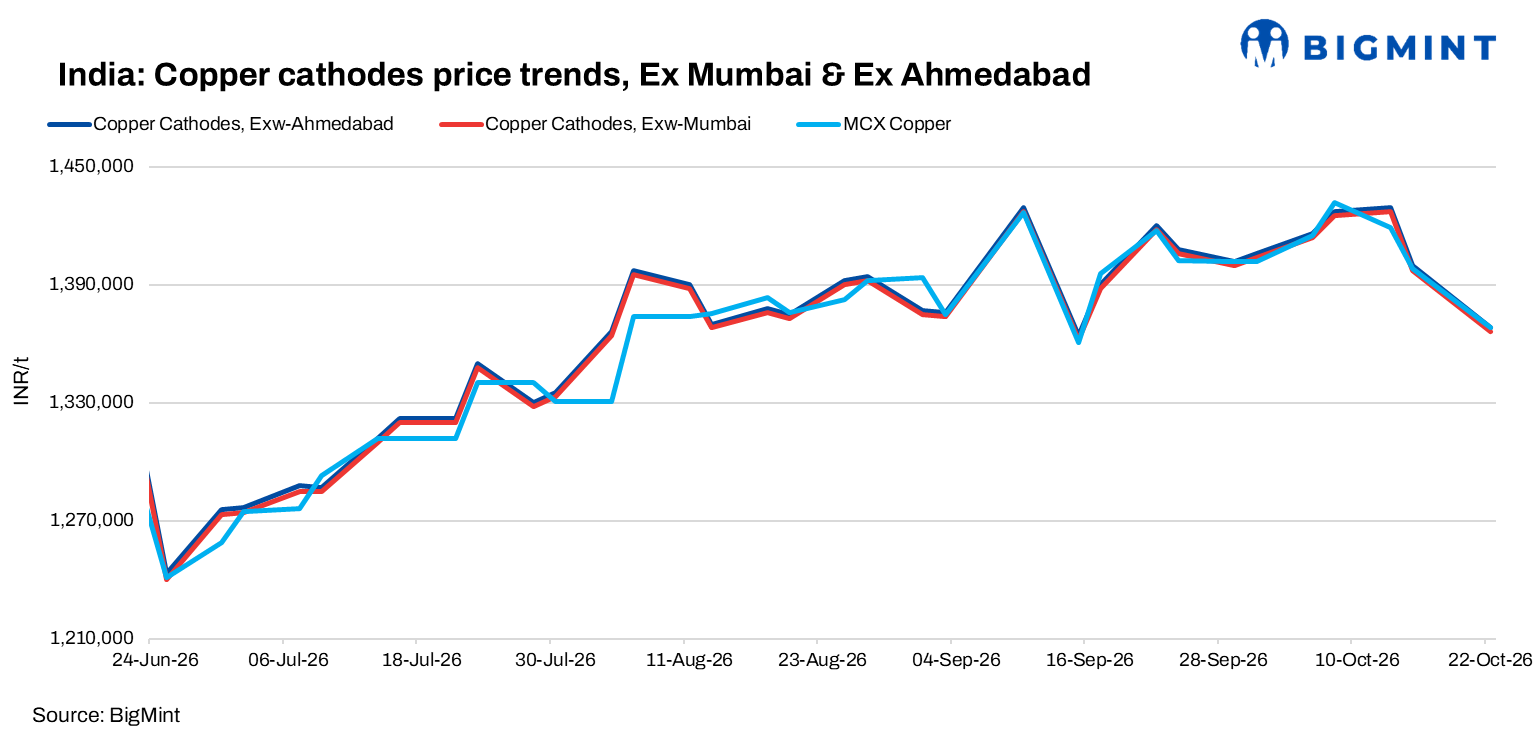
- Domestic cathode prices fall as buyers await further corrections
- LME copper declines 0.93% w-o-w, while inventories rise 1.81%
India’s copper cathode market weakened in the week ended 22 October 2026 as lower global benchmarks and cautious spot demand pressured domestic prices. London Metal Exchange (LME) copper fell 0.93% w-o-w to $14,356/tonne (t), while inventories increased 1.81% to 233,800 t from 229,650 t. The combination of softer prices and rising stocks encouraged buyers to delay purchases amid expectations of further corrections.
According to BigMint’s assessment, ex-Ahmedabad copper cathode prices declined by INR 32,000/t (2.29%) w-o-w, to INR 1,368,000/t from INR 1,400,000/t. Ex-Mumbai cathode prices fell by INR 31,000/t (2.22%) to INR 1,366,000/t from INR 1,397,000/t.
Meanwhile, copper primary CC wire rod (CCR) prices, ex-Delhi, decreased by INR 40,000/t (2.75%) w-o-w, to INR 1,415,000/t from INR 1,455,000/t.
Domestic buyers remain cautious amid price volatility
Indian copper buyers have adopted a cautious approach as domestic prices soften. Recent weakness in Indian copper futures has reinforced expectations of further price corrections, prompting consumers to avoid committing to large volumes upfront.
This has created a cautious trading environment, with buyers waiting for more competitive offers while sellers assess whether the recent decline will continue. Consequently, spot transactions remain sensitive to daily price movements, and purchasing activity may improve only when buyers gain greater confidence in price stability.
Elevated Japanese premiums limit import flexibility
Japanese copper cathode premiums remain high despite the recent decline in domestic prices. Market participants indicated Grade A cathode premiums of around $310/t – $320/t CIF Nhava Sheva on 21 October, keeping imported material relatively expensive.
The delivered import indication was approximately $130/t – $140/t above the MCX-linked domestic price before additional landing costs. This limits the scope for buyers to switch to imported cathodes simply because domestic benchmark-linked prices have declined.
As a result, lower LME prices have not translated into a proportionate reduction in import costs. Buyers must continue to assess the premium alongside benchmark movements before committing to overseas purchases.
The elevated premiums also reflect supply-side constraints in Japan. Japanese suppliers reported improving Indian cathode demand following the end of the monsoon season, while availability from Japan remained tight. Furthermore, scheduled maintenance at Japanese facilities in November could constrain supplies further as Indian demand improves.
LME weakness and rising inventories weigh on sentiment
Copper prices on the LME fell 0.93% w-o-w to $14,356/t. Meanwhile, inventories rose 1.81% to 233,800 t, adding to market uncertainty.
Lower international prices give Indian buyers room to negotiate better offers. However, continued price weakness has discouraged large purchases. Buyers remain cautious and prefer to wait for further corrections.
Meanwhile, Japanese cathode premiums remain elevated, and supply could tighten further in November. As a result, lower benchmarks may not translate into cheaper imports. Buyers must also account for premiums and additional landing costs.
Domestic sellers face pressure to adjust offers to weaker benchmarks. However, high-cost inventories may limit their willingness to reduce prices. Their pricing decisions will depend on whether the market stabilises or declines further.
Outlook
Indian copper cathode prices may remain under pressure if LME prices weaken further. Cautious buying and rising inventories could also limit demand for fresh material.
However, improving post-monsoon demand and tight Japanese supply may support physical premiums. Further domestic price movements will depend on benchmark trends, buyer restocking and sellers’ pricing strategies.
Leave a Reply