- Receipts cover 96% of burn during 13-19 October
- Critical plants increase to 96 as inventories weaken
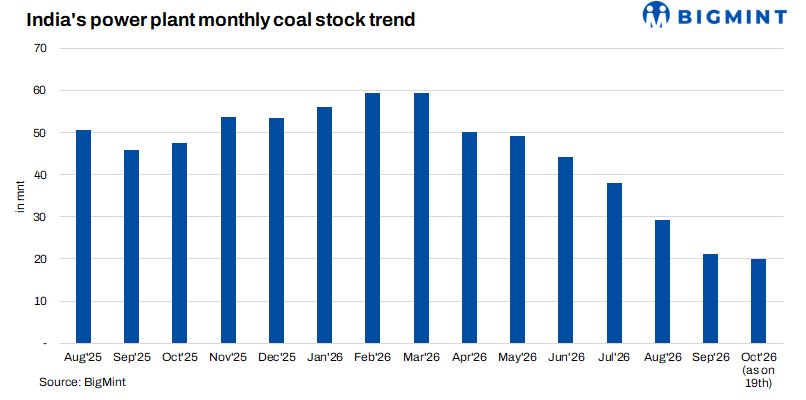
India’s power-plant coal stocks have failed to sustain their early-October recovery, despite lower electricity demand during the festival period and weather-related relief in southern states.
Total monitored inventories fell to 20.07 mnt on 19 October, compared with 20.87 mnt on 11 October. Ninety-six plants were classified critical, including 90 domestic-coal-based stations.
Deliveries are performing considerably better than during September’s rapid depletion. However, the latest figures show that matching daily requirements remains difficult, leaving insufficient surplus for sustained rebuilding.
Near-balance has not become replenishment

During 13-19 October, plants received approximately 18.55 mnt against consumption of 19.25 mnt. Receipts covered 96.4% of burn, leaving a deficit of approximately 0.695 mnt.
This compares favourably with September’s coverage of around 90%, but reverses the modest surplus recorded during 7-11 October.
Only 17 October showed an aggregate receipt surplus in the latest seven-day period. Several days were close to balance, but pronounced deficits on 13 and 19 October outweighed those improvements.
The distinction is straightforward: matching consumption stops depletion; deliveries above consumption rebuild stocks.
Lower electricity demand creates an opportunity
Grid India’s reports show shortages falling sharply after 14 October, alongside lower demand during the festival period.
Holiday reductions in factory shifts, offices and institutional activity could have contributed, although the available data do not quantify the industrial component. Festival lighting and public events also offset part of the reduction.
Weather provided clearer regional relief. Rainfall reduced Tamil Nadu’s electricity requirements, while IMD recorded rain across several southern subdivisions.
Such conditions should create some room for replenishment. Yet national coal consumption averaged approximately 2.75 mnt/day during 13-19 October.
Demand relief at particular locations or hours therefore did not translate into a sufficiently large reduction in overall coal burn to generate a sustained surplus.
Domestic-coal stations remain exposed
Domestic-coal-based plants held 17.84 mnt on 19 October, down from approximately 18.32 mnt on 11 October.
Inventories recovered modestly during 14-18 October, then fell by almost 0.30 mnt on 19 October. Receipts that day were 2.23 mnt against consumption of 2.52 mnt.
The number of critical domestic-coal plants increased from 81 on 11 October to 90.
Higher mine production and despatches are necessary, but plant replenishment occurs only after coal has passed through loading, transport, unloading and stockyard handling.
The receipt figures establish a continuing delivery gap. They do not isolate how much comes from mine availability, railway performance, plant handling or commercial arrangements. Nor do they establish festival-related transport disruption as the cause of the latest decline.
Individual plants retain very little protection
Bellary held 23,600 t on 19 October, only 4% of normative requirements. Amravati had 6,200 t, approximately 2%, while GMR Warora held 10,400 t, around 6%.
Against that day’s consumption, stocks represented approximately 1.1 days at Bellary, 0.3 days at Amravati and 1.2 days at GMR Warora.
These are illustrations of limited buffers rather than shutdown forecasts, since continuing receipts can sustain operations.
Northern and north-western plants also remained vulnerable. Panipat held 14% of normative stock, Yamuna Nagar 21% and Rajiv Gandhi 24%. Rajasthan’s Kota stood at 10%, Chhabra-II at 13% and Kalisindh at 20%.
A stable national total can consequently conceal significant operating risk at individual stations.
Imported-coal inventories also decline
Imported-coal-based plant stocks fell to 2.23 mnt on 19 October, from approximately 2.54 mnt on 11 October.
Receipts on 19 October were only 77,400 t against consumption of 152,800 t. Six plants remained critical.
Conditions differed sharply within the category. Mundra UMPP held approximately 0.944 mnt, equivalent to 136% of normative requirements, while Adani Mundra III held 48,300 t, around 10%.
Imported-coal stations therefore cannot be treated as uniformly well supplied.
Domestic replenishment becomes more important
Reuters reported on 19 October that Bloomberg’s sources said India had shelved a proposed mandatory coal-import requirement. Reuters could not independently verify the account.
The alternative is higher Coal India production and stronger railway delivery, avoiding expensive imported replenishment.
That approach addresses affordability, but does not reduce the tonnes required to restore inventories. It places greater responsibility on the domestic supply chain.
Voluntary imports and supplies to imported-coal-based plants could continue. Shelving a proposed mandate would not amount to a prohibition on overseas purchases.
BigMint assessment
Stocks on 19 October remained approximately 9.05 mnt below 1 September. Restoring that volume would require around 91 days at a sustained surplus of 0.10 mnt/day, or 45 days at 0.20 mnt/day-illustrations rather than forecasts.
The festival and weather-related demand respite has not yet produced sustained rebuilding. If working-day demand recovers while inventories remain thin, deliveries must first meet the returning requirement before restoring the buffer.
The decisive signals will be consistent receipt surpluses and fewer critical stations, particularly among domestic-coal plants.
Leave a Reply