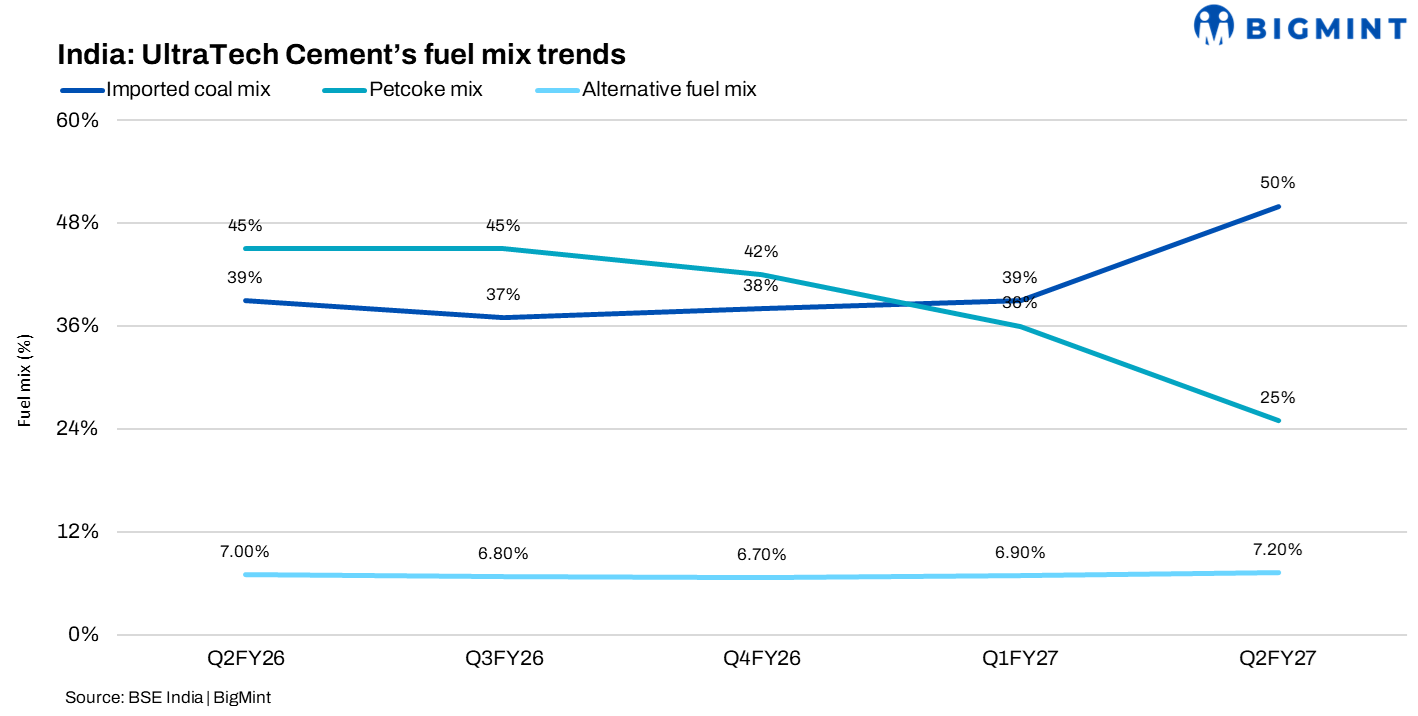
- Petcoke share falls to 25% as fuel costs rise
- Capacity expansion supports demand; domestic coal availability remains a concern
India’s cement industry is entering the post-monsoon period with stronger volumes and improving prices, but rising energy costs are changing fuel procurement.
UltraTech Cement’s September-quarter commentary highlights this tension. Its volumes increased approximately 14% year-on-year, ahead of estimated industry demand growth of 10%, while blended fuel costs rose around 10% quarter-on-quarter.
For coal and petcoke suppliers, the opportunity is therefore more complex than simply supplying a growing market. Cement producers need additional energy, but are actively changing their fuel mix, improving efficiency and comparing alternatives to expensive petcoke.
UltraTech’s reduction in petcoke dependence to approximately 25% provides a clear indication of this adjustment.
Key indicators for fuel and energy markets

Source: UltraTech Q2FY27 management commentary. Capacity figures represent annual installed capacity, not production.
Higher output supports fuel demand
UltraTech’s volume growth exceeded the industry estimate, while utilisation improved despite a larger capacity base. This indicates both market-share gains and increased activity across its operations.
Regional performance was uneven. Company volumes grew more than 20% in the North, 15-20% in the South and around 10% in the West and Central regions. Eastern growth was approximately 5%, constrained by prolonged rainfall.
For suppliers, these differences matter. Stronger regional production creates demand for fuel at particular plants and receiving ports, rather than a uniform increase across India.
Higher cement sales also do not translate directly into equivalent kiln-fuel growth. Clinker production, clinker inventories, purchased clinker and the proportion of blended cement determine the actual thermal-energy requirement.
Petcoke loses share as buyers compare alternatives
UltraTech said it reduced petcoke dependence to approximately 25% because of higher prices.
That is the most important procurement signal for solid-fuel suppliers. Petcoke demand is sensitive to its delivered energy cost relative to coal, rather than cement growth alone.
Competing fuels must be compared after accounting for calorific value, moisture, ash, sulphur, handling and kiln performance. A lower price per tonne does not necessarily mean cheaper usable energy.
Low-ash imported coal can offer blending flexibility where domestic coal carries higher ash. However, suitability varies between plants because fuel ash enters the cement raw-material balance, while sulphur and other constituents affect operating conditions.
The commentary does not disclose the complete replacement mix. It therefore supports an opportunity for competing fuels, but not a quantified conclusion that the displaced petcoke has moved entirely to domestic coal, US coal or another origin.
Domestic availability complicates substitution
Management also highlighted domestic coal availability as an issue.
This creates a procurement dilemma: reducing expensive petcoke exposure is useful only if suitable alternatives can be obtained reliably and delivered economically.
For suppliers, dependable scheduling, consistent specifications and access to suitable stock can become as important as the headline offer price. Freight, inland delivery and working capital influence the final choice.
The result could be a more flexible procurement strategy combining domestic supply with imported blending material. The precise balance will depend on plant requirements and relative delivered costs.
Cement prices improve the ability to absorb fuel costs
Fuel cost increased from approximately INR 45/bag to INR 51/bag. Meanwhile, trade cement prices rose INR 7-10/bag in the second half of September, with further increases in October.
Spot realisations were approximately 5% above the second-quarter average, according to management.
These movements suggest improving scope to recover higher costs. However, the figures should not be treated as a direct margin calculation: price changes apply across different markets, channels and periods, while other costs also move.
Management expects the fuller benefit of price increases in Q3FY27, although festival-season demand could slow absorption.
This matters to fuel suppliers because stronger cement realisations can support purchasing capacity. Sustained cost pressure without corresponding price recovery would instead strengthen resistance to expensive fuels.
Festivities may delay the demand acceleration
Management expects activity typically to strengthen after the festive season, around mid-November.
Fuel demand may therefore rise unevenly rather than immediately after the monsoon. Construction-site activity, dealer purchases and plant operating schedules can move differently during holidays.
Housing, infrastructure, private investment and industrial projects are expected to support second-half demand. Eastern markets could improve as rainfall disruption recedes and projects move into execution.
Suppliers should consequently distinguish seasonal interruptions from a deterioration in the underlying demand outlook.
Expansion supports a larger market, with important qualifications
UltraTech targets domestic grey cement capacity of approximately 237 Mnt/year by FY28-end, against around 205 Mnt/year currently.
The planned increase of roughly 32 Mnt/year expands the potential energy-consumption base. Further northern expansion is also under consideration.
However, cement capacity alone is insufficient to estimate additional coal or petcoke tonnage. That requires clinker-capacity additions, utilisation, thermal efficiency and fuel-mix assumptions.
UltraTech’s blended cement share of 67.3% is also relevant: greater use of supplementary materials can reduce clinker requirements per tonne of cement, depending on product composition.
Electricity demand grows, but sourcing changes
UltraTech met approximately 47% of its power requirements through non-fossil sources and added renewable and waste heat recovery capacity during the quarter.
Higher production therefore need not generate a proportionate increase in grid purchases or captive coal-power consumption.
The distinction between electricity and kiln heat is essential. Renewable electricity and waste heat recovery can reduce conventional power requirements, but do not directly replace the coal and petcoke burned to produce clinker.
BigMint assessment
India’s cement expansion supports a growing energy market, but UltraTech’s experience shows that fuel shares are increasingly contested.
Petcoke faces substitution pressure, domestic coal faces availability constraints, and imported fuels must justify their delivered cost and quality.
For suppliers, the strongest opportunity lies in reliable, plant-specific fuel solutions. For energy watchers, clinker output and electricity sourcing will reveal more than cement-capacity growth alone.
Leave a Reply