- HBA thermal coal benchmarks rise 3-4% across major grades
- Prices may remain firm on regional demand, physical market trends
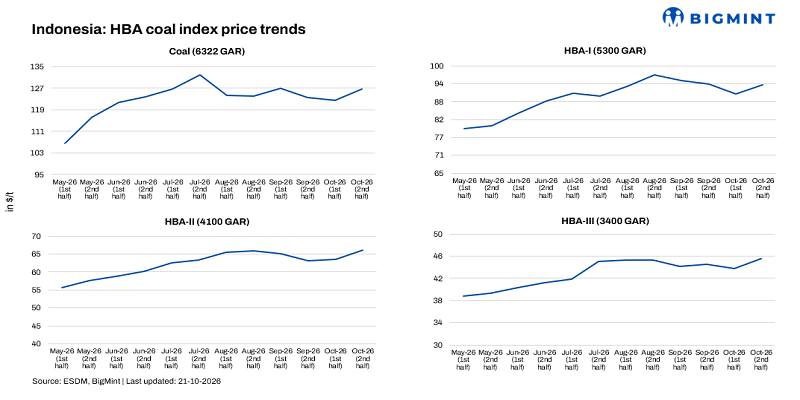
Indonesia’s Harga Batubara Acuan (HBA) thermal coal benchmarks increased across all four major calorific-value grades in the second half of October 2026, reflecting firmer benchmark pricing across high-, mid- and low-calorific-value coal. The gains ranged from 3%-4%, indicating broad-based upward adjustments across the Indonesian coal pricing spectrum.
High- and mid-CV coal lead benchmark gains
Indonesia’s 6,322 kcal/kg GAR high-CV benchmark rose 3.5% to $126.81/t in the second half of October from $122.52/t in early-October. Meanwhile, the 5,300 kcal/kg GAR HBA-I benchmark increased 3.3% to $93.62/t from $90.60/t.
The increases reflect upward revisions in official benchmark values, although they should not be interpreted as direct evidence of an equivalent rise in spot market prices. High-CV coal generally commands a premium for its higher energy content, while mid-CV material caters to buyers balancing calorific value and procurement costs.
Lower-CV coal records stronger percentage growth
The lower-calorific-value segment posted the strongest percentage increase. The 4,100 kcal/kg GAR HBA-II benchmark climbed 4.2% to $66.1/t from $63.45/t, while the 3,400 kcal/kg GAR HBA-III benchmark also increased, reflecting higher reference values across lower-grade coal categories.
What is driving the benchmark increase?
The broad-based rise reflects the upward adjustment of Indonesia’s official reference prices, which are linked to coal price indices and market assessments from preceding periods. Key factors influencing these benchmarks include:
- Regional demand and price movements: Buying activity from major Asian coal importers, particularly India and China, can influence seaborne thermal coal prices.
- Supply-side uncertainty: Weather disruptions, mining conditions, export regulations and transportation constraints can affect Indonesian coal availability and market pricing.
These factors provide market context, but the benchmark increase alone does not establish that tighter supply or stronger demand caused the latest revision.
Outlook
Indonesian thermal coal benchmarks may remain supported if regional coal prices strengthen and import demand from India and China improves. However, the sustainability of the increase will depend on actual buying interest, competing coal supplies, freight costs and the relative competitiveness of Indonesian coal against alternative origins. For Indian buyers, higher HBA values could increase benchmark-linked procurement costs, although actual cargo prices will continue to depend on coal quality, contractual terms and delivery economics.
Leave a Reply