- Domestic polymer prices increase selectively as Middle East disruptions tighten global supply
- Oil retreats from recent highs, while feedstock and shipping uncertainties persist
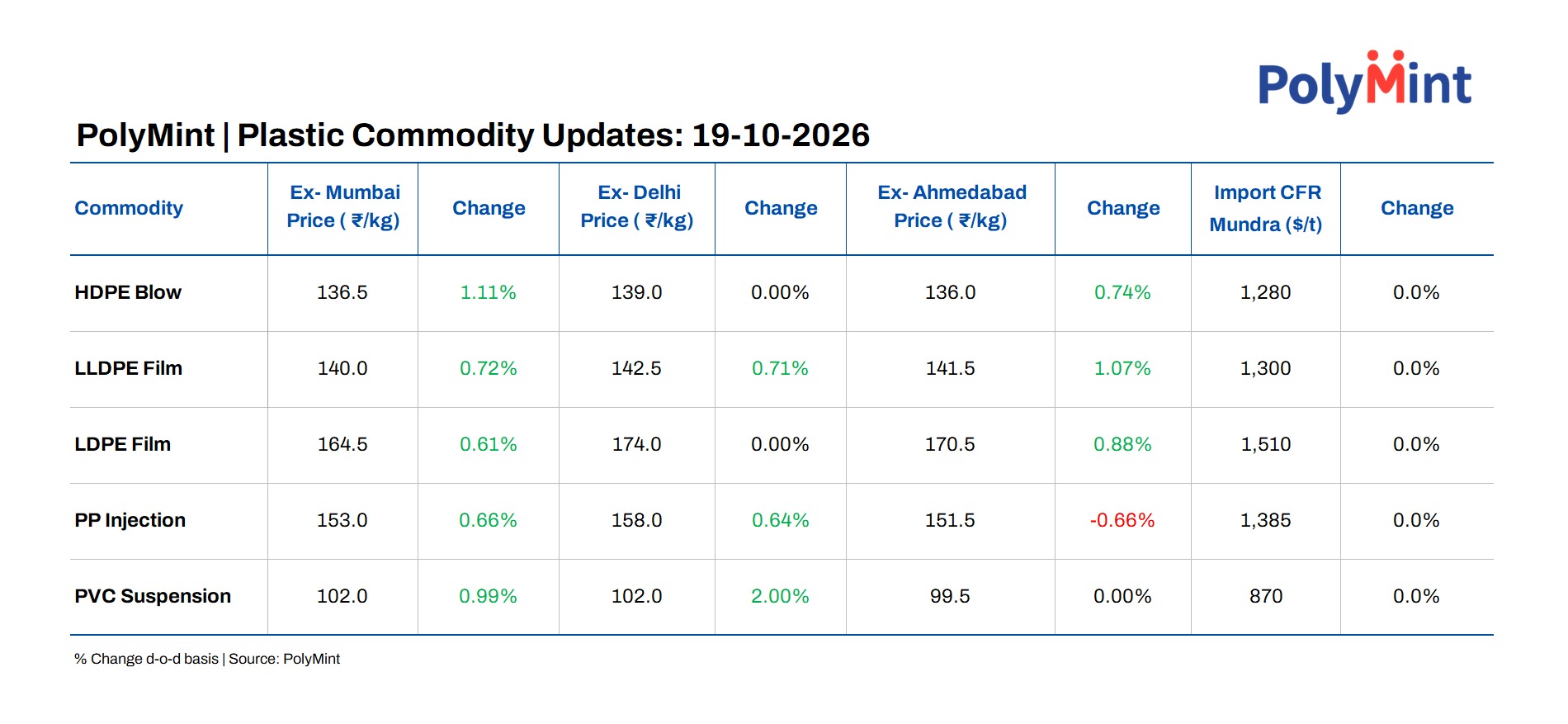
India’s polymer market recorded broad-based domestic price increases on 19 October, while import prices at CFR Mundra remained unchanged. High-density polyethylene (HDPE) blow moulding held at $1,280/t, linear low-density polyethylene (LLDPE) film at $1,300/t, and low-density polyethylene (LDPE) film at $1,510/t. Polypropylene (PP) injection remained at #1,385/t and polyvinyl chloride (PVC) at $870/t.
Brent crude fell 1.30% to $108.35/barrel and West Texas Intermediate (WTI) declined 0.91% to $98.15/barrel. Naphtha eased 1.20% to $988/t, while natural gas rose 0.67% to $3.13/MMBtu. The USD-INR rate stood at 95.20, with the reported daily change indicating a weaker rupee. Oil eased from recent highs, although attacks on shipping and reduced crude flows through the Strait of Hormuz continued to underpin supply concerns.
Domestic Market Overview
Domestic polymer prices increased across several grades and markets. In Mumbai, HDPE blow moulding rose 1.11% to INR 136.50/kg, LLDPE film gained 0.72% to INR 140/kg, LDPE film increased 0.61% to INR 164.50/kg and PP injection advanced 0.66% to INR 153/kg. PVC climbed 0.99% to INR 102/kg.
In Delhi, LLDPE film rose 0.71% to INR 142.50/kg, PP injection increased 0.64% to INR 158/kg and PVC gained 2% to INR 102/kg. Ahmedabad HDPE blow moulding rose 0.74% to INR 136/kg and LLDPE film increased 1.07% to INR 141.50/kg. LDPE film held at INR 170.50/kg, while PP injection declined 0.66% to INR 151.50/kg and PVC remained at INR 99.50/kg.
Supreme Petrochemicals rolled over general-purpose polystyrene (GPPS) and high-impact polystyrene (HIPS) prices, effective 19 October, signalling unchanged domestic offers for these grades.

Other Updates
Hormuz disruption tightens global polyethylene supply
Shipping restrictions through the Strait of Hormuz have disrupted nearly 20% of global ethylene capacity and affected up to 40% of Asia’s naphtha supply. The Middle East accounted for more than 40% of global polyethylene exports in 2025. Buyers are diversifying sourcing, while some North American and European producers have increased operating rates to meet additional demand. Supply constraints have strengthened producers’ pricing power, although Gulf suppliers retain a competitive advantage due to their large-scale operations and lower feedstock costs.
LyondellBasell permanently shuts 230,000-tonne PP unit in Italy
LyondellBasell permanently closed its 230,000-tonne-per-year PP2 unit at Brindisi, Italy, on 17 October. The plant lost its local propylene supply following the shutdown of Eni Versalis’ cracker in 2025, while imported feedstock and freight costs undermined its economics. Weak European demand and persistent oversupply added to the pressure. The closure reflects wider European petrochemical consolidation and removes additional polypropylene capacity from the regional market.
Shipping attacks and freight costs sustain supply concerns
Oil flows through the Gulf fell to a seven-day average of approximately 8.5 million barrels per day last week, down from more than 20 million barrels per day the previous week. A tanker reportedly struck a naval mine and exploded in the southern Strait of Hormuz. Continued attacks could delay energy and petrochemical cargoes, raise freight and insurance costs, and increase supply uncertainty for Indian polymer importers.
Leave a Reply