- Chinese coke cuts squeeze producers as coal costs stabilise
- Indian buyers book 180,000 t of Australian PCI
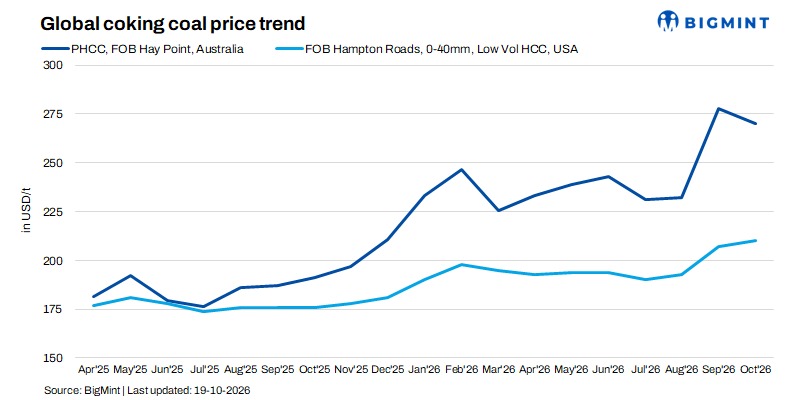
Global steelmaking fuel markets are caught between weak steel margins and supply uncertainty. Chinese coke prices are falling, Australian premium coking coal has softened modestly, and Indian buyers remain selective. Yet Russian mine disruption and pressure on coke producers’ profitability are limiting the scope for further declines.
Three Australian PCI transactions to India, totalling 180,000 t during 13-15 October, illustrate the market’s underlying resilience: mills continue buying where fuel economics and operating requirements justify purchases.

Steel margins restrain forward buying
Weak finished-steel realisations are restricting buyers’ willingness to build raw-material inventories.
Chinese mills have favoured domestic and Mongolian coal over some seaborne alternatives. November-December purchases carry the risk that Chinese mine supply improves before cargoes arrive, leaving buyers holding expensive inventory.
Domestic coking coal prices have begun stabilising, with some grades recovering. Nevertheless, uncertainty over supply recovery encourages immediate-needs buying.
Indian spot demand is also selective. Inventories and long-term contracts cover part of near-term requirements, while pressure on steel prices discourages additional commitments.
Supply concerns therefore coexist with buyer resistance: mills need coal, but purchases must fit increasingly constrained operating margins.
Australian premium coal holds near $269/t
Australian premium hard coking coal eased to around $269/t FOB by 15 October. The confirmed 40,000-t Peak Downs deal at $270/t FOB on 9 October, for November loading, provides a useful transaction reference.
Some subsequent selling indications were substantially higher, including around $290/t FOB on 12 October. These reflect seller expectations rather than accepted prices.
Premium Australian coal remains important for producing strong blast-furnace coke. Cheaper coals can enter blends, but substitution depends on coking properties, coke strength and furnace performance. This supports underlying demand without guaranteeing acceptance of higher offers.
Chinese coke producers face a double squeeze
China’s second nationwide coke price cut took effect on 12 October, bringing cumulative reductions since 1 October to RMB 200-220/t, approximately $30-33/t.
Steelmakers are seeking input-cost relief after a short-lived post-holiday demand recovery. Coke producers, however, face falling selling prices alongside stabilising or recovering coal costs.
Some top-charged operations in Shanxi were reportedly losing RMB 80-100/t after the latest cuts, while stamp-charged producers retained marginal profits.
A third reduction is anticipated, potentially at a smaller RMB 50-55/t, although this remains unsettled. Further cuts could strengthen resistance and encourage production restraint-reducing coal purchases while also limiting coke availability.
Export sentiment has weakened too. Chinese 65/63 CSR coke was offered at $315/t FOB for first-half November loading on 12 October, down $15/t from 9 October.
Russian suspension adds supply uncertainty
Raspadskaya suspended mining at its namesake Russian mine following a fire overnight on 30 September. All 305 underground workers were evacuated safely, but no restart timeline was provided.
The incident follows other operating interruptions within the group, whose first-half 2026 raw coal output declined 12% year-on-year to 7.9 mnt.
The market impact depends on the suspension’s duration, inventories and replacement supply. The group’s output cannot be treated as production lost at the affected mine, nor does this incident alone establish a Russian PCI shortage.
For Asian buyers, shipment reliability and replacement options have nevertheless become more important.
Indian coke holds steady despite weaker pig iron
Indian coke assessments remained unchanged in the week ended 15 October, despite softer imported benchmarks.
Specific-quality buying continued. An eastern Indian 12,000-t transaction was reported at INR 43,750/t ex-works, alongside a separate 2,000-t purchase around INR 44,000/t for 65 CSR material. These deals show quality-specific demand rather than broad market strengthening.
Indonesian coke eased to $368/t CFR India, but the modest reduction has not translated into lower domestic assessments.
Meanwhile, Durgapur pig iron fell INR 550/t week-on-week. Lower product realisations alongside stable coke prices squeeze consumers’ margins.
Captive production also offers limited relief to merchant buyers: integrated steelmakers largely consume their coke internally. Strong national output can therefore coexist with restricted availability for independent pig iron producers and foundries.
PCI transactions demonstrate selective demand

Fixed-price business at $191-195/t FOB represents a headline discount of approximately $74-78/t to premium coking coal. Actual savings depend on fuel quality, coke replacement rates and furnace efficiency.
PCI cannot replace all coke, which remains necessary to support the furnace burden and maintain gas flow. The $4/t difference between the two brands also does not establish a market-wide increase.
Russian low-vol and mid-tier PCI indications were around $199/t and $188/t CFR China on 12 October; freight and quality must be considered before comparison.
India’s reported PCI import decline needs caution. After February 2026, reliance on shipping data has increased classification uncertainty, with some PCI potentially recorded as coking or non-coking coal.
BigMint assessment
Steelmakers’ affordability remains the main restraint, while supply disruptions and coke producers’ losses limit price flexibility. Chinese coke production decisions and the Russian restart timeline will be important signals.
For Indian buyers, the relevant measure is delivered hot-metal cost-including quality, freight, furnace performance and working capital. Selective procurement, rather than broad restocking, is likely to define near-term demand.
Leave a Reply