- Tight concentrate supply, recovering battery demand support prices
- Rising secondary output, substantial exchange stocks may cap gains
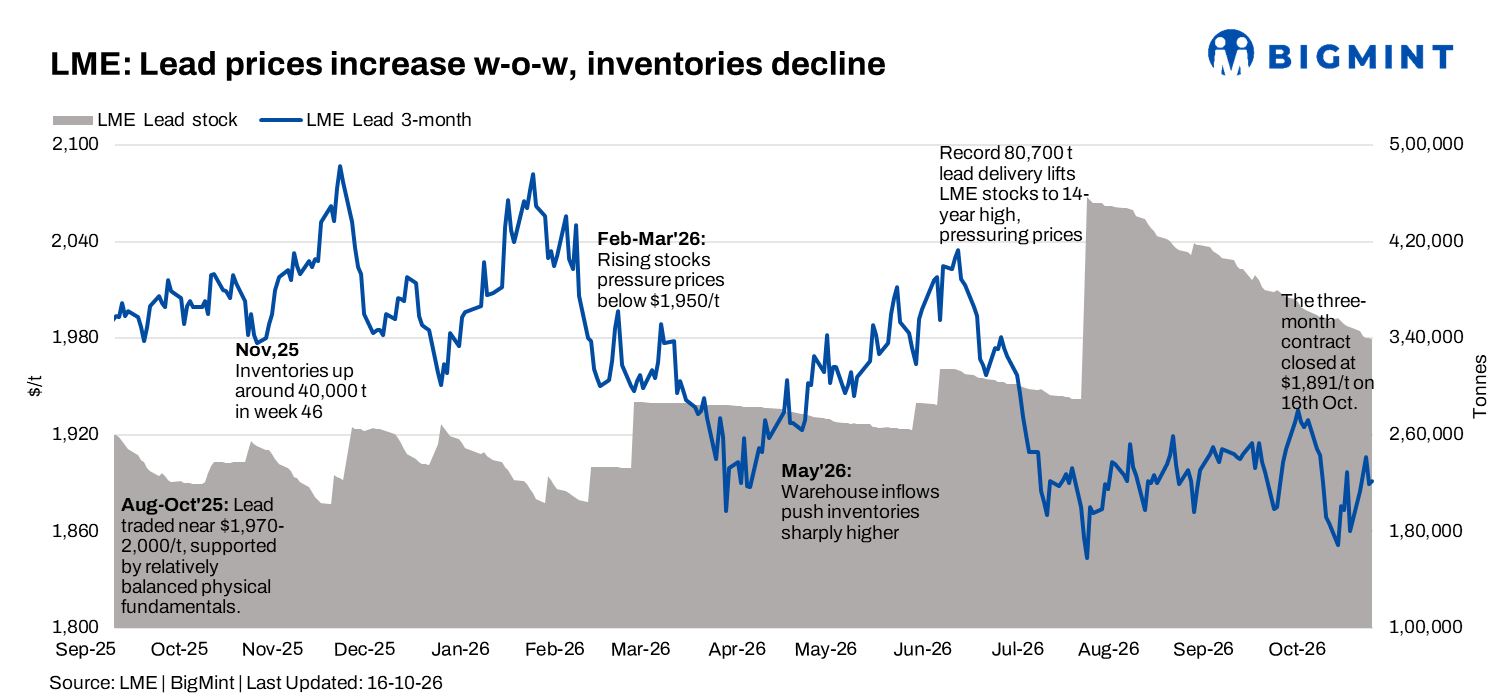
London Metal Exchange (LME) lead prices edged higher during the week ended 16 October, supported by falling inventories, tighter concentrate supply and recovering Chinese battery demand. However, rising secondary lead output and substantial exchange stocks could limit further gains.
LME lead cash-settlement prices rose 0.4% to $1,854/t on 16 October from $1,847/t on 9 October, while the three-month contract increased 0.4% to $1,891/t. Inventories fell 7,850 t, or 2.3%, to 339,275 t.
LME inventories decline
LME lead stocks fell to 339,275 t on 16 October from 347,125 t a week earlier. Despite the drawdown, inventories remained substantial.
The cash-to-three-month spread widened slightly to $37/t from $36.50/t, with the market remaining in contango. This indicates that immediate supply tightness has yet to translate into a refined-metal shortage.
Concentrate treatment charges fall to zero
China’s lead concentrate market tightened during 12-16 October. Domestic Pb50 treatment charges fell by RMB 100/t of contained lead to zero, while imported Pb60 charges declined by $5/dmt to -$190/dmt.
Limited ore arrivals, winter stockpiling and the approaching seasonal slowdown in northern China’s mining activity pressured availability. Zero or negative treatment charges signal tighter feedstock supply and weaker smelter bargaining power, potentially constraining primary lead production.
Chinese battery demand recovers
China’s lead-acid battery operating rate across five provinces rose 13.32 percentage points week on week to 73.37% during 9-15 October as manufacturers resumed operations after the National Day holiday. Downstream buyers also returned to lead-ingot restocking.
However, the recovery partly reflected the resumption of holiday-disrupted production. Sustained procurement will be necessary to absorb additional refined lead supply.
Secondary lead output may cap gains
China’s secondary lead production is expected to increase as curtailed facilities resume operations. Market assessments indicated a potential month-on-month production increase of around 24,900 t in October.
Improved margins have supported restarts, but scrap-battery availability remains a constraint for some smelters. A sustained recovery in secondary output could offset tighter primary supply and limit price gains.
MCX lead eases; HZL cuts benchmark
MCX lead futures for the 30 October contract closed at INR 194.50/kg on 16 October, down 0.4% from INR 195.20/kg on 9 October. Open interest declined to 408 lots from 582 lots.
Hindustan Zinc Ltd (HZL) cut its lead benchmark by INR 1,200/t to INR 212,300/t on 14 October. The company also reduced its SHG zinc benchmark by INR 3,400/t to INR 407,900/t.
Global surplus remains a risk
The International Lead and Zinc Study Group (ILZSG) reported a refined lead surplus of 49,000 t in the first half of 2026. Its April forecast projected a full-year surplus of 109,000 t, highlighting the potential for refined supply to remain adequate despite tighter mine supply. Updated forecasts are expected to clarify the latest market balance.
Outlook
BigMint expects LME lead prices to remain largely stable in the near term. Falling inventories, tighter concentrate availability, and recovering battery demand may provide support, while substantial exchange stocks and rising secondary output could cap gains.
Market direction will depend on whether concentrate shortages constrain refined production and whether post-holiday battery demand can absorb additional secondary supply.
Leave a Reply