- Limited Pacific bookings, surplus of prompt ballasters in Atlantic pressure sentiment
- Cautious buying by mills, weakening Chinese steel demand weigh on broader market
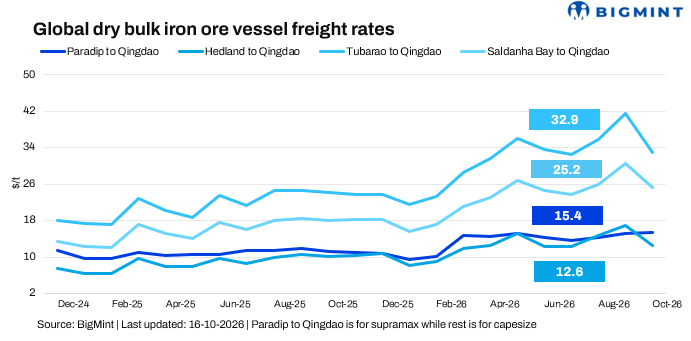
Dry bulk iron ore freight sentiment weakened further in the week ended 16 October, with sharp declines in Capesize rates across the Pacific and Atlantic markets. India-China Supramax freights remained stable, reflecting subdued cargo enquiries and limited spot activity. The broader market faced pressure from weakening Chinese steel demand, falling iron ore futures, and cautious buying by mills.
Capesize freight sentiment remained bearish across the Pacific and Atlantic markets, amid thin cargo enquiries, weak prompt tonnage demand and continued downward pressure on rates. Limited fresh iron ore requirements in the Pacific and a surplus of prompt ballasters in the South Atlantic weighed on market confidence, despite a marginal pickup in cargo activity from Brazil.
Meanwhile, sparse trading activity in South Africa and cautious charterer behaviour further constrained rate recovery, with near-term sentiment likely to remain under pressure unless cargo enquiries strengthen and vessel availability tightens.
A shipbroker stated, “Freight FFA sentiment remained bearish, with larger vessel segments facing sustained pressure from thin cargo enquiries, limited fixture activity and subdued iron ore demand. In contrast, geared vessels continued to show resilience, supported by buying interest in forward contracts.”
Route-wise update

Freight and commodity indicators
- Baltic Dry Index declines sharply: The Baltic Dry Index (BDI) fell by 428 points, or 14.40%, to 2,545 on 15 October from 2,973 on 8 October, primarily driven by the Capesize segment. The Baltic Capesize Index (BCI) plunged by 1,187 points, or 26.33%, to 3,322, and in contrast, the Supramax Index (BSI) rose by 49 points, or 2.71%, to 1,856. The sharp correction in Capesize rates suggests persistent pressure from subdued iron ore cargo enquiries and weaker China-bound demand, while gains in Supramax provided limited support to the overall market.
- DCE iron ore futures decline further: The benchmark DCE iron ore contract fell by RMB 10/tonne (t), or 1.47% w-o-w, to RMB 672.5/t on 16 October from RMB 682.5/t on 9 October. Prices remained under pressure from weak steel margins, subdued downstream demand and cautious mill buying, while uncertainty over China’s steel demand recovery continued to weigh on market sentiment.
- Bunker prices rise further w-o-w: Singapore Very Low Sulfur Fuel Oil (VLSFO) increased by $13.5/t, or 1.5% w-o-w, to $910/t on 16 October from $896.5/t on 9 October. The continued rise reflects persistent crude-price volatility and Middle East supply concerns, adding to fuel-cost pressures for vessel operators and potentially supporting higher freight rates.
- Brent crude futures rise w-o-w: December Brent crude futures climbed 2.1% ($2.20/barrel (bbl)) to $106.48/bbl as of 16 October, from $104.28/bbl on 9 October, supported by persistent geopolitical tensions and concerns over potential supply disruptions in the Middle East. Rising crude prices could push marine fuel costs higher, adding to vessel operating expenses and keeping dry bulk freight rates exposed to further volatility.

Outlook
Dry bulk freight sentiment is likely to remain weak, particularly for Capesize vessels, amid subdued Chinese steel demand, falling iron ore prices and thin cargo enquiries. Surplus tonnage may continue to pressure Atlantic rates, while Supramax shows relative resilience. Recovery will depend on stronger cargo bookings and tighter vessel availability, despite rising bunker costs.
Leave a Reply