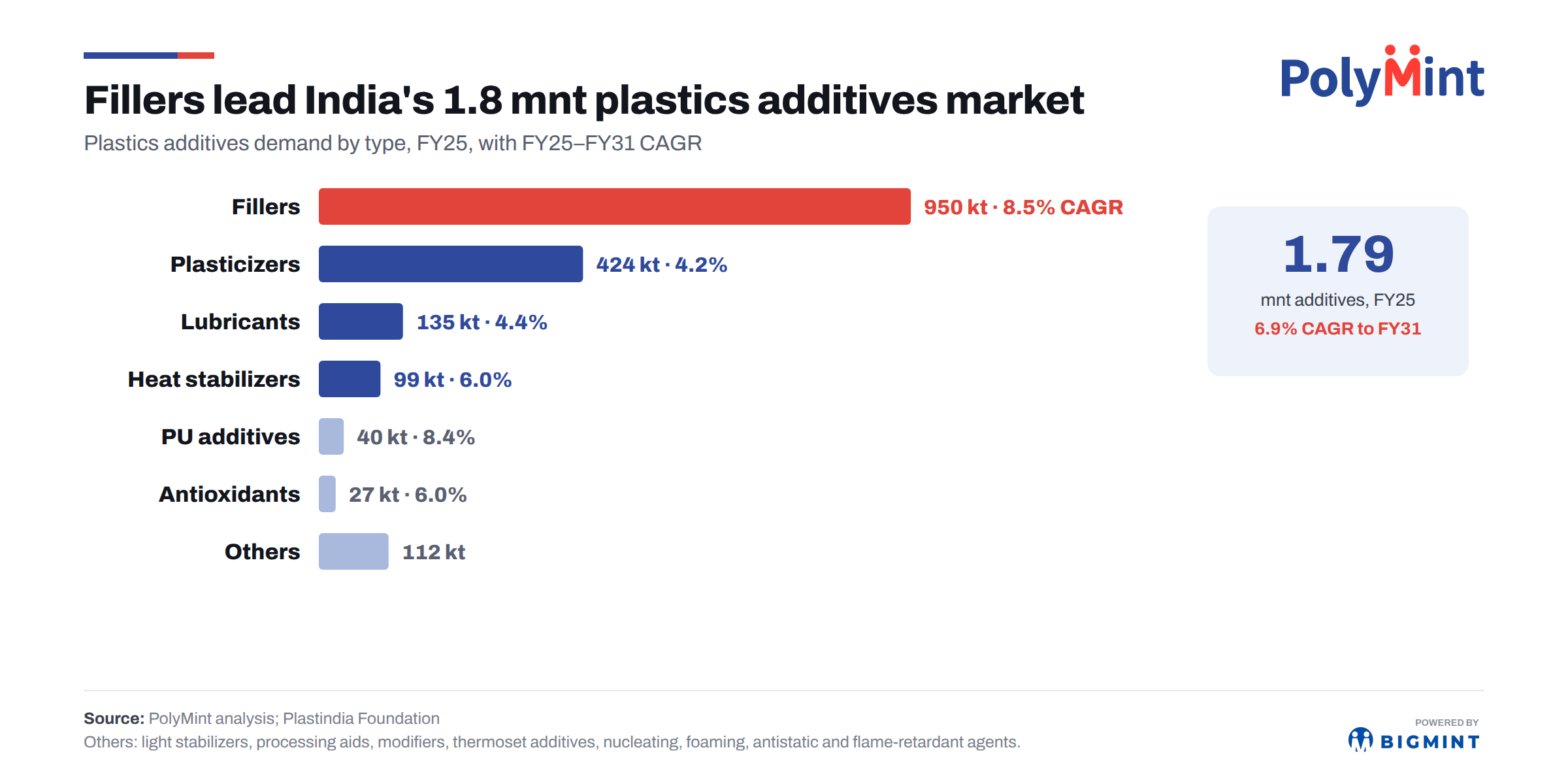
- Additives market at 1.79 mnt, projected to grow at 6.9% CAGR till FY’31
- Compounds add 1.45 mnt, led by rotomoulding, cables and automotive
India’s plastics industry used 1.79 million tonnes (mnt) of additives in FY25, according to Plastindia Foundation, and demand is expected to grow 6.9% a year to FY31. Fillers are the largest category at 950,000 t and the fastest-growing at 8.5% a year, followed by plasticisers at 424,000 t and lubricants at 135,000 t.

Smaller, higher-value categories such as heat stabilisers, antioxidants, and light stabilisers are growing at 5-6% a year as converters demand better performance and longer product life, particularly in pipes, cables, agricultural films, and outdoor products.
Masterbatches – from colour to function

Masterbatch demand stood at about 2 mnt in FY25: 1.26 mnt of filler masterbatches and 730,000 t of black, colour and additive masterbatches. The segment is moving from basic colouring to functional performance, including UV resistance, anti-microbial and anti-fog properties, nano-additives, and bio-based fillers.
Recycled content is creating a new growth area. As recycled-content obligations for rigid packaging rise from 30% to 60% by FY29, converters need masterbatches that mask colour and odour variation in recyclate, restore mechanical properties, and keep finished products consistent.
Compounds: automotive and infrastructure lead
Ready-to-use PE compounds reached 820,000 t in FY25, led by rotomoulding (355,000 t), wire and cable (244,000 t) and pipes and fittings (181,000 t). PP compounds stood at 633,000 t, with automotive taking 379,000 t as carmakers replace metal to cut weight and meet emission norms. Medium-voltage and HVDC cables, city gas distribution, and EV components are expected to drive further growth.
What it means for converters
Fillers dominate because calcium carbonate and talc masterbatches reduce resin use and cost in raffia, films, and moulded products, a key lever for price-sensitive converters when polymer prices rise. The challenge is balancing cost savings against strength, processability, and recyclability, especially as brand owners tighten specifications for recycled-content packaging. Plasticisers, the second-largest additive, track PVC demand in cables, films, and calendered products, where PVC consumption grew 10.9% in FY25.
Plastics industry to gather at Ahmedabad
How will additives, masterbatches, and compounds change as recycled content and performance demands rise?
At PLAST.CONNECT 2026 — West India, PolyMint will bring together industry leaders to discuss additives, stabilisers, functional and recycled-content masterbatches, and compounding.
Technical Session 1 covers additives and performance enhancers, and Technical Session 2 on masterbatches features Dr. Ajay Kumar Nema, Assistant Vice President, Alok Masterbatches, on functional, specialty, and recycled-content masterbatch trends.
Join us on 22 October 2026 at Le Meridien, Ahmedabad, and be part of the conversation shaping India’s plastics value chain.

Leave a Reply