- Shipments from Guinea, Mauritania support West African volumes
- Capesize freight sentiment weakens in Atlantic, Pacific rates hold firm
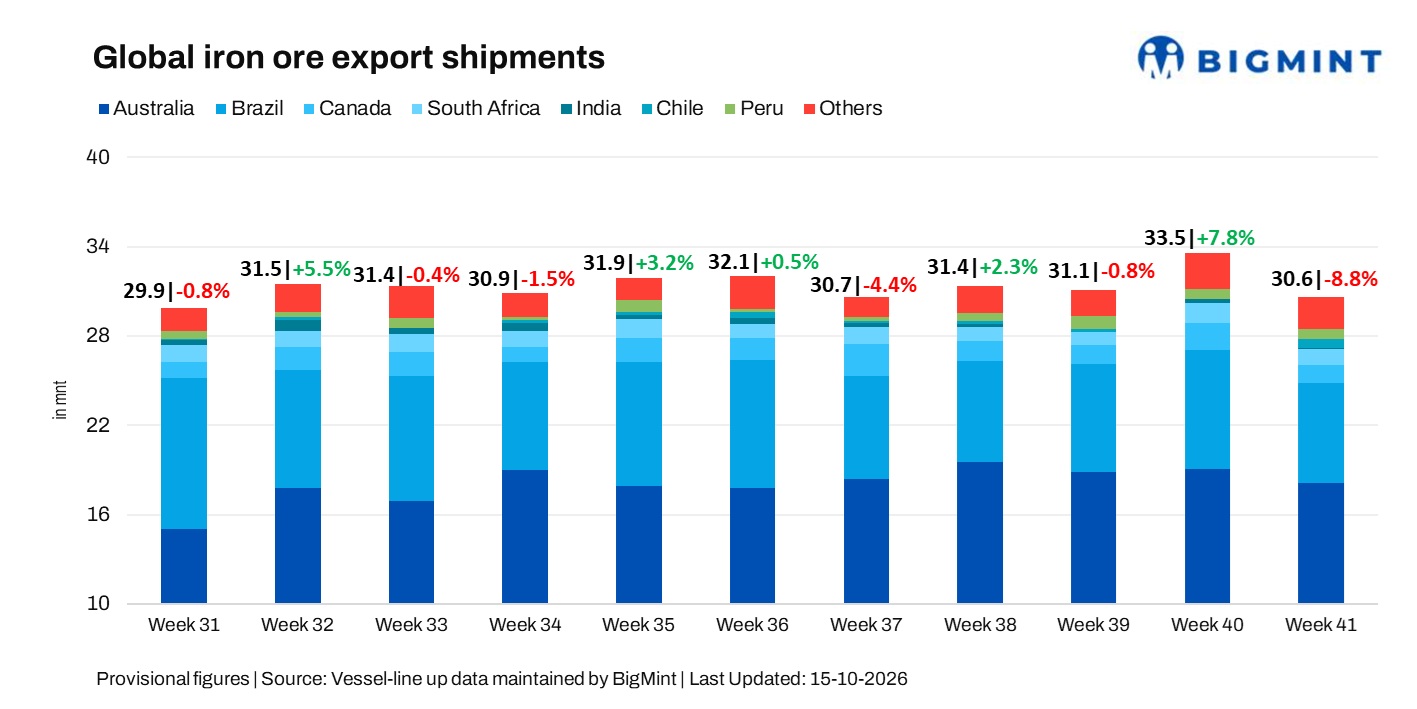
Global seaborne iron ore shipments fell 8.8% w-o-w to 30.6 million tonnes (mnt) in the week ended 9 October, from 33.5 mnt a week earlier. Softer volumes from Australia, Brazil, Canada and South Africa weighed on overall shipments, while stronger flows from Guinea, Mauritania and Peru provided partial support. Chile resumed recorded seaborne activity, while Sweden reported no cargo movements during the week.
The market remained divided between softer exports from major origins and stronger availability from parts of West Africa. China’s cautious iron ore buying, weak steel margins and subdued downstream demand continued to weigh on market sentiment. Guinea’s Simandou ramp-up supported regional export availability, although lower shipments from Brazil and Australia limited overall seaborne volumes.
Country-wise exports

Port & shipper-wise trends
- Australia: Hedland led at 10.87 mnt, followed by Dampier at 3.54 mnt and Walcott at 3.33 mnt. Rio Tinto topped shippers at 6.87 mnt, followed by BHP at 4.98 mnt and Fortescue Metals at 4.61 mnt. China remained the key destination at 13.83 mnt, followed by Japan at 1.67 mnt and South Korea at 1.05 mnt.
- Brazil: Ponta da Madeira led at 3.20 mnt, followed by Itaguai at 1.44 mnt and Tubarao at 1.00 mnt. Vale accounted for 3.46 mnt, while CSN and Vale jointly contributed 2.44 mnt. China was the leading destination at 3.59 mnt.
- Canada: Port Cartier led at 0.42 mnt, followed by Milne Inlet at 0.40 mnt and Sept-Iles at 0.38 mnt. ArcelorMittal accounted for 0.42 mnt, followed by Baffinland at 0.40 mnt and IOC at 0.38 mnt. Belgium received 0.24 mnt, followed by Spain at 0.17 mnt and the Netherlands at 0.16 mnt.
- South Africa: Saldanha handled 1.01 mnt, while Richards Bay accounted for 0.08 mnt. Japan received 0.25 mnt.
- India: Krishnapatnam led at 0.06 mnt, followed by Kandla at 0.05 mnt. Minera Steel and Power accounted for 0.06 mnt, while Bahrain received 0.05 mnt.
- Chile: Huasco handled 0.35 mnt, followed by Caldera at 0.21 mnt. China received 0.38 mnt, while Japan accounted for 0.18 mnt.
- Peru: Shougang Hierro accounted for 0.66 mnt, with San Nicolas handling the same volume. China was the leading destination at 0.39 mnt, followed by the US at 0.17 mnt and Japan at 0.15 mnt.
- Guinea: Morebaya handled 1.37 mnt, with China receiving 0.61 mnt.
- Liberia: Buchanan handled 0.22 mnt, with France receiving 0.06 mnt and Spain 0.05 mnt.
- Sierra Leone: Freetown handled 0.18 mnt, with the entire volume destined for China.
- Mauritania: Nouadhibou handled 0.35 mnt during the week.
- Norway: Mo i Rana handled 0.01 mnt during the week.
Capesize freight sentiment weakens in Atlantic; Pacific holds firm
Capesize freight markets remained mixed, with Atlantic rates under pressure from lower fixtures, subdued cargo enquiries and ample vessel availability. Brazil-China rates softened amid limited fresh demand, while Pacific rates held firm on steady Australian cargo enquiries and tighter prompt tonnage.
The Pacific market continued to draw support from active chartering for Australian iron ore cargoes, while limited fresh enquiries and surplus vessels weighed on Atlantic sentiment. Rising bunker costs added to voyage expenses, although their impact on freight rates remained dependent on cargo demand and vessel availability.
Outlook
Atlantic freight rates may remain under pressure amid surplus tonnage and limited fresh fixtures, while Pacific rates could find support from steady Australian iron ore demand. China’s buying activity and fresh cargo enquiries will be key factors shaping freight market direction in the coming week.
Leave a Reply