- Services resume after short-lived interruption
- Asian demand remains important for export pricing
A brief interruption on South Africa’s coal railway has highlighted the vulnerability of export logistics, but available evidence does not establish a prolonged shortage.
A power failure affected the section between Halfgewonnen C and Hamelfontein during 10-11 October, disrupting operations between Ermelo and Ogies. Services to Richards Bay Coal Terminal resumed on 11 October, and the associated force majeure was lifted.
The reported impact was 21 export trains, equivalent to approximately 174,300 tonnes (t) of interrupted rail movement. This represents missed scheduled deliveries during the disruption, rather than proof of a permanent export loss.
Shipments strengthen before incident
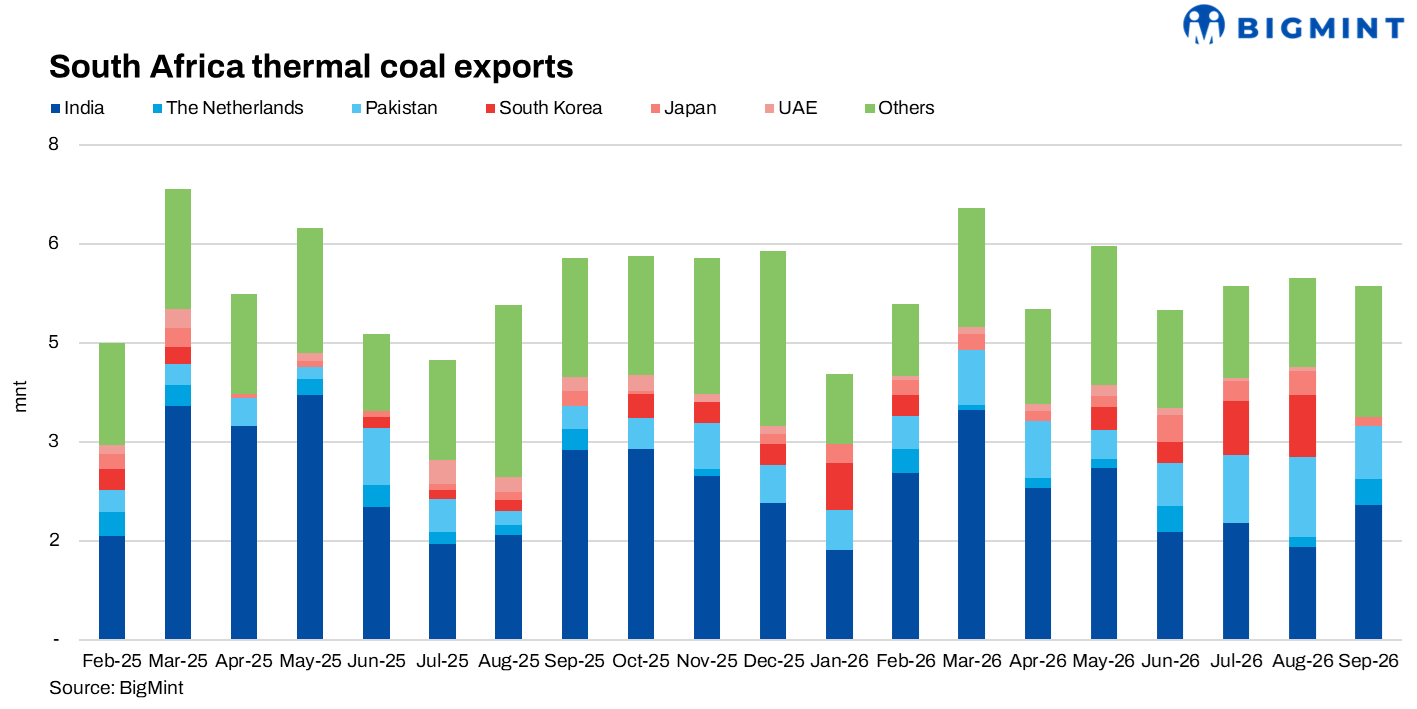
South African exports increased to 1.62 mnt during 3-9 October, from 1.02 mnt the preceding week. India was the destination for approximately 0.48 mnt, while Pakistan accounted for around 0.39 mnt. Together, they represented approximately 54% of tracked shipments.

India-bound cargoes were distributed across ports including Vizag, Mangalore, Kandla, Salaya, and Jaigarh, illustrating the breadth of demand for South African coal.
Terminal stocks influence immediate impact
A railway interruption does not necessarily stop vessel loading immediately. Existing terminal stocks can support departures while incoming deliveries recover. The consequences depend on outage duration, inventories by grade and exporter, and the ability to recover missed train movements.
Without terminal stock data and post-disruption departures, a material export shortfall cannot be quantified.
Prices remain supported
South African 5,500 NAR coal was assessed at $112.05/t FOB Richards Bay on 13 October, up $0.80/t from the previous day. Richards Bay-western India Panamax freight stood at approximately $23.05/t, illustrating the significant transport component in Indian replacement costs.
The price increase should not be attributed entirely to the outage. Asian procurement and constraints on competing supplies remain relevant.
BigMint assessment
The incident demonstrates delivery risk rather than a lasting export crisis. Repeated interruptions would be more consequential than a brief outage followed by service restoration. Indian buyers should watch recovered rail throughput, terminal stocks and vessel schedules. These will determine whether the interruption merely changes timing or creates a more persistent shortage of available cargoes.
Leave a Reply