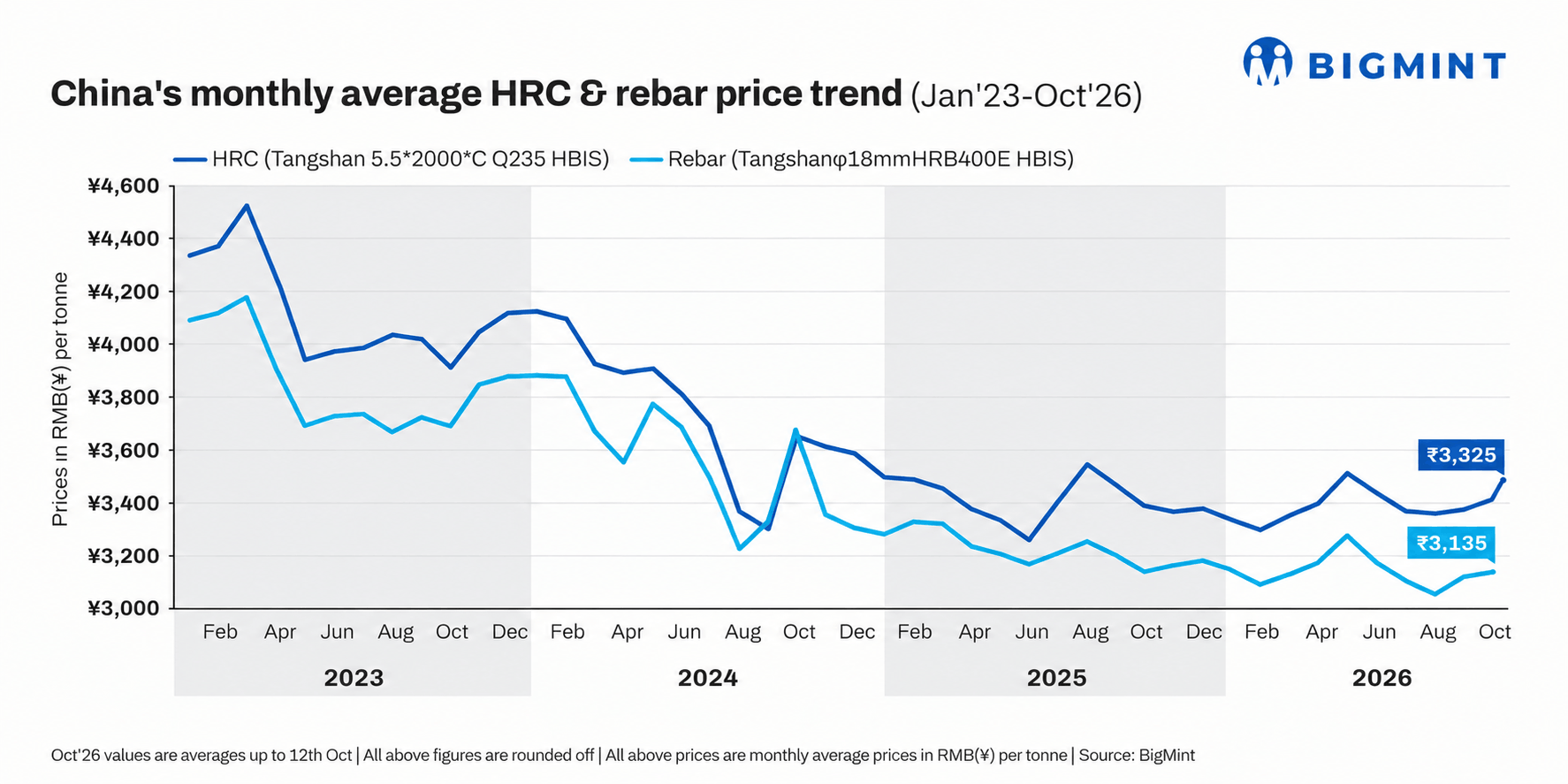
- HRC prices average CNY 3,409/t ($509.3/t) as manufacturing demand and supply cuts support flat steel
- Rebar averages 3,119 CNY/t as weak construction and real estate demand limit recovery
- Mills reduce output but high inventories and subdued buying keep the broader steel market under pressure
Morning Brief: China’s HRC prices averaged CNY 3,409/t ($509.3/t) in September, while rebar averaged 3,119 CNY/t (USD 465.29/t), with relatively resilient demand from manufacturing sectors supporting flat steel while weak construction and real estate activity continued to constrain long steel consumption. Steelmakers cut output and increased maintenance in response to weak margins, while high inventories, subdued spot buying and falling coking coal and coke prices limited the scope for a broader steel price recovery.
HRC benefits from manufacturing demand and supply adjustments
HRC demand remained subdued in September, with limited spot activity and high inventories reflecting weak downstream buying. Buyers largely focused on immediate requirements rather than building substantial stocks, keeping transactions thin.
Steelmakers faced pressure from weak demand and margins, prompting maintenance and output reductions. Environmental controls also kept some blast furnaces offline.
China’s key large and medium-sized steelmakers recorded lower daily pig iron and crude steel output towards the end of September, indicating some moderation from elevated production levels.
Raw material costs initially provided support to mill pricing as coking coal supply remained tight and costs were elevated. However, falling coking coal and coke prices subsequently reduced this support and eased pressure on mills’ production costs.
Pre-holiday restocking helped lower inventories and provided some support to HRC demand, but buying remained focused on immediate requirements rather than a broad recovery. Manufacturing demand was relatively more resilient than construction, with equipment manufacturing, shipbuilding, wind power, construction machinery, automobiles and home appliances supporting flat steel consumption.
Rebar remains constrained by construction weakness
Rebar prices averaged 3,119 CNY/t in September as subdued construction and real estate activity continued to limit demand.
Weak consumption left mills unable to fully pass higher costs through to buyers, putting pressure on margins. Losses encouraged maintenance and production cuts, while environmental controls kept some blast furnaces offline.
Social inventories declined during the month, but elevated mill inventories indicated that lower overall stocks did not represent a broad improvement in underlying demand. Falling coking coal and coke prices eased mills’ cost pressure, but also removed some of the cost-driven support for steel prices.
The September market review pointed to weak transactions and limited improvement in demand despite production adjustments, indicating that supply-side measures had not yet translated into a sustained recovery in rebar consumption.
HRC-rebar spread reflects divergent demand
The HRC-rebar spread stood at 290 CNY/t in September, with HRC averaging 3,409 CNY/t compared with 3,119 CNY/t for rebar.
The gap reflects the stronger demand base for flat steel than for long steel. HRC benefited from relatively resilient manufacturing activity, including demand linked to equipment manufacturing, shipbuilding, wind power, construction machinery, automobiles and home appliances. Rebar remained more heavily exposed to construction and real estate, where demand was weak.
Both markets continued to face weak steel demand and substantial production capacity. Mills responded through maintenance and output reductions, but the return of idled capacity could limit price gains if margins improve without a corresponding increase in end-user demand.
Outlook
Early October data suggest the divergence between flat and long steel has widened further. HRC reached 3,853 CNY/t compared with 3,409 CNY/t in September, while rebar was little changed at 3,135 CNY/t against 3,119 CNY/t in September.
The early October move indicates stronger price momentum in HRC, although lower coking coal and coke prices could limit further cost-driven gains and improved margins could encourage mills to restart idled capacity.
Rebar remains more dependent on a recovery in construction and real estate demand. Production cuts and lower social inventories can provide some downside protection, but a sustained recovery will require stronger physical demand rather than further supply adjustments alone.
Leave a Reply