- Escondida strike raises copper supply risks as labour talks fail in Chile
- China’s aluminium market remains under pressure after holiday
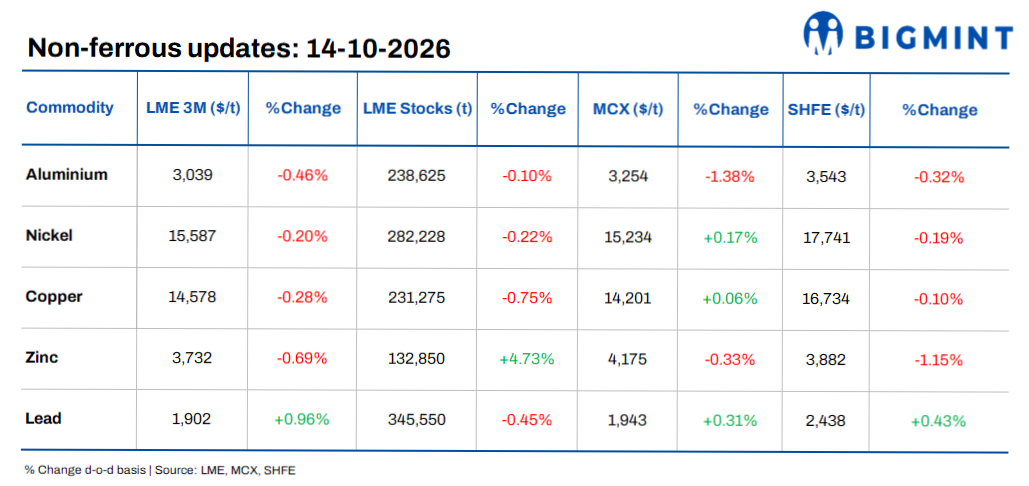
LME base metals mostly declined on 13 October, with lead the sole gainer among the group. Lead rose 0.96% d-o-d to $1,902/t, while zinc fell 0.69% to $3,732/t. Aluminium declined 0.46% to $3,039/t, followed by copper, down 0.28% to $14,578/t. Nickel edged lower by 0.20% to $15,587/t.
The decline was driven primarily by weaker investor risk appetite, concerns over AI-related capital spending and a stronger US dollar. A recent global sell-off in technology shares raised doubts about the returns from expanding AI data centres, weighing on copper and aluminium amid concerns over future demand from data centre construction and power infrastructure.
LME inventories recorded mixed movements. Zinc stocks increased 4.73% to 132,850 t, the largest percentage change, while copper inventories fell 0.75% to 231,275 t. Lead stocks declined 0.45% to 345,550 t, followed by nickel, down 0.22% to 282,228 t. Aluminium inventories eased 0.10% to 238,625 t.
Domestic market overview
India’s non-ferrous market recorded declines across the supplied aluminium and copper armature scrap quotations. The available MCX data showed aluminium futures weakening, while copper futures edged higher.
Aluminium tense scrap (loose) fell by INR 2,500/t, or 1.02%, to INR 242,000/t ex-Delhi. Ex-Chennai prices declined by INR 1,000/t, or 0.41%, to INR 245,000/t. P1020 aluminium ingot dropped INR 9,000/t, or 2.60%, to INR 337,000/t. MCX aluminium fell 1.38% to INR 325,350/t.
Meanwhile, copper armature scrap (Cu 99%) declined INR 4,000/t, or 0.30%, to INR 1,348,000/t from INR 1,352,000/t. In contrast, MCX copper rose 0.06% to INR 1,420,100/t.

Other updates
Middle East attacks lift oil prices amid supply concerns
Brent crude rose 64 cents to $106.33/barrel on 14 October, while WTI gained 80 cents to $94.14/barrel. Houthi attacks on Saudi targets, including a reported fire at a Saudi Aramco administrative building in Dhahran, heightened concerns over regional supply security. Potentially higher Russian diesel exports could temper price gains. Separately, OPEC expects global oil demand to grow by 2.55 million barrels/day in 2027, reaching 108.3 million barrels/day, as markets anticipate replenishment of depleted inventories.
BHP’s Escondida mine faces strike action in Chile
Supervisors at BHP’s Escondida copper mine in Chile announced strike action from 14 October after mediated negotiations failed to secure a new labour agreement. The dispute involves approximately 1,020 union members seeking changes to employment conditions and compensation. Escondida produced approximately 1.26 mnt of copper in FY’26, down 3% from the previous year. A prolonged stoppage could affect mining, processing and maintenance, although the scale of any disruption will depend on the strike’s duration and the outcome of further negotiations.
Australia secures Tomago aluminium smelter beyond 2028
Australia’s federal and New South Wales governments announced a $2.5 billion support package in August to secure Tomago Aluminium’s future beyond 2028. The smelter’s existing electricity contract expires on 31 December 2028, creating uncertainty over continued operations. Tomago has committed at least $1.1 billion in investment, while the agreement supports nearly 3 GW of renewable generation and firming capacity. The arrangement is intended to preserve industrial capacity and employment, reducing the risk of a future loss of Australian primary aluminium production.
China’s aluminium market remains under pressure after holiday
China’s aluminium spot market weakened amid excess availability and cautious downstream buying. On 13 October, SMM A00 aluminium was quoted at RMB 23,710/t, down RMB 100/t from the previous session. The most-traded SHFE aluminium contract also declined, reflecting limited buying interest. Meanwhile, aluminium ingot inventories at major Chinese consumption centres fell 35,000 tonnes to 651,000 tonnes on 12 October. However, stocks remained above pre-holiday levels, indicating that the recovery in consumption had not fully absorbed accumulated material.
Leave a Reply