- HRC, semis exports rise sharply; Vietnam, UAE, UK drive growth
- Exports to EU decline 26% amid CBAM, tighter new steel import regime
- Total steel imports drop marginally even as Chinese shipments increase
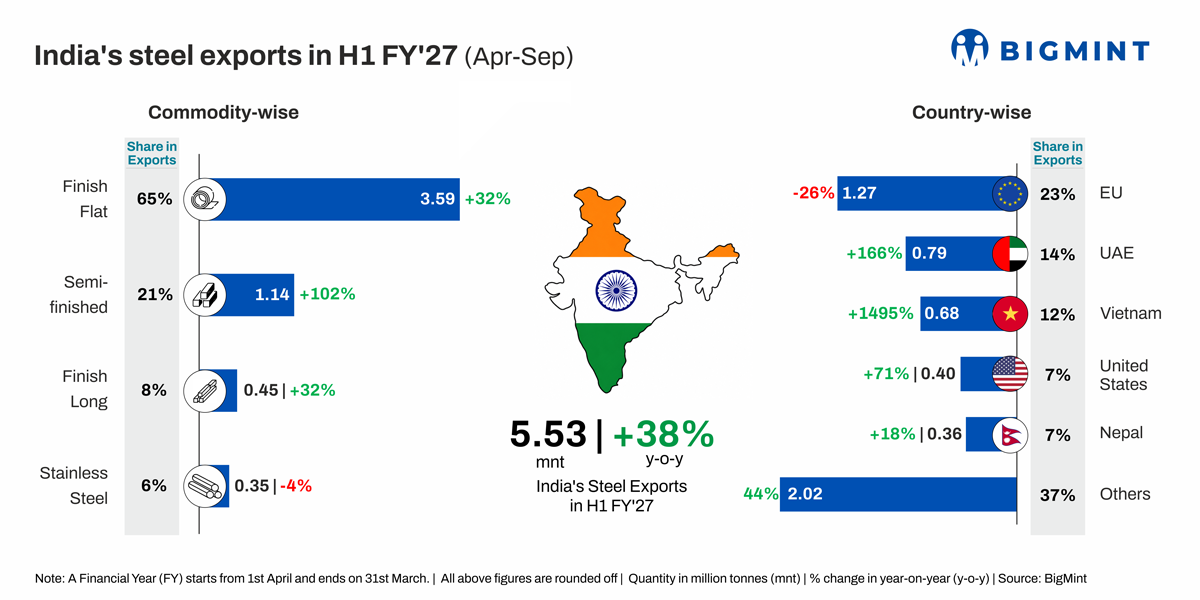
Morning Brief: India turned into a net steel exporter in H1FY’27 (April-September 2026): the country’s steel exports (including semi-finished and stainless steel) rose 38% y-o-y to 5.53 mnt in H1 compared with 4 mnt a year earlier. Meanwhile, imports of steel and stainless steel edged down 1.5% y-o-y to 4.84 mnt in H1 from 4.91 mnt, according to provisional data with BigMint.
India therefore recorded a total export surplus of 0.69 mnt, compared with a net import position of 0.9 mnt in H1FY’26.
Steel export scenario in H1FY’27
Export volumes reached their highest level for the six-month period since H1FY’22, when shipments had totalled 11.3 mnt.
Higher shipments to the UAE, Vietnam, the UK, and the US more than offset a 26% decline in exports to the European Union (EU), as Indian mills redirected material towards alternative markets amid a tighter European steel safeguard regime and caution regarding carbon costs under the Carbon Border Adjustment Mechanism (CBAM).
Within carbon steel, the export expansion was concentrated in hot-rolled coils (HRCs) and plates and semi-finished steel. HRC and plate exports rose 89% to 1.8 mnt, while billet shipments more than doubled to 1.14 mnt. Together, these two categories accounted for 2.93 mnt, or about 53% of total steel exports.

Geographical diversification boosts export volumes
The recovery has coincided with a change in the geographical distribution of shipments. Exports to the EU fell 26% to 1.27 mnt, but shipments to the UAE increased 166% to 0.79 mnt, while Vietnam’s intake rose to 0.68 mnt from just 0.04 mnt. Exports to the UK doubled to 0.53 mnt from 0.26 mnt, and shipments to the US rose to 0.40 mnt from 0.23 mnt.
The combined increase in exports to the UAE, Vietnam, the UK, and the US more than compensated for the decline in EU shipments.

Notably, India’s steel exports to the UK rose 105% y-o-y, coinciding with improved market access under the India-UK Comprehensive Economic and Trade Agreement (CETA), which came into force on 15 July 2026. Subsequent arrangements increased India’s HRC-specific allocation under Category 1A to 33,456 t. India also secured a 40% share of the quota under the Authorised Use Scheme (AUS), equivalent to around 945,000 t annually. Together, the stated arrangements provide more than 1.1 mnt a year in duty-free steel access.
Total finished flat exports increased by 32% y-o-y to 3.6 mnt, with pipes and tubes increasing 3.9% to 1.03 mnt and galvanised steel rising 4.4% to 0.51 mnt. In contrast, cold-rolled coil (CRC) exports fell 33% to 0.16 mnt. Exports of finished long products rose 32% to 0.45 mnt.
HRC exports shift towards Vietnam, Middle East
HRC and plate exports increased 89% y-o-y to 1.80 mnt in H1FY’27. The EU remained the largest destination for this category, but shipments fell 27% to 0.49 mnt from 0.67 mnt, reflecting the impact of tighter import conditions and subdued European demand.
As per the new safeguard quota regime, which kicked in from July 2026, the EU has reduced India’s HRC import quotas by 34% to 597,274 t. India’s HRC and plate exports to the EU totalled 1.4 mnt in FY’26.
Vietnam and the UAE accounted for much of the increase in alternative market shipments. HRC and plate exports to Vietnam surged to 0.48 mnt from 30,600 tonnes (t), while shipments to the UAE rose to 0.35 mnt from 97,000 t and exports to Oman also increased to 85,700 t from 8,300 t.
The expansion in Vietnam reflects opportunities created by changing supplier flows. The country imported around 11.58 mnt of steel during January-September 2026, up approximately 3.5% y-o-y, while imports from China, Japan and South Korea declined. Indian suppliers were able to capture a larger share of this demand as buyers sought alternative sources.
The UAE and neighbouring Gulf markets have also become more attractive because Indian suppliers can benefit from shorter shipping distances and competitive delivery times relative to some East Asian suppliers. Higher freight costs for Chinese cargoes have further improved the relative position of Indian mills in certain transactions.
Semi-finished steel exports more than double
Semi-finished carbon steel exports rose 102% y-o-y to 1.14 mnt in H1 from 0.56 mnt. The UK remained the largest listed destination, receiving 301,300 t, up 46% y-o-y. Shipments to the US more than tripled to 180,900 t, while exports to Sri Lanka rose to 143,400 t from just 4,386 t.
Semis exports to the EU also increased sharply to 114,100 t from 2,700 t, to the UAE rose to 60,300 t from just 300 t, while exports to Tanzania increased to 51,000 t from 9 t. By contrast, shipments to Nepal fell 22% to 70,400 t, and exports to Thailand declined 69% to 19,300 t.
Exports exceeded 200,000 t during June-September, as softer domestic steel prices, subdued demand, and favourable export realisations due to a weaker rupee encouraged producers to boost overseas shipments.
Additionally, the halt in Iranian semi-finished steel exports after the Middle East conflict was a significant demand driver. Iran exported about 2.84 mnt of semis in 2025, and its billet shipments reportedly stopped altogether from late April.
Rising shipments to the UK may be attributed to slabs imported by Tata Steel UK from its Indian facilities following the closure of its blast furnaces at Port Talbot in September 2024.
Data also shows that shipments to the EU started in June, right before the new import regime commenced. BigMint understands that tightening quotas have increased EU demand for semi-finished steel, which does not face restrictive safeguard measures unlike finished flat products.
Meanwhile, shipments to Southeast Asia fell sharply amid mounting billet exports from China. Chinese mills, not Indian ones, filled the Iranian supply gap in Southeast Asia, where Iran usually sends around 70% of its semis.
Steel imports stable y-o-y, but Chinese shipments increase
India’s steel and stainless steel imports declined marginally to 4.84 mnt in H1FY’27 from 4.91 mnt a year earlier, according to data. The country mix changed more sharply than the overall total, with imports from China rising 61% to 1.42 mnt from 0.88 mnt.

South Korean shipments declined 4% to 1.36 mnt, while imports from Japan fell 6.5% to 0.61 mnt. Imports from Vietnam, largely semi-finished steel, decreased 38% to 0.39 mnt.
Within carbon steel, imports of HRC and plates fell 2.6% to 1.35 mnt, while electrical steel imports rose 10% to 0.96 mnt, galvanised steel increased 20% to 0.58 mnt, and cold-rolled coil (CRC) imports climbed 73% to 0.15 mnt. Overall, finished flat imports increased 6% to 3.4 mnt, while semi-finished steel imports fell 54% to 0.35 mnt.

Imports from South Korea and Japan are supported by established supply arrangements between overseas parent companies and their Indian subsidiaries or downstream manufacturing units. Product specifications, quality requirements, and contractual commitments make these flows less sensitive to short-term price movements.

The surge in Chinese imports, largely of HRC and plates, is associated in part with export-oriented production of downstream products, including pipes for international oil and gas projects, under the Advance Authorisation Scheme. The scheme allows eligible manufacturers to import inputs duty-free and without requiring BIS compliance, provided these are used to produce goods for export.
Last year, India had imposed a 12% safeguard duty on selected carbon flat steel products, which was reduced to 11.5% for the 21 April 2026 to 20 April 2027 period. The duty has reduced the attractiveness of routine imports where domestic alternatives are available, but it has not eliminated demand for overseas material in specialised and export-linked segments.
Stainless steel exports inch down, imports increase
Finished stainless steel exports declined 3.5% to 0.35 mnt in H1 amid subdued overseas demand, limited fresh bookings and growing trade barriers in Europe. The EU’s CBAM, effective from January 2026, has increased carbon emissions reporting and cost considerations for importers, while tighter steel safeguard quotas from July have further constrained market access.
Additionally, disruptions to shipping routes and higher freight costs amid the Middle East crisis have affected shipment schedules and trade flows, adding to the pressure on exports.
Stainless steel imports increased by 9% to 0.88 mnt, with finished flat products increasing 86% y-o-y to 0.78 mnt, while semi-finished imports fell 76% to 0.09 mnt.
The surge in finished flats imports came amid temporary relaxations in BIS quality-control requirements. The Ministry of Steel issued a stainless steel QCO exemption order on 27 April this year, with exemptions for specified products and import consignments, easing compliance requirements for eligible imports.
Outlook
BigMint expects India’s steel exports to continue rising y-o-y, supported by firm demand from Vietnam and the Middle East. Strong domestic demand and tighter supply are currently encouraging mills to prioritise local sales, while a weakening of domestic prices could prompt exporters to redirect volumes overseas.
The rupee’s depreciation has improved export realisations in INR terms, strengthening Indian suppliers’ price competitiveness. However, the downside to this outlook remains in the form of renewed competition from China.
Trade restrictions on Chinese steel have helped Indian exporters gain market share, but China’s export momentum has never really flagged, with shipments rising y-o-y for four consecutive months. A sustained increase in Chinese exports could intensify competition in India’s key export markets and limit further gains.
Steel imports, meanwhile, are likely to remain selective, with volumes broadly holding at current levels. Contractual commitments and grade requirements for specialised applications will sustain demand for overseas material as well as sourcing for exports.
The safeguard duty should continue to curb imports where domestically produced steel is commercially viable, not to mention the current AD probe on flats imports from key countries. However, latest reports indicate that the government is not favourably disposed to clamping down more restrictions on imports. Therefore, India’s steel imports may remain broadly stable y-o-y in FY’27, while exports are expected to edge higher.
Leave a Reply