- Ample material availability, delayed payments curb buying
- Buyers remain cautious amid subdued market demand
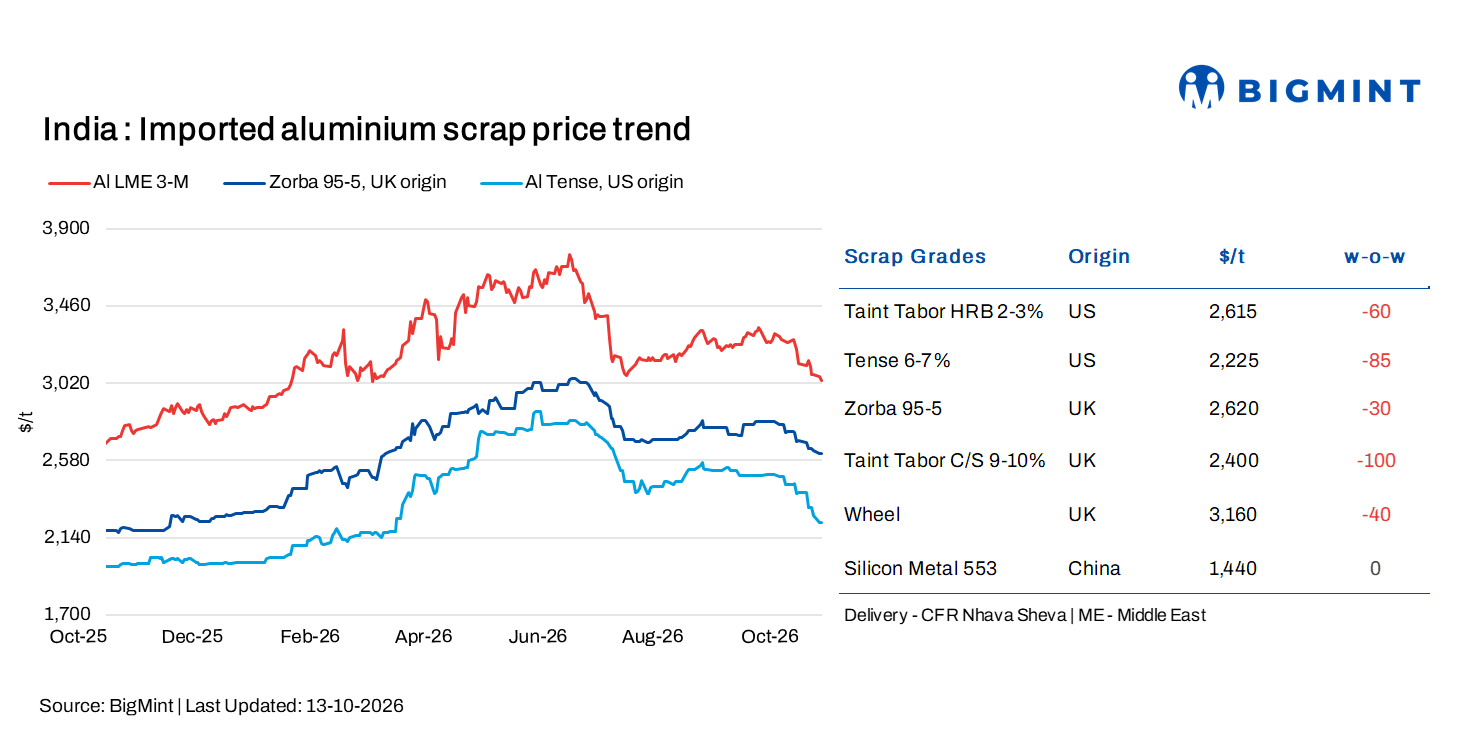
India’s imported aluminium scrap prices declined w-o-w, tracking weaker London Metal Exchange (LME) aluminium prices. Limited buying interest also weighed on market activity.
According to BigMint’s latest assessment for CFR Nhava Sheva deliveries, UK-origin Taint Tabor C/S 9-10% scrap prices fell by $100/t w-o-w to $2,400/t, from $2,500/t. Meanwhile, US-origin Tense 6-7% scrap prices declined by $85/t to $2,225/t, from $2,310/t.
LME aluminium prices decline w-o-w
The LME three-month aluminium contract declined by $58/t, or 1.9% w-o-w, to $3,060/t on 12 October from $3,118/t on 5 October. Prices came under pressure from a stronger US dollar, expectations of improving global supply, particularly from Indonesia, and easing concerns over Middle East supply disruptions. Expectations surrounding US inflation data also weighed on market sentiment.
Meanwhile, LME aluminium inventories declined by 1,750 t, or 0.7%, to 238,625 t on 12 October from 240,375 t on 5 October. Despite the drawdown, stocks remained near historically low levels, indicating continued tightness in readily available metal. However, the decline in inventories was insufficient to offset bearish market sentiment and expectations of improving global supply.
The market also faced pressure from a stronger US dollar, which reached an 18-month high amid safe-haven demand and anticipation of US inflation data. Easing concerns over Gulf supply disruptions and expectations of additional Indonesian capacity further weighed on prices.
Market scenario
The imported aluminium scrap market remained very quiet w-o-w despite lower prices, as buyers continued to avoid fresh purchases amid ample material availability and delayed payments.
Market participants noted that prices were already low and broadly in line with prevailing demand, but buying remained largely paused, with several suppliers reluctant to quote. Scrap availability is expected to remain adequate during October and November, based on import trends in July and August.
The impact of the EU’s proposed scrap export measures may take time to materialise, with greater clarity expected after the final list is announced on 21 November.

Meanwhile, the domestic aluminium scrap market remained weak amid low demand and subdued spot enquiries. Market participants described the recent price decline as a correction, with expectations that it may not last long. However, cautious buying and sufficient material availability continue to limit near-term recovery.
The domestic ADC12 market also remained subdued, with buyers showing limited interest and avoiding firm price indications. Although festive-season demand could offer some support, ample local material availability is expected to cap near-term price gains. Market participants expect the effects of scrap export restrictions and stronger ADC12 demand to become more visible over the next couple of months, keeping market activity slow in the near term.
Outlook
India’s imported aluminium scrap prices are expected to remain rangebound through October and November, as adequate material availability from earlier imports, subdued buying interest and delayed payments continue to weigh on market activity. Domestic scrap and ADC12 markets are also likely to remain subdued amid weak demand and comfortable material availability, although festive-season demand may provide some support.
However, the impact of the EU’s proposed scrap export measures and uncertainty over UAE export restrictions could change supply dynamics and influence prices in the following months. Market participants expect greater clarity after the EU announces its final list on 21 November, with any significant market impact likely to emerge gradually thereafter.
Leave a Reply