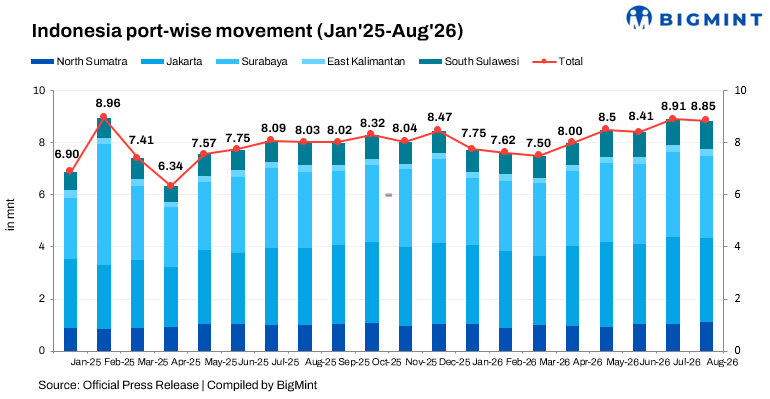
- Shipments from Jakarta and Surabaya decline
- Coal exports weaken amid logistics disruptions
Shipments across Indonesia’s five major mining and industrial cargo hubs declined marginally by 1% m-o-m to 8.85 million tonnes (mnt) in August 2026, from 8.91 mnt in July. Lower volumes from Jakarta, Surabaya and East Kalimantan outweighed growth in North Sumatra and South Sulawesi. The shipments comprise coal, lignite, copper ore and other minerals.
The broader mining sector came under pressure in August as Indonesia’s seaborne coal exports declined amid policy uncertainty and drought-related disruptions to barge movements along the Barito River. Reduced water levels constrained the movement of coal barges, complicating transportation from inland mining areas to export terminals and disrupting the flow of shipments.
The combination of logistical bottlenecks and uncertainty over government policy weighed on export activity, highlighting the vulnerability of Indonesia’s coal supply chain to weather conditions and regulatory changes.
Port-wise shipment trends
- Jakarta: Shipments fell 4% m-o-m to 3.23 mnt from 3.36 mnt, remaining the largest contributor among the five hubs. The decline weighed most heavily on the overall monthly performance.
- Surabaya: Shipments declined 3% m-o-m to 3.17 mnt from 3.28 mnt, indicating a moderation in cargo movements despite stronger national export values.
- North Sumatra: Shipments rose 9% m-o-m to 1.11 mnt from 1.02 mnt, suggesting improved regional cargo flows and partially offsetting declines at the larger hubs.
- South Sulawesi: South Sulawesi shipments rose 11% m-o-m to 1.09 mnt, potentially supported by stronger agricultural and nickel-related cargo movements through regional ports, although the increase contrasts with a decline in the province’s overall export value.
- East Kalimantan: Shipments slipped 5% m-o-m to 0.25 mnt from 0.26 mnt. The decline was consistent with broader pressure on Indonesian coal logistics, although the regional cargo mix may also have influenced volumes.
Outlook
Indonesia’s mining and industrial cargo shipments may remain uneven in the near term. Stronger national non-oil and gas exports provide a supportive backdrop, but declining seaborne coal exports, production-quota uncertainty and weather-related logistics disruptions could constrain cargo flows. Seasonal coal demand ahead of winter may offer some support in the fourth quarter, depending on export availability and buyers’ restocking activity.
Leave a Reply