- Leading auto maker’s settlement cut signals continued pricing pressure
- EU export policy uncertainty clouds future scrap availability
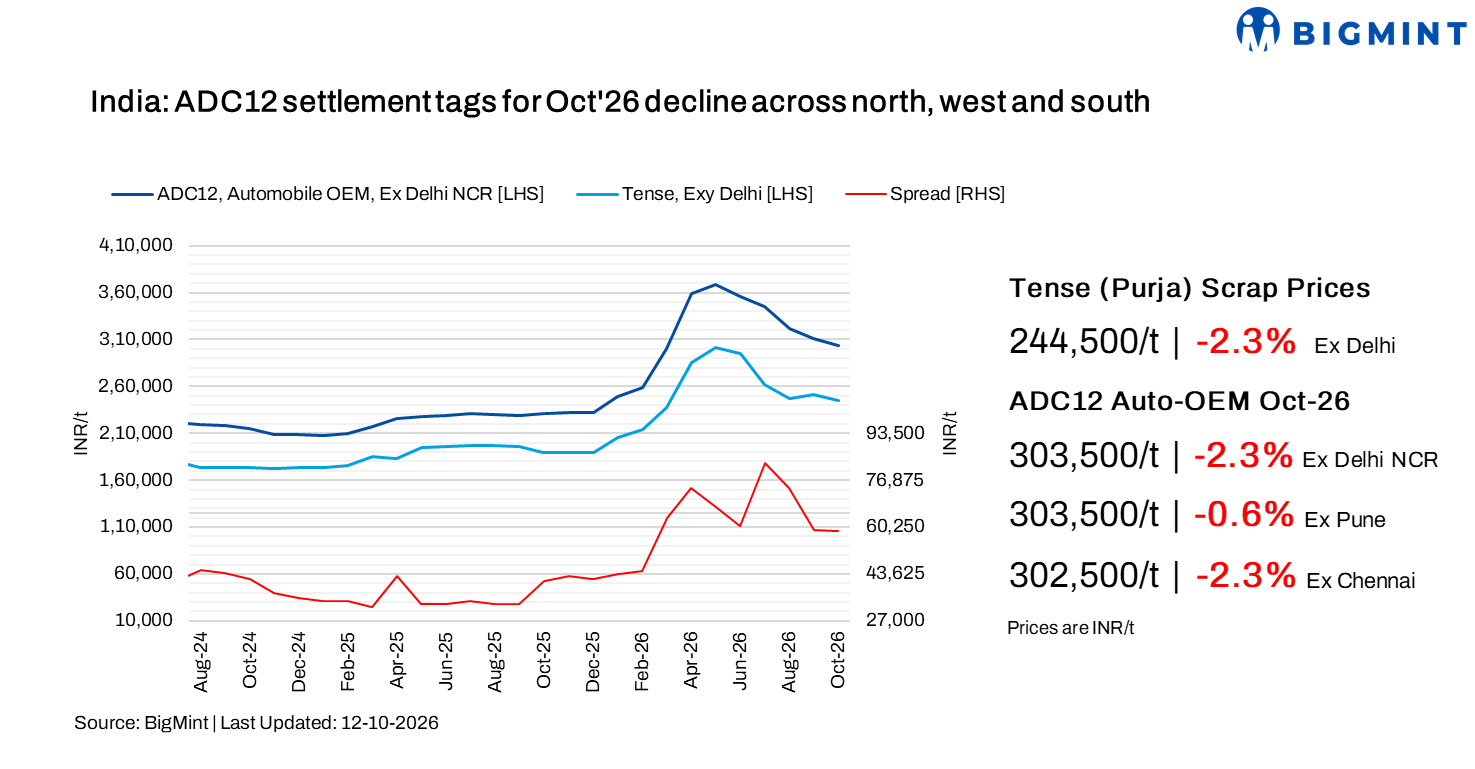
India’s ADC12 aluminium alloy ingot settlement prices declined across all three major markets as of 12 October 2026, compared with September. According to BigMint’s latest assessment, prices fell 2.3% m-o-m to INR 303,500/t in Delhi NCR, while Pune declined 0.6% to INR 303,500/t and Chennai decreased 2.3% to INR 302,500/t.
The spread between aluminium scrap and ADC12 alloy ingot prices remained around INR 57,000-59,000/t in Delhi NCR and Chennai. Both scrap and ADC12 prices declined during the period. The spread is expected to widen if ADC12 prices recover faster than scrap, supported by improving seasonal demand.
Market insights
ADC12 alloy ingot prices fell across major Indian markets amid softer raw material costs.
India’s leading automaker reduced its ADC12 settlement price by INR 500/t (0.2% m-o-m) to INR 304,500/t for October 2026, from INR 305,000/t in September. This followed a sharper decline of INR 12,000/t (3.8%) in September, reflecting subdued demand, lower raw material costs and cautious procurement. The latest reduction is expected to influence other original equipment manufacturers (OEMs) settlements and domestic market pricing, with suppliers likely to reassess offers around the revised benchmark.
Spot market activity remains subdued, particularly in southern India, as comfortable OEM inventories and expectations of further price adjustments continue to limit fresh buying. Prices are heard at INR 303,000-305,000/t in Delhi NCR and Pune, and INR 300,000-303,000/t in Chennai, for 30-day payment terms. Buyers are negotiating aggressively on prices and payment conditions, while suppliers are facing limited urgency for fresh orders. The relatively higher price range in Chennai reflects regional market differences, although buying activity remains cautious.
The market is closely monitoring automotive demand, raw material costs and the availability of imported ADC12 material. Lower scrap prices have reduced production costs, while competitively priced imports and comfortable inventories have limited suppliers’ pricing flexibility. However, seasonal demand during the festive and marriage period could encourage some restocking if buyers begin replenishing inventories. Any sustained recovery will depend on stronger spot enquiries and improved procurement activity.
An OEM buyer based in Chennai said supplier offers are currently in the range of INR 305,000-307,000/t. However, the buyer is negotiating for lower prices of INR 300,000-303,000/t. With sufficient inventories on hand, the buyer has no immediate requirement to procure additional material.
Alloy imports decline y-o-y in 8MCY’26
Imports: India’s aluminium scrap imports declined 11.3% y-o-y during 8MCY’26 to 1.09 mnt, from 1.23 mnt in 8MCY 25. Despite the decline, imports continue to meet around 85% of India’s aluminium scrap requirement, highlighting the country’s dependence on overseas supply. Lower inflows, combined with weak domestic demand, cautious buying, limited spot enquiries and subdued activity among secondary producers kept import activity subdued during the period.
Raw material trends
In October, three-month LME aluminium prices averaged around $3,110/t, down $163/t (5.0%) from September’s average of $3,273/t. Meanwhile, LME aluminium inventories declined to 238,875 t on 9 October from 241,375 t at the end of September, down 2,500 t (1.0%), indicating tighter exchange stocks despite weaker benchmark prices.
Imported and domestic aluminium scrap prices are expected to remain relatively rangebound during October and November, supported by adequate availability based on July-August import trends. However, uncertainty over the EU’s proposed scrap export measures could affect global availability and procurement costs, potentially influencing raw-material prices in the coming months. Market participants expect greater clarity after the final list is announced on 21 November 2028. The UAE’s export outlook also remains uncertain beyond the current restriction period, while revised Pre-Shipment Inspection Certificate (PSIC) requirements have created operational challenges for some importers.
For the Indian ADC12 market, stable scrap prices and adequate availability may limit significant increases in production costs during October and November. However, any subsequent correction in scrap prices following greater clarity on export policies could put renewed pressure on ADC12 prices. Conversely, tighter global scrap availability or higher procurement costs could provide support. Meanwhile, declining imported ADC12 inventories and improving demand during the festive and marriage season may help ease downward pressure on alloy prices, although the extent of any recovery will depend on raw-material movements and market demand.
Among key imported grades, UK-origin Wheel scrap prices declined by $115/t m-o-m to $3,220/t in October 2026, from $3,335/t in September. US-origin Tense scrap prices fell by $170/t m-o-m to $2,315/t in October, from $2,485/t in September.
Meanwhile, China-origin silicon metal 553 prices decreased by $10/t m-o-m to $1,445/t in October, from $1,455/t in September.
Outlook
India’s ADC12 aluminium alloy ingot prices are expected to remain under pressure in the near term amid subdued spot demand, cautious procurement and comfortable OEM inventories. Declining LME aluminium and imported scrap prices may continue to weigh on production costs and limit price recovery. However, adequate scrap availability is likely to keep raw-material costs relatively stable in October and November, unless global supply restrictions alter trade flows.
Meanwhile, uncertainty over the EU’s proposed scrap export measures and the UAE’s export outlook could influence import costs in the coming months. Improving automotive demand, festive and marriage-season restocking, and declining imported ADC12 inventories may provide some support. The pace of recovery will depend on raw-material price movements, fresh buying activity and the extent of inventory replenishment.
Leave a Reply