- Stock drawdown at mines, power plants support coal supply requirements
- Buyers may turn to costlier imports if delivery delays persist
India’s coal supply recovery depends not only on higher production but also on how quickly coal reaches power plants. Stocks have fallen at both mines and power stations, leaving less room to absorb delays as consumption remains high.
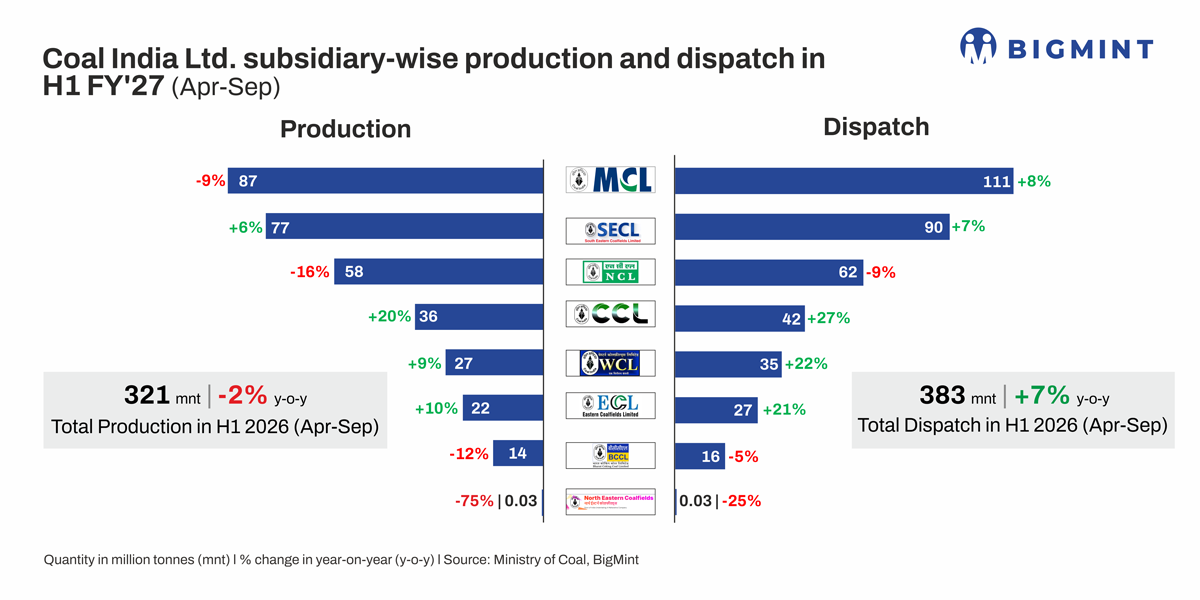
Coal India Ltd (CIL) increased production and dispatches in early October, while railway loading also improved. However, the recovery has yet to establish sustained stock rebuilding at domestic-coal-based power plants. If deliveries remain below consumption, some consumers may need to turn to costlier imports or alternative transport routes.
Two inventory cushions have weakened
BigMint’s reconstruction of India’s pithead coal stocks estimates that inventories declined from 151.96 mnt at end-March to 86.61 mnt at end-August — a reduction of 65.35 mnt, or approximately 43%.
CIL accounted for most of that depletion. Its reconstructed stocks fell from 129.97 mnt to 75.41 mnt. Captive/other producers’ inventories declined from 16.93 mnt to 10.31 mnt.

Falling mine stocks show that dispatch has been supported by accumulated inventories as well as current production. They do not, by themselves, demonstrate a transport bottleneck: during July and August, coal was leaving mines faster than it was being produced.
At power plants, a separate inventory cushion was also being used. Consumption exceeded receipts by approximately 36.75 mnt during April-September.
These two figures should not be added together. They cover different periods, producer groups and stages of the supply chain. Together, however, they demonstrate that inventories have been absorbing the mismatch between production, deliveries and consumption.
Power plants need deliveries above consumption
Power plants consumed 473.24 mnt during April-September against receipts of 436.49 mnt.
The imbalance was persistent. The monthly receipt deficit widened from 4.30 mnt in May to 8.60 mnt in August. September receipts remained 7.85 mnt below consumption.

During April-August, consumption rose 9.2% y-o-y, while receipts increased only 3.2%. Identified power-house rail loading declined approximately 5.4% between May and August, even as monthly consumption remained close to 79 mnt.
This does not measure the entire delivery system: imported-coal categories can contain additional power-sector movements, and plants also receive supplies through road, captive rail systems and other routes. Nevertheless, the figures show why merely maintaining deliveries is insufficient. Plants need a surplus to replenish stocks.
Regional balances in Sep reveal widespread pressure
The September cumulative report provides a useful regional view. Every region received less coal than it consumed.
Western India recorded the largest absolute deficit, at approximately 2.80 mnt. Northern India’s stocks declined by approximately 1.78 mnt, while southern inventories fell by around 1.02 mnt.

The eastern deficit is important: proximity to coal-producing areas did not eliminate pressure. The problem therefore cannot be explained by distance alone.
For distant consumers, however, longer routes and additional handling stages increase exposure to interruptions. The northern aggregate also does not isolate north-western states; plant-level analysis is needed to establish their individual vulnerability.
Coastal supply remains dependent on rail
Approximately 36.17 mnt of identified power-house coal moved by rail to four principal coastal loading ports during April-September.
Paradip dominated this chain, receiving 4.79 mnt in August and 4.51 mnt in September across the identified port sidings. Dhamra, Gangavaram and Visakhapatnam provided additional loading routes.
Coastal shipping is already expanding. August discharge-side volumes reached 5.59 mnt, approximately 16% above August 2025. Krishnapatnam, Ennore and Tuticorin together received approximately 82% of that volume.
For southern consumers, this provides an alternative to an entirely inland rail journey. But the chain still requires coal to reach the loading port, berth access, vessel loading, sailing and efficient discharge.
Rail-to-port and coastal volumes must remain separate: adding them would count the same cargo at successive transport stages.
Rain disrupted an already depleted system
The late-September deep depression and associated railway disruption added pressure when plant buffers were already thin. Average receipts at domestic-coal-based and washery-reject stations fell from 2.394 mnt/day during 18-22 September to 2.145 mnt/day during 23-27 September.
Consumption moderated too, but remained above receipts. Domestic-origin stocks declined from 19.65 mnt on 22 September to 18.36 mnt on 30 September.
Official weather and railway notices confirm the disturbance and affected sections. They do not quantify how much national coal movement was lost.
Oct recovery brings supplies closer to balance
CIL produced 16.73 mnt and dispatched 17.58 mnt during 1-8 October. Its dashboard reported production growth of 35.9% and dispatch growth of 33.4%. Singareni exceeded both cumulative targets.
Rail loading also strengthened. The government’s 9 October update reported an early-October average exceeding 465 rakes/day, with the 470-rake target achieved for three consecutive days.
Daily figures reported subsequently show loading rising from 447 rakes on 1 October to 477 on 4 October, followed by 470 and 472 on 5 and 6 October. The reported September average was 426 rakes/day, implying an improvement of more than 9% in early October.

The improvement confirms that evacuation is responding alongside production. However, the government’s expectation that sustained loading of 465-475 rakes/day will enable stock rebuilding also assumes seasonal demand moderation. If coal burn remains elevated, stronger loading may continue to cover consumption without generating enough surplus to restore reserves.
For distant consumers, the decisive test is whether these additional loaded trains translate into timely plant receipts. Higher national loading alone cannot establish that supplies are reaching every vulnerable station. Road lifting provides another option, but reliable route allocation, transit and unloading remain essential.
The October response is therefore meaningful, while sustained inventory recovery remains the next milestone.
Road lifting provides flexibility at a cost
CIL has offered eligible FSA-linked power plants additional road supplies alongside rail, including quantities above Annual Contracted Quantities where contractual provisions permit.
This can help consumers with practical access to nearby sources. Its effectiveness depends on truck availability, loading facilities, receiving capacity and journey length.
Road transport also brings greater exposure to diesel expenditure. Higher fuel costs increase the cost of trucking, handling and waiting, making faster replenishment commercially more difficult. It is a supplementary route whose usefulness varies by plant.
Could delivery delays support imports?
Imports could become a balancing source for some exposed consumers even while domestic production improves.
The BigMint price series shows why this would be costly. September monthly-average South African 5500 coal at Vizag rose 15.6% m-o-m to INR 13,227/t. Indonesian 4,200 GAR coal at Kandla increased 11.5% to INR 9,800/t.
For compatible coastal plants, imported coal can avoid part of the long domestic supply route. Buyers would weigh higher prices against delivery timing, fuel specifications and the cost of inadequate availability. For inland north-western consumers, imports still require port-to-plant transport. They may change the route without removing the logistics constraint.
The risk is a regional delivery shortfall persisting despite a national production recovery. Depleted inventories leave less room for interruptions, while higher fuel costs make alternative transport and imported supplies more expensive. The decisive indicators are sustained plant receipts above consumption, falling critical-stock numbers and recovery in inventories — not production growth alone.
Leave a Reply