- India’s iron ore, pellet exports plunge 67% m-o-m to nearly 4-year low
- Brazilian iron ore exports decline 12%; South African shipments fall 5%
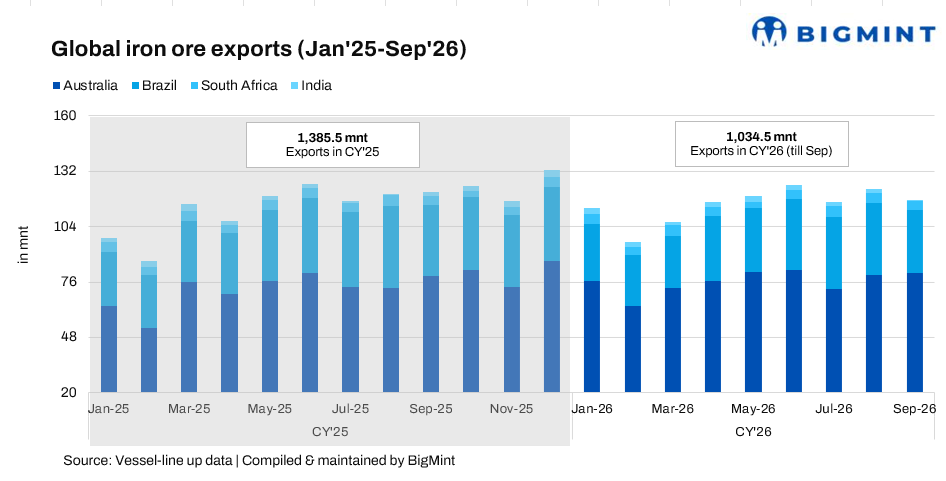
Global iron ore and pellet exports from four major suppliers presented a mixed picture in September 2026, with Australia recording marginal growth m-o-m while Brazil, South Africa and India saw lower shipments. The overall trend highlights diverging supply dynamics across major exporting regions, with reduced shipments from three key suppliers partly offset by Australia’s resilience. Of the four, India’s exports registered the steepest decline, hitting a nearly four-year low amid tighter domestic availability and weak Chinese buying.
Australian shipments remain resilient
Australia’s iron ore and pellet exports edged up 1% m-o-m to 80.4 million tonnes (mnt) in September 2026, compared with 79.6 mnt in August, according to BigMint’s vessel line-up data. Shipments also increased 2% y-o-y from 79 mnt in September 2025, reflecting broadly stable export activity.
China remained the dominant destination, receiving 64.9 mnt, followed by Japan at 5.4 mnt and South Korea at 4.4 mnt. Among exporters, Rio Tinto led with 29.3 mnt, followed by BHP at 24.7 mnt and Fortescue Metals Group (FMG) at 18.7 mnt. Australia’s steady shipment volumes continued to underpin seaborne supply, despite uncertainty over Chinese steel demand and raw material procurement.
The marginal increase was supported by higher shipments through key export ports, with Port Hedland and Dampier recording improved loading volumes.
Brazil exports contract m-o-m, y-o-y
Brazil’s iron ore exports declined 12.4% m-o-m to 31.8 mnt in September, from 36.3 mnt in August. Shipments also dropped around 11% y-o-y from 35.7 mnt in September 2025, marking a broad-based contraction in export volumes.
China accounted for the largest share at 22.51 mnt, followed by Malaysia at 1.11 mnt and India at 1.09 mnt. The decline in Brazilian shipments added to the reduction in seaborne supply from major exporting regions, although the price impact will depend on Chinese buying activity, port inventories and the availability of competing cargoes.
The decline was likely driven by lower shipment volumes from key Brazilian export terminals and fluctuations in vessel loading schedules.
South African shipments decline 5% y-o-y
South Africa’s iron ore exports fell 4.7% m-o-m to 4.71 mnt in September, compared with 4.94 mnt in August. Volumes also declined 5.2% y-o-y from 4.97 mnt a year earlier, indicating sustained weakness in shipment performance.
China remained the leading destination at 2.76 mnt, while the Netherlands and South Korea received 0.18 mnt each. The reduction contributed to the broader decline in exports from key suppliers, while cautious procurement and subdued steelmaking margins in China continued to cloud the demand outlook.
The decline was likely driven by logistical constraints affecting South African export corridors, alongside fluctuations in port operations and vessel loading schedules.
Indian exports plunge to nearly four-year low
India’s iron ore and pellet exports slumped 67.2% m-o-m to 0.70 mnt in September, the lowest monthly level in nearly four years. The last comparable low was recorded in November 2022, when exports stood at around 0.3 mnt following the imposition of export duty.
Fines and lumps accounted for 0.15 mnt, while pellet shipments totalled 0.55 mnt. Malaysia was the largest destination at 0.22 mnt, followed by China at 0.19 mnt. Exports to China plunged 88.3% m-o-m amid weaker buying interest, lower domestic production, and firm domestic prices. On the demand side, subdued Chinese steel mill margins and increased blast furnace maintenance further constrained buying appetite for imported material.
Outlook
Seaborne iron ore supply may remain uneven in the near term, with lower shipments from Brazil, South Africa and India potentially providing some support to prices, while steady Australian exports continue to ensure substantial availability. However, a sustained price recovery will depend largely on improvements in Chinese steel mill profitability, stronger procurement activity, and a pick-up in steel demand. Elevated port inventories and cautious buying could limit the upside, leaving the market sensitive to changes in export flows, steel production and inventory trends in the coming weeks.
Leave a Reply