- Domestic met coke production rises 3%, but merchant output falls 36% in H1FY’27
- Imports climb 46% to 2.8 mnt, with Indonesia accounting for around 68% of shipments
- Export-linked duty benefits and domestic supply constraints sustain import demand
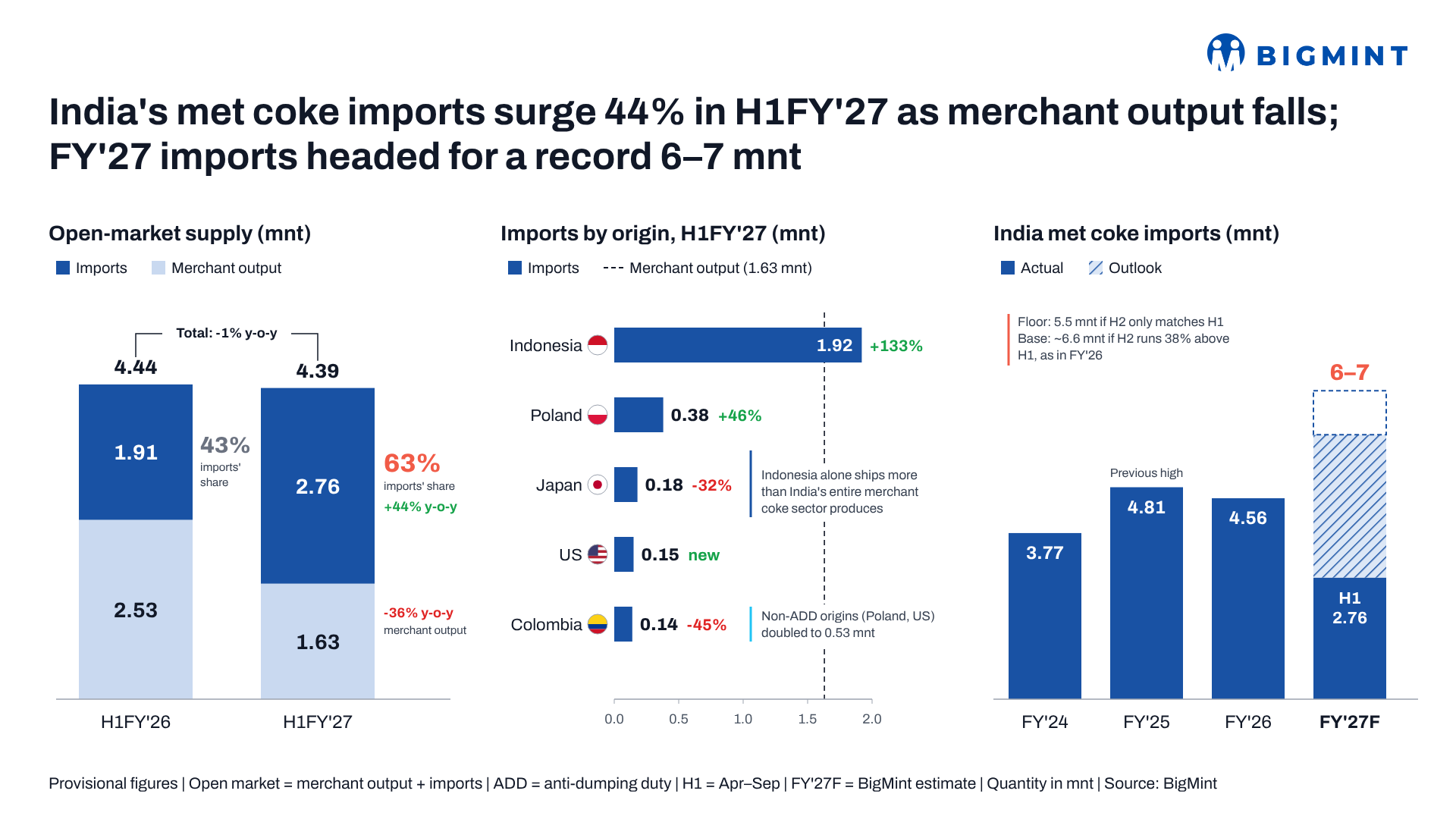
Morning Brief: India’s metallurgical coke (met coke) market is becoming increasingly dependent on imports despite growth in domestic production, as declining merchant output and export-oriented pig iron production reshape sourcing economics. BigMint’s provisional data show domestic production rising 3% y-o-y to 27.6 million tonnes (mnt) in H1FY’27 (April-September 2026), while merchant production fell 36% to 1.6 mnt and imports increased 46% to 2.8 mnt.
The divergence highlights a structural gap between total production and commercially available supply. Integrated steelmakers largely consume captive coke, limiting the volume available to independent buyers. Meanwhile, eligible pig iron exporters can retain an economic incentive to import met coke under the Advance Authorisation Scheme, reinforcing overseas sourcing even when anti-dumping duties raise import costs for other buyers.
Domestic production growth masks sharp contraction in merchant supply
India’s total met coke production increased by approximately 0.8 mnt y-o-y in H1FY’27, based on the reported growth rate. However, merchant output declined by around 0.9 mnt to 1.6 mnt. The contraction in merchant supply is therefore significant relative to the increase in aggregate production.
This distinction is central to understanding the market. Captive coke production supports integrated steelmaking requirements but does not automatically improve availability for independent blast furnaces, pig iron producers and foundries. These consumers must compete for merchant material or source imports when domestic availability, quality or delivered costs do not meet their requirements.
Demand has remained supportive. Indian hot metal production increased 2% y-o-y to 48.3 mnt during H1FY’27, while steel demand rose 7%, according to the figures cited by BigMint. However, stronger demand alone does not explain the rise in imports; the contraction in merchant supply and differences in sourcing economics are equally important.
Rising import dependence reflects widening gap in market availability
India’s met coke imports increased 46% to 2.8 mnt in H1FY’27, equivalent to approximately 61% of the 4.6 mnt imported during FY’26. The increase indicates a greater reliance on overseas material to meet market requirements.
Indonesia emerged as the leading supplier, with shipments rising approximately 133% y-o-y to 1.9 mnt. Its share of India’s met coke imports increased to around 68%, from approximately 42% a year earlier. The gain also indicates that Indonesia captured a substantial portion of incremental import demand while strengthening its position relative to competing origins.
The competitiveness of imported material, however, varies by buyer. India’s anti-dumping duty on qualifying low-ash met coke from specified countries increases the landed cost for affected imports. Yet the duty does not necessarily apply uniformly to every product and end user.
The Directorate General of Trade Remedies’ 29 September 2026 corrigendum clarified actual-user conditions for specified exclusions relating to ferro alloys and pig iron. These are conditional exclusions, not blanket exemptions for the respective industries. Eligible manufacturers must satisfy the prescribed product, end-use and documentation requirements.
Consequently, buyers importing similar material may face different effective costs depending on their eligibility and intended use. The relevant comparison is not simply the overseas price against the domestic price, but the landed cost after applicable duties, scheme benefits, inland freight and grade-specific considerations.
Export-linked duty benefits keep imported coke viable for pig iron producers
Export-oriented pig iron production is an important mechanism supporting imported met coke demand. Under the applicable Advance Authorisation framework, eligible manufacturers may obtain relief from customs duties on qualifying inputs used in exported products, subject to the scheme’s conditions.
Met coke is a key input in pig iron production, with consumption estimated at approximately 450 kg per tonne of pig iron. Where the applicable scheme permits duty relief on qualifying imported coke, the effective input cost can be materially lower than for buyers who must bear the full duty burden.
This can preserve the incentive to import even when the headline anti-dumping duty weakens import parity. However, the benefit is conditional on eligibility and compliance; it should not be assumed to apply to all pig iron producers or imports.
The export channel is gaining importance. India exported approximately 0.9 mnt of pig iron in H1FY’27, exceeding the 0.61 mnt exported during the whole of FY’26, according to the figures cited by BigMint.
If export demand remains firm and eligible producers continue to find imported coke economically attractive, their procurement requirements could sustain met coke imports through H2FY’27. Conversely, a material slowdown in pig iron exports could weaken this incentive for export-oriented producers, although demand from other consumers and domestic supply conditions would continue to influence import volumes.
The key distinction is that export-linked duty relief can support imports by eligible manufacturers, but it does not establish that imported coke is cheaper for the entire domestic market.

Higher coal costs limit the scope for a domestic production recovery
The contraction in merchant production also reflects the economics of converting coking coal into met coke. BigMint’s average met coke price assessment, ex-Jajpur, rose 21% y-o-y to INR 37,000/tonne ($385/t) in H1FY’27 from INR 30,500/t ($317/t) in H1FY’26. Over the same period, BigMint’s coking coal index, CNF Paradip, increased 34% to an average of $266/t.
The faster increase in coking coal prices suggests pressure on conversion economics, although the two assessments have different cost bases and cannot be used directly to calculate merchant producer margins. Coal quality, coke yield, freight, conversion costs, financing and inventory requirements also influence profitability.
For independent producers, higher selling prices do not automatically translate into stronger margins. If coal procurement costs rise faster than realised coke prices, production may remain commercially unattractive despite firm demand.
Domestic quality differences also influence sourcing. Domestic met coke typically contains around 29-40% ash, compared with approximately 12-14% for imported material, according to the figures cited by BigMint. Higher ash can increase slag generation and fuel requirements during ironmaking, although the operational benefit of lower-ash coke depends on furnace conditions and the overall cost of the burden.
These factors mean that domestic production cannot respond to import demand simply through higher market prices. A sustained recovery requires suitable coal availability, adequate working capital and selling prices that cover the full cost of production.
Indonesia’s growing dominance increases India’s exposure to supply disruptions
Indonesia’s rising share of Indian imports reflects the growing competitiveness and availability of its export supplies. Expanding coke capacity, integrated logistics and access to a broader range of coking coal grades have strengthened Indonesia’s position in international markets.
However, the concentration also creates a supply-side vulnerability. With Indonesia accounting for around 68% of Indian met coke imports in H1FY’27, disruptions affecting its production, logistics or export economics could have a disproportionate impact on Indian buyers. Low river water levels that constrained Indonesian exports across several commodities in September highlight the importance of logistics in determining actual export availability. Any sustained disruption could increase delivered costs or force Indian buyers to seek alternative origins.
Pig iron exports and merchant margins will determine import dependence
India’s met coke imports are likely to remain elevated in H2FY’27 if merchant output remains constrained and pig iron export demand continues to support procurement by eligible manufacturers. Indonesia is positioned to retain a leading role because of its growing share of Indian imports and established supply base.
The domestic market’s ability to reduce import dependence will depend on two linked developments: whether merchant coke producers can restore competitive conversion margins, and whether imported material retains its cost advantage for key consuming segments.
If pig iron exports remain strong, eligible producers may continue to import coke under applicable export-linked arrangements. If export economics weaken, some of this incentive could diminish. Meanwhile, improved domestic merchant margins could increase open-market availability, provided producers can secure suitable coal and working capital.
For now, the central issue is not whether India produces enough met coke in aggregate, but whether domestic producers can supply the right grades at competitive prices to buyers outside integrated steelmaking systems. Unless that gap narrows, higher domestic production alone is unlikely to eliminate the need for imports.
Leave a Reply