- South Korea maintains lead among key suppliers
- EU bookings drive higher September exports
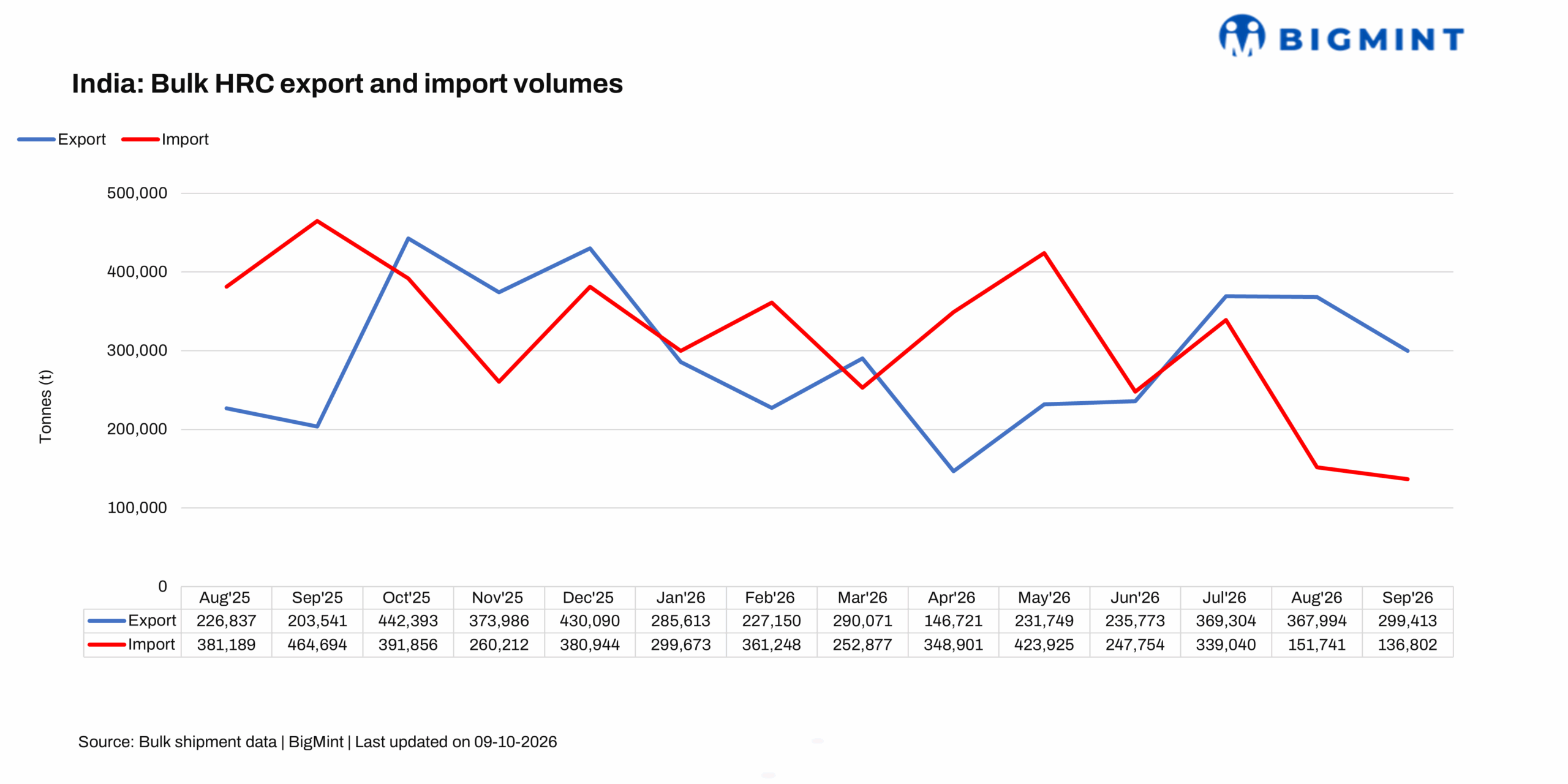
India’s bulk hot-rolled coil (HRC) imports declined by 10% m-o-m to 136,082 tonnes (t) in September from 151,741 t in August 2026, according to BigMint’s vessel line-up data. However, arrivals were 23% lower q-o-q at 423,171 t compared with 552,313 t recorded in Q1FY’27 (April-June 2026). The sequential decline was primarily due to lower shipments from China and Japan, partly offset by continued inflows from South Korea.
Established supply channels support imports
South Korea, China and Japan remained the three largest bulk HRC suppliers to India in Q2FY’27 (July-September 2026), with shipments of 295,669 t, 43,572 t and 83,930 t, respectively.
Imports from South Korea increased by 38% q-o-q, indicating continued inflows under existing supply arrangements. In contrast, shipments from China and Japan both declined by 56% and 61% respectively, during the quarter.
Market participants indicated that a significant share of HRC imported from South Korea is supplied under long-term contracts between Indian companies and their parent entities.
The Advance Authorisation Scheme remained a key channel for export-oriented HRC imports, allowing manufacturer-exporters and merchant-exporters to import inputs duty-free for incorporation into export products, subject to prescribed export obligations. The scheme also allows eligible imports without mandatory BIS certification, helping exporters source specialised steel grades while reducing upfront import-related costs.
Industry sources indicated that imported HRC is primarily linked to downstream manufacturing requirements, particularly in segments such as pipes and tubes, where specialised grades are used for export-oriented production. This limits the extent to which such imports directly compete with domestically traded HRC. India’s finished-steel exports also remained substantial during April-August, with HR coil/strip and pipes accounting for a significant share of exports, supporting the role of downstream export manufacturing in steel consumption.
EU bookings support September exports
India’s bulk HRC exports increased by 17% m-o-m to 299,413 t in September from 255,380 t in August. Meanwhile, exports were 29% higher q-o-q at 889,325 t compared with 635,848 t in Q1FY’27 (April-June 2026), supported by shipments to the European Union amid the new quota cycle and selective bookings earlier in the month.
An EU-based source stated, “The opening of the new quota window has prompted buyers to return to the market and secure volumes. However, the broader market remains cautious as prices continue to move higher, with buyers remaining watchful of further price increases.”
EU export activity was stronger earlier in the month as buyers secured selective volumes following the opening of the Q1 CY’27 quota window. However, rising offers and relatively well-covered inventories increasingly limited fresh buying as the month progressed.
Meanwhile, Indian HRC export offers to the Middle East and Vietnam remained on hold during the month, as mills continued to prioritise domestic sales amid firm domestic realisations and limited availability for fresh export business. With most export allocations already committed, mills had limited incentive to offer additional volumes, keeping trading activity subdued in these markets.
Outlook
HRC imports are likely to remain supported by long-term supply arrangements between Indian companies and their parent entities, particularly from South Korea, while arrivals from China and Japan may remain limited. On the export side, shipments to the EU may remain an important outlet in the coming months, supported by previously secured bookings, although higher Indian mill offers and rising buyer resistance could limit new business as EU buyers remain well covered. Export availability to the Middle East and Vietnam may also remain constrained if mills continue to prioritise domestic sales and firm realisations.
Leave a Reply