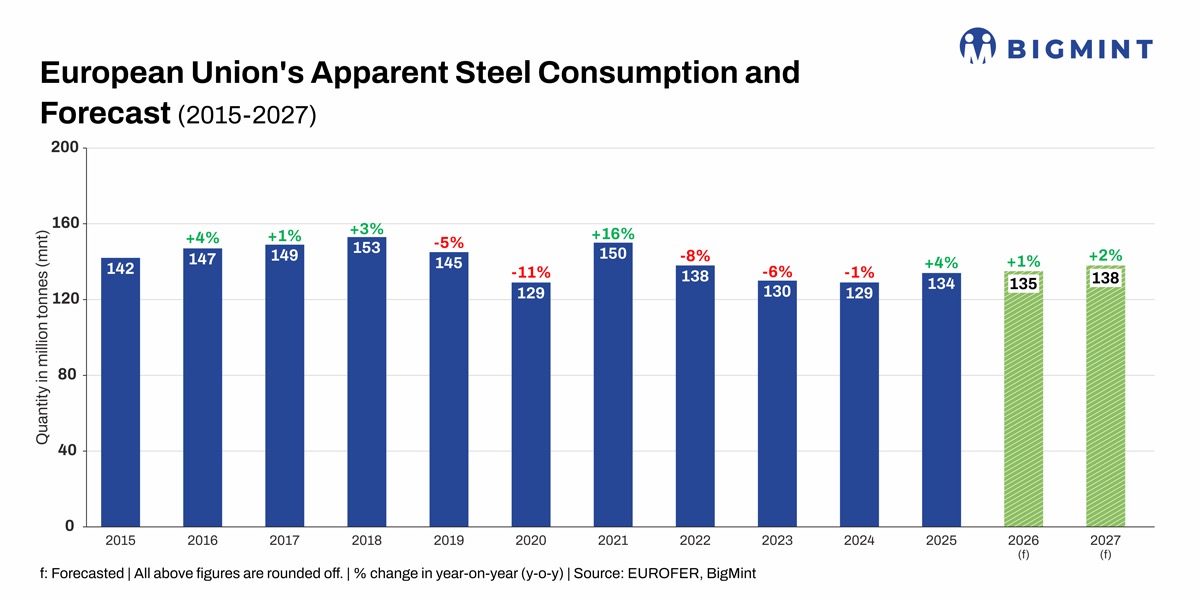
- EU’s apparent steel consumption projected to rise 2.3% to 138 mnt in 2027
- SWIP growth may accelerate to 2.5% in 2027 as construction strengthens
- Defence and energy investments to boost steel demand
Morning Brief: EU apparent steel consumption is forecast to increase 2.3% to 138 mnt in 2027, accelerating sharply from the 0.1% growth expected in 2026. The increase follows two years of contraction and would take consumption above 2025’s 134 mnt, but still leave the market around 7 mnt below the 2019 level of 145 mnt. The more significant change is in the composition of demand. Construction is strengthening, automotive is expected to move from contraction to growth, and defence and energy investment are creating additional steel-intensive activity.
The forecast is also supported by a broader improvement across steel-using sectors. The Steel Weighted Industrial Production (SWIP) index is expected to grow 2.5% in 2027, compared with 1.5% in 2026 and a 0.1% decline in 2025. Construction is forecast to accelerate from 1.8% to 2.9%, while automotive moves from a 0.9% contraction to 3.5% growth. Mechanical engineering remains positive at 1.8%. Other steel-using sectors including metalware, tubes and domestic appliances are also forecast to remain in growth.
Construction moves into a second investment cycle
Construction is likely to remain the largest base for incremental steel demand. It accounts for around 37% of EU apparent steel consumption, and output has already recorded growth for four consecutive quarters. The recovery has been supported by infrastructure spending, EU and national construction programmes and the delayed effects of monetary easing.

The 2027 forecast points to a second phase of this recovery, with housing demand and infrastructure spending expected to strengthen together. Construction output is forecast to rise 2.9% in 2027 after 1.8% growth in 2026. That matters for steel because the recovery extends beyond a cyclical improvement in building activity into civil engineering, infrastructure and replacement-related investment.
Defence spending adds another steel-consuming investment stream
Defence investment provides a separate source of demand as European governments move from higher budgets towards procurement and industrial capacity. The Readiness 2030 framework aims to mobilise more than EUR 800 billion in defence investment, including the EUR 150 billion SAFE instrument for joint procurement of ammunition, missiles, air defence and ground combat systems produced within Europe.
The steel effect will extend beyond military equipment. Defence production requires industrial capacity, while military mobility and related infrastructure require construction and engineering inputs. The shift towards joint procurement and domestic production therefore creates steel demand across manufacturing and infrastructure rather than through defence equipment alone.
Automotive turns from a drag into a contributor
Automotive represents the clearest change in the SWIP forecast. Output fell 9.6% in 2024 and 4.1% in 2025, with another 0.9% decline expected in 2026. EUROFER expects the sector to return to growth in 2027 at 3.5%, although production will remain well below pre-pandemic levels.
There are already signs of improvement on the demand side. EU passenger-car registrations were up 5.7% year-to-date in June 2026, with hybrids accounting for 37% of the market and battery-electric vehicles 20.7%.
The steel implication is larger than the 3.5% growth rate suggests because automotive has been offsetting gains in construction. Once the sector returns to growth, construction no longer has to compensate for a major steel-consuming industry contracting elsewhere.
Energy investment broadens the demand base
The energy transition provides another investment cycle that is less dependent on the traditional manufacturing cycle. Around EUR 660 billion a year is estimated to be required for the EU energy sector between 2026 and 2030, covering generation, energy efficiency and infrastructure.
Grid investment is particularly relevant for steel demand. Around EUR 730 billion for electricity distribution and EUR 477 billion for transmission is estimated to be required through 2040.
As these projects move into execution, steel demand can come through transmission and distribution infrastructure as well as the machinery and equipment required for electrification. This adds a longer-duration investment component to a recovery that is otherwise still emerging from a weak industrial cycle.
Safeguard changes who supplies the recovery
The demand forecast is also arriving alongside a change in the EU steel import regime. The new measure caps duty-free steel imports at 18.3 mnt/year, with a 50% out-of-quota duty, and entered into application on July 1, 2026.
Imports accounted for 30% of EU apparent steel consumption in 2025 and 23% in Q1 2026, after reaching an exceptional 37% in Q4 2025.
The safeguard does not create additional steel demand. It changes the supply mix. If apparent consumption reaches 138 mnt in 2027 while import access is more constrained, EU mills have a greater opportunity to capture the incremental tonnes. That could lift domestic utilisation even though overall consumption remains below pre-pandemic levels.
Outlook
The 2027 forecast is therefore built on a wider recovery than the one visible in 2026. Construction is moving from resilience into stronger growth, automotive is shifting from a persistent drag to a contributor, and defence and energy investment add steel-intensive activity outside the traditional industrial cycle.
That combination explains the difference between 135 mnt of apparent consumption in 2026 and 138 mnt in 2027, while the rise in SWIP from 1.5% to 2.5% indicates that the improvement is also spreading across steel-using industries.
If these investment cycles translate into physical activity as forecast, 2027 should mark the point at which EU steel demand moves from stabilisation to a broader recovery. With import access simultaneously tightening, more of that additional demand could accrue to domestic producers.
Leave a Reply