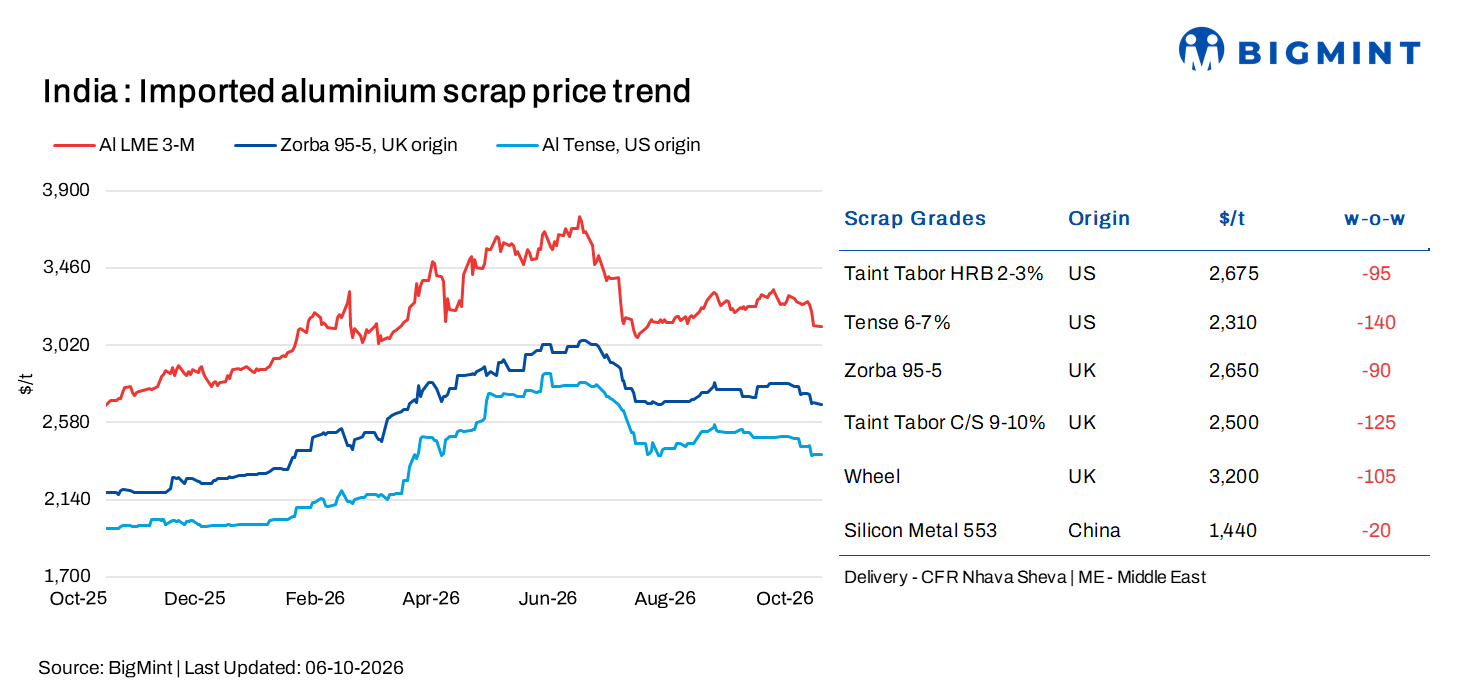
- Suppliers remain uncertain on workable price level; buyers remain cautious
- Expectations of adequate scrap supply in Oct, Nov reduce buying urgency
India’s imported aluminium scrap prices declined w-o-w, tracking lower London Metal Exchange (LME) aluminium prices. Limited buying interest also weighed on market activity.
According to BigMint’s latest assessment for CFR Nhava Sheva deliveries, US-origin Taint Tabor HRB 2-3% scrap prices fell by $95/t w-o-w to $2,675/t, from $2,770/t. Meanwhile, UK-origin Taint Tabor C/S 9-10% scrap prices declined by $125/t to $2,500/t, from $2,625/t.
LME aluminium prices decline w-o-w
Three-month aluminium prices on the LME declined by $134/t, or 4.1% w-o-w, to $3,118/t on 5 October from $3,252/t on 28 September. Prices came under pressure from expectations of improving global supply, easing concerns over Gulf supply disruptions, and a stronger US dollar. Expectations of new Indonesian capacity and faster-than-expected Middle East smelter restarts also weighed on sentiment.
Meanwhile, LME aluminium inventories remained unchanged at 240,375 t on 5 October compared with 28 September. Despite prices falling sharply, stocks remained near multi-decade lows, indicating continued tightness in readily available metal. However, the limited inventory movement was not enough to offset bearish macro sentiment and improving supply expectations.
The market also faced pressure from thin trading activity during China’s Golden Week holiday, while the stronger dollar and elevated US Treasury yields weighed on dollar-denominated metals.
Market scenario
The imported aluminium scrap market remains slow, with no significant trades reported over the past 2-3 days. Buyers are currently reluctant to provide firm price indications, while suppliers are also uncertain about workable levels following the sharp decline in LME aluminium prices.
A US supplier offered Taint Tabor HRB 2-3% at around $2,700/t on Saturday, but no firm buyer response has emerged. Most recent trading activity is taking place outside India, with the domestic market remaining cautious and largely in a wait-and-watch mode.
Scrap availability is expected to remain adequate during October and November, based on import trends observed during July and August, reducing buying urgency. However, the impact of the EU’s pending decision on scrap exports is likely to take some time to materialise. According to market participants, any significant impact may emerge only after the final list is announced on 21 November, potentially affecting availability over the following months.

The domestic aluminium scrap market also declined, pressured by weak local demand. Buyers remained cautious and largely adopted a wait-and-watch approach, resulting in subdued trading activity and limited spot enquiries.
The domestic ADC12 market was also subdued, with buyers showing limited demand and unwilling to provide firm price indications. While festive-season demand could provide some support, market participants believe the large availability of material in the local market may limit any near-term price increase.
The impact of scrap export restrictions and higher ADC12 demand is expected to take another couple of months to become visible, with the market likely to remain slow in the near term.
Outlook
Imported aluminium scrap prices are expected to remain under pressure in the near term amid weak Indian demand, cautious buying and uncertainty over workable price levels. Domestic scrap prices may also remain under pressure due to subdued demand and adequate local availability. However, the impact of the EU’s scrap export decision is likely to emerge gradually
Leave a Reply