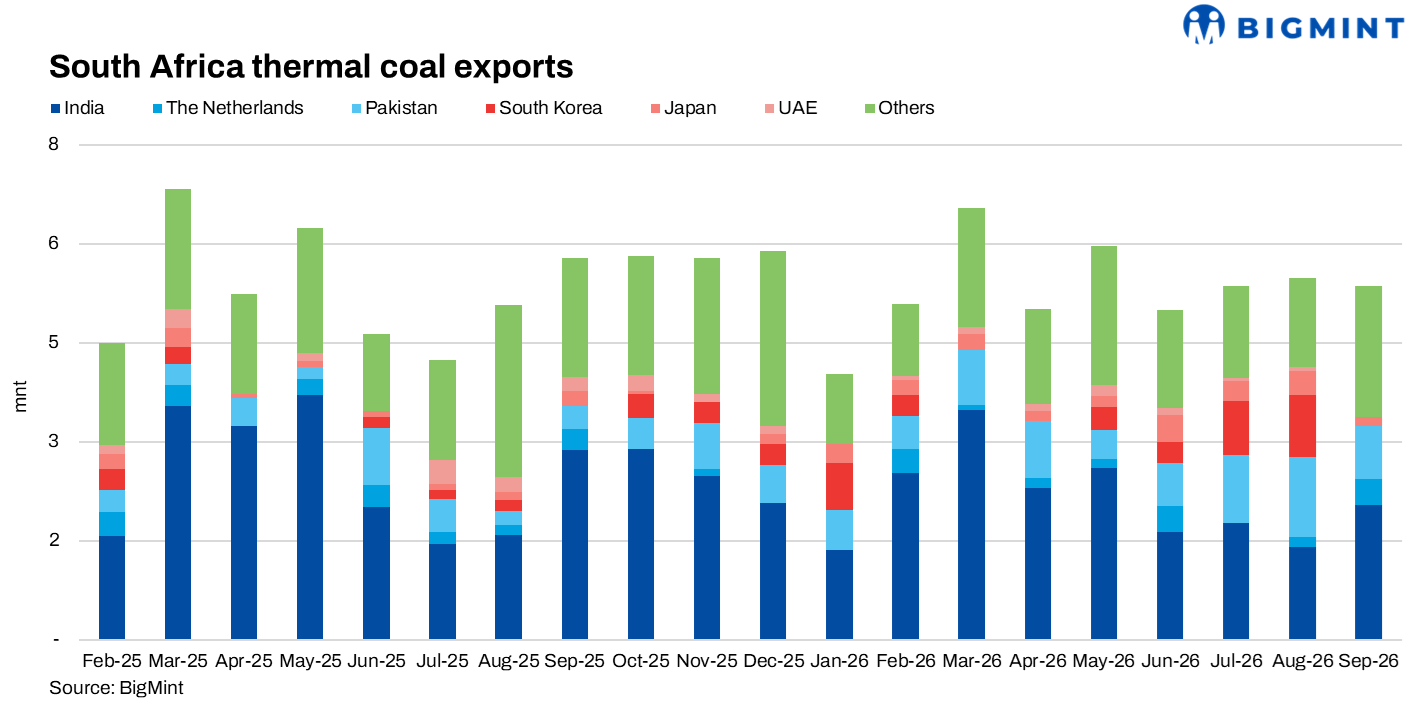
- Q3 exports improve despite September’s y-o-y, m-o-m decline
- Pakistan, South Korea gain share as Indian volumes contract
South Africa’s non-coking coal exports stood at 5.36 million tonnes (mnt) in September 2026, down 7.4% from 5.79 mnt a year earlier and 2.4% below August’s 5.49 mnt. September matched July’s volume, indicating a broadly steady shipment pace during Q3 rather than sustained monthly acceleration.
January-September exports totalled 47.86 mnt, down just 1.2% from 48.42 mnt in the corresponding period of 2025. Beneath this relatively stable aggregate, trade flows changed materially: lower shipments to India were largely offset by stronger exports to Pakistan, South Korea and China.
India remained the largest destination, but its share declined. Pakistan emerged as a substantially larger outlet, reinforcing South Asias importance while changing the balance within the region.
Q3 improves, but Sep trails last year
Exports increased modestly across successive quarters, from 15.67 mnt in Q1 to 15.98 mnt in Q2 and 16.21 mnt in Q3. Q3 was 1.4% above Q2 and 7.2% higher y-o-y.
This quarterly improvement helped narrow the cumulative shortfall. First-half exports were approximately 5% below 2025, whereas the nine-month decline was only 1.2%.
However, September’s 5.36 mnt remained below March’s 6.55 mnt peak and May’s 5.97 mnt. It was close to the nine-month monthly average of 5.32 mnt, suggesting stabilisation around prevailing shipment levels.
The export recovery is therefore clearer in the quarterly comparison than in the latest month. September did not sustain August’s increase, and its y-o-y decline contrasts with stronger July and August performances.
Destination changes: growth markets cushion India’s decline

Volumes in mnt. Selected destinations shown. “-” indicates no recorded shipment. Nine-month 2025 figures are calculated from monthly volumes; 2026 figures use reported totals. Minor differences reflect rounding.
India: Sep rebound does not reverse cumulative weakness
India received 2.05 mnt in September, up 45.4% from August’s 1.41 mnt but down 28.6% from September 2025.
The monthly recovery followed relatively subdued July-August shipments. Nevertheless, Q3 India-bound exports totalled only 5.24 mnt, down 21.7% from Q3CY’25 and 20.2% from Q2CY’26.
Nine-month shipments declined by 4.02 mnt to 19.14 mnt. India’s share of South African exports fell from approximately 47.8% to 40.0%.
India therefore remained the anchor market, but absorbed a smaller proportion of available exports. The shipment data establishes this change without identifying whether it reflects procurement timing, competing origins, inventories or changes in end-user demand.
Pakistan: largest offset to India’s contraction
Pakistan-bound exports more than doubled to 6.92 mnt in January-September, adding 3.53 mnt. This increase alone offset approximately 88% of the reduction in India-bound shipments.
Pakistan’s share rose from 7.0% to 14.5%, making it South Africa’s second-largest destination.
September shipments reached 0.79 mnt, up 125.7% y-o-y, although below August’s 1.21 mnt. Q3 volumes totalled 3.02 mnt, against 1.10 mnt a year earlier, demonstrating that the expansion extended beyond a single cargo-heavy month.
Combined exports to India and Pakistan declined only 1.8% to 26.06 mnt. Their joint share remained near 54.5%, showing that South Asia retained its overall importance even as procurement shifted between its two principal markets.
East Asia strengthens cumulatively; other outlets weaken
South Korea’s nine-month receipts more than doubled to 3.47 mnt, supported by substantial July-August shipments. China increased from 0.39 mnt to 1.38 mnt, while Japan rose 11.3%.
Together, these three destinations added approximately 3.08 mnt compared with 2025. Taiwan moved in the opposite direction, declining 18%.
The gains were unevenly distributed across months: neither South Korea nor China had recorded September shipments. Strong cumulative growth should therefore not be interpreted as uninterrupted current buying.
Outside Asia, Netherlands-bound exports declined over nine months despite September’s increase to 0.40 mnt. Morocco and the UAE recorded particularly sharp contractions. South Africa’s redistribution consequently differs from a broad shift towards European markets; its strongest gains were concentrated in Pakistan and selected Asian destinations.
September also included 0.71 mnt with unidentified destinations, equivalent to 13.2% of exports, limiting the latest month’s geographic assessment.
BigMint assessment
South Africa’s export market has become less dependent on India, while remaining heavily oriented towards Asia. Pakistan’s expansion and stronger East Asian shipments helped preserve overall volumes despite substantial losses in several established destinations.
Q3’s improvement indicates firmer shipment momentum, but September suggests consolidation rather than acceleration. The near-term test is whether India’s monthly rebound continues and whether Pakistan sustains its enlarged buying programme. Continued demand across these markets would support export stability; renewed weakness would expose the importance of maintaining alternative outlets.
Leave a Reply