- DRI gains preference on challenging scrap economics
- October prices to remain firm but sensitive to demand
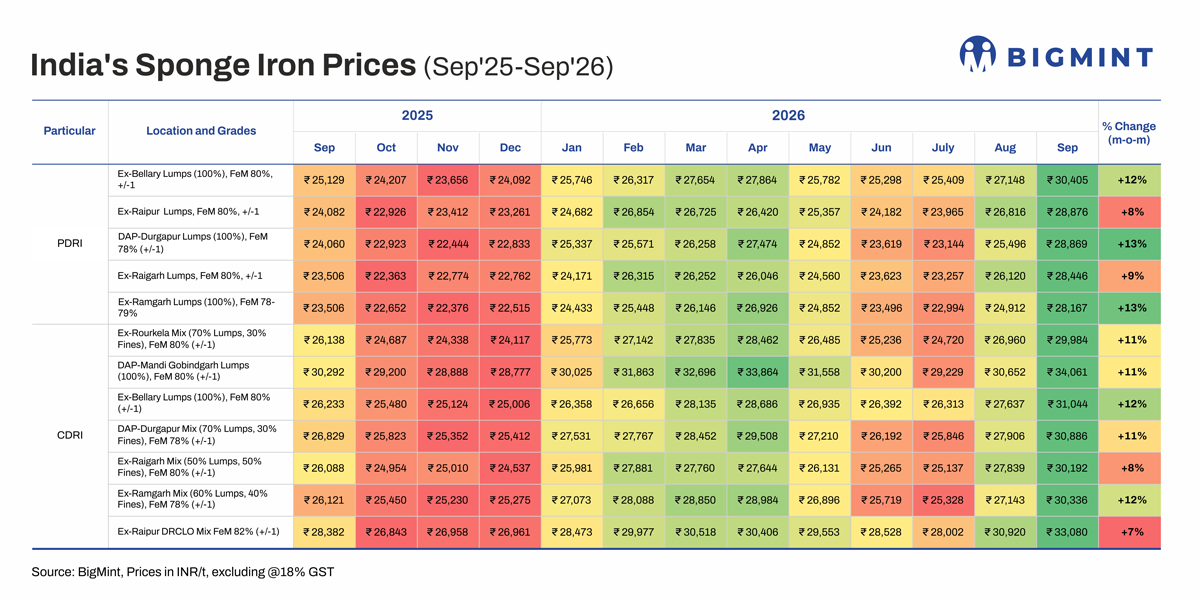
India’s sponge iron market remained volatile and regionally divergent in September 2026, with prices increasingly driven by higher raw material costs rather than strong end-user demand. While cautious buying and weak billet production limited fresh bookings during parts of the month, tighter coal availability, higher non-coking coal prices and rising iron ore and pellet costs pushed up production costs and supported producer offers.
The strongest price movement came towards the end of September, when non-coking coal prices rose sharply following the SECL auction on 26 September. Earlier price corrections in several markets, caused by subdued downstream demand, were reversed as higher coal replacement costs forced producers to raise offers.
Central India: Raipur and Raigarh
In Raipur, the PDRI benchmark averaged around INR 29,150/t in September, down about INR 200/t m-o-m. Ex-Raigarh prices also eased from INR 29,000/t on 1 September to INR 28,800/t on 30 September.
Market activity was initially subdued as weak billet production and finished-steel offtake encouraged mills to procure only on a requirement basis. However, the market strengthened towards month-end as domestic coal prices increased and imported coal replacement costs remained elevated.
Ex-Bilaspur 4,500 GCV coal increased by INR 500/t w-o-w to INR 7,000/t, while 5,000 GCV coal rose by INR 700/t to INR 9,000/t as of 1 October. Recent SECL auctions also recorded premiums above 200% for selected G8 sources. Higher coal costs limited producers’ ability to increase output, while sellers maintained firm offers despite buyer resistance. By month-end, buying again became more selective as consumers resisted higher sponge iron prices.
South India: Bellary-Hospet
Sponge iron prices in the Bellary-Hospet cluster increased by around INR 1,500-1,600/t m-o-m in September. The increase was primarily driven by higher raw material costs, with iron ore and coal prices rising by around 8-9% m-o-m. Higher input costs raised production costs and supported producer offers. The region also saw increased preference for DRI over imported scrap as relative scrap economics became less competitive, supporting sponge iron consumption among southern mills.
Availability remained tighter as higher input costs and improved downstream demand encouraged sellers to maintain firm offers. Buyers, however, continued to monitor price movements closely.
East India: Rourkela and Durgapur
The Eastern Indian sponge iron market strengthened sharply in September, supported by higher raw material costs and improved finished-steel demand. Durgapur PDRI prices increased by INR 3,372/t m-o-m to INR 28,869/t from INR 25,497/t in August, approaching a two-year high.
Rourkela CDRI 70:30 mix sponge iron (FeM 79) prices also increased by INR 3,028/t to INR 29,984/t from INR 26,956/t in August. Ex-Paradeep South African RB2 (5,500 NAR) non-coking coal prices increased by INR 1,420/t m-o-m, while RB2 (4,800 NAR) gained around INR 1,390/t. Domestic coal availability remained tight, with ECL auctions attracting premiums of 100-300%.
Firm imported coal prices and limited domestic availability raised production costs. Raw pellet prices also increased by INR 375/t m-o-m to INR 10,525/t from INR 10,150/t. Improved finished-steel demand and bullish market sentiment supported procurement across the Eastern belt. Buyers booked healthy volumes, although sharp price movements kept some participants cautious. Export enquiries from Nepal and Bangladesh remained moderate.
North India: Mandi Gobindgarh
Sponge iron prices in Mandi Gobindgarh increased by around INR 1,600/t m-o-m in September, with the monthly average at approximately INR 34,100/t DAP Mandi Gobindgarh. As the region has no significant sponge iron production, supplies are largely sourced from eastern India, particularly West Bengal and Odisha. Freight from eastern origins was around INR 3,500-4,200/t.
Rourkela supplies typically comprised around 70% lumps and 30% fines, with FeM around 80%, and averaged approximately INR 30,000/t ex-works Rourkela during September.
What shaped the market?
Coal availability and costs: Coal remained the biggest driver of sponge iron prices. Domestic availability was constrained, while imported coal became more expensive. Monsoon-related disruptions also affected mining and logistics. Thermal coal imports by Indian steel and sponge iron producers reportedly declined 19% in July following an 11% decline in June.
Uneven downstream demand: Finished steel demand remained inconsistent, prompting mills and traders to limit inventory accumulation. This was particularly visible in billet and ingot markets, where procurement remained largely need-based.
Higher raw material costs: Rising coal, pellet, iron ore and coke costs increased replacement costs for DRI producers. This created a divergence between physical demand and price direction, allowing producers to raise offers even when spot buying remained selective.
Seasonal factors: Festive holidays and intermittent market closures reduced trading intensity and fresh enquiries during parts of September. Lower transaction volumes amplified price volatility as relatively small changes in bookings influenced spot offers.
Export market: Higher offers amid selective overseas buying India’s sponge iron export market remained active in September, with Nepal and Bangladesh continuing to be key nearby destinations. Export offers increased alongside higher domestic sponge iron prices, although overseas buying remained selective.
Pellet-based DRI offers to Nepal increased by around $33/t m-o-m to $323/t CPT Raxaul, while CDRI-mix offers rose by around $31/t to $347/t. Bangladesh offers increased by approximately $34/t to $362/t CPT Benapole.
Around 28,000 t of sponge iron export deals were concluded for the two destinations during the month, providing an additional outlet for producers despite cautious overseas demand.
Near-term outlook
Sponge iron prices are likely to remain firm but volatile in October, with coal costs, post-monsoon finished steel demand and billet production emerging as the key variables. A recovery in finished steel demand could allow mills to absorb higher sponge iron costs and support further price increases. However, continued cautious buying could trigger intermittent corrections even as production costs remain elevated.
Coal availability will remain particularly important. Higher auction premiums and elevated imported coal replacement costs are likely to keep pressure on DRI production economics. As a result, October prices could retain cost support, but sustained gains will depend on whether finished-steel demand improves sufficiently to absorb the higher input cost base.
Leave a Reply