- GrafTech raises prices by 30%, Chinese prices increase by 5%
- Indian buyers shift from half-yearly to quarterly contracts
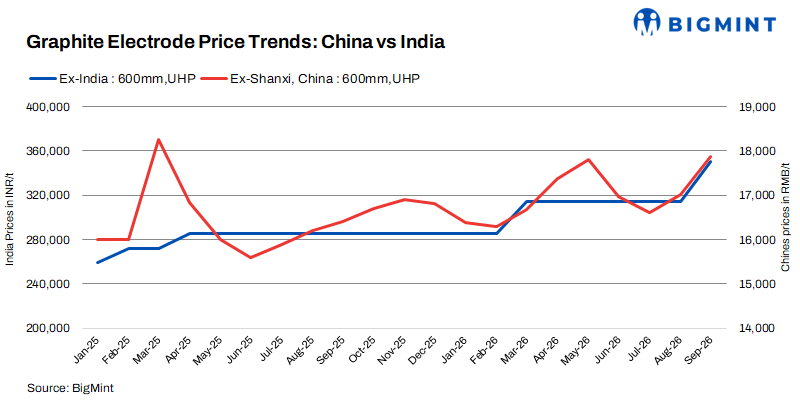
Graphite electrode prices in India increased by nearly 10% m-o-m in September, driven by a combination of supply-side disruptions, higher global prices, and rising raw material costs, according to a BigMint analysis.
Graphite electrodes are critical consumables used in electric arc furnace (EAF)-based steelmaking, where they conduct electricity to melt scrap and other metallic inputs. The industry is highly consolidated, with the top five global manufacturers accounting for nearly 75% of high-end ultra-high-power (UHP) electrode capacity. A significant share of this capacity is located in relatively high-cost regions such as the US, Europe, and Japan.
Supply disruptions tighten availability
One of the key factors supporting prices has been the reduction in global graphite electrode capacity.
GrafTech International Ltd., a leading global manufacturer of graphite electrodes, announced plans to permanently close its manufacturing facility in Monterrey, Mexico, which has approximately 35,000 tonnes per annum (t/year) of graphite electrode capacity. The company said the move is aimed at improving manufacturing utilisation, reducing its cost structure and lowering capital requirements.
GrafTech is also reducing annual graphite electrode capacity at its Pamplona facility by around 16,000 t/year, reflecting a change in its production mix to support the company’s full pin stock requirements.
The capacity reductions are expected to tighten availability in an already concentrated global market, providing support to electrode prices.
Global price increases add to domestic pressure
Global graphite electrode prices have also moved higher.
On 8 September, GrafTech announced that it had informed customers of a minimum 30% increase in graphite electrode prices, effective immediately for all open commercial negotiations.
At the same time, monthly average Chinese graphite electrode prices increased by around 5% in September, further strengthening the international price environment.
The combination of higher global offers and tighter supply has increased replacement costs for Indian buyers and supported domestic price increases.
Rising raw material costs create further pressure
The cost environment for graphite electrode manufacturers has also become increasingly challenging.
Mitsubishi Chemical Group announced in February 2026 that it would completely exit its coke and carbon materials business, with production scheduled to cease in the second half of fiscal 2027. The planned exit includes the closure of production at its Kagawa Plant, which produces needle coke and pitch coke — key raw materials used in the graphite electrode value chain.
Meanwhile, imported petroleum hard coking coal (PHCC) prices increased by around $50/tonne m-o-m in September, adding to the cost pressure faced by manufacturers.
With raw material availability and prices influencing electrode production costs, higher input costs are increasingly being reflected in electrode offers.
Indian buyers shift towards shorter ordering cycles
The recent price volatility is also changing purchasing behaviour among Indian steelmakers.
Market participants indicate that Indian graphite electrode orders are increasingly being converted from half-yearly contracts to quarterly ordering cycles. Buyers are showing greater caution in committing volumes for longer periods amid uncertainty over global electrode prices and raw material costs.
This shift could result in more frequent price negotiations and greater sensitivity to international market movements.
Outlook
The near-term outlook for graphite electrodes in India remains firm to bullish, as supply rationalisation, higher global prices, and raw material cost pressures continue to provide support.
However, the pace of further price increases will depend on steelmaking activity, electrode demand from EAF-based mills, Chinese export availability and the extent to which higher input costs are passed through to end users.
For Indian buyers, the shift towards shorter procurement cycles is likely to remain a key feature of the market as participants seek to manage price risk in an increasingly volatile global graphite electrode market.
Leave a Reply