- Rebar prices rise across markets on tight availability, project demand
- Major mills raise rebar, HRC, coated steel prices for Oct’26 supplies
- Firm coking coal, domestic iron ore prices offer support to steel prices
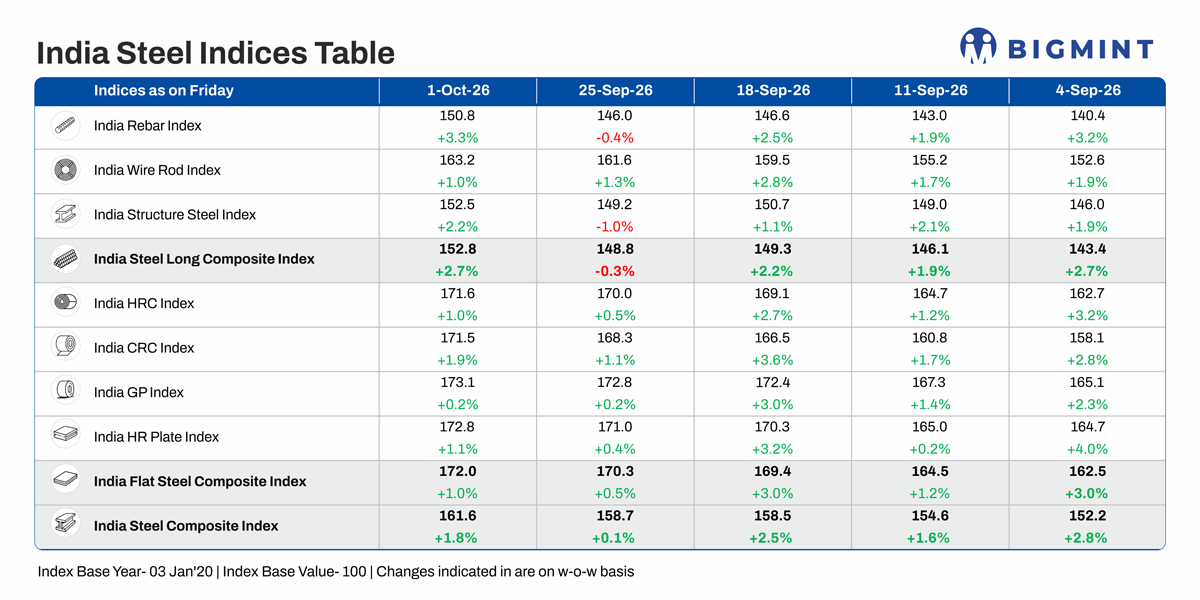
Morning Brief: BigMint’s India steel composite index increased by 1.8% w-o-w as of 1 October 2026, marking a clear acceleration from the 0.1% increase recorded in the previous week. The index now stands at the highest level in four years and four months, with these price levels last witnessed in June 2022.
The stronger weekly increase was supported by gains across long and flat steel. The long steel index increased by 2.7% w-o-w, while the flat steel composite index rose by 1.0%.

The market is being supported by a combination of tighter spot availability, firm mill pricing and improving post-monsoon demand. The latest movement also indicates a shift from the relative stability seen in the previous week.
Highlights of price movements
BF-rebar market uptrend continues on tight availability: BigMint’s assessment for rebar (IS 1786 Fe 550D, 12–32 mm, BF route) increased to INR 63,100/t on 1 October, up by INR 1,000/t w-o-w from INR 62,100/t in the previous assessment on 25 September. Prices are ex-Mumbai for the distributor-to-dealer segment and exclude 18% GST.
The key driver remains tightening availability of material across the supply chain. Rebar inventories have remained lean, limiting prompt availability. A couple of leading primary producers have reported a sharp deceleration in production due to internal issues related to disruption in operations and ramp up of new facilities. With around 55% of blast furnace-based rebar production supplied directly to project customers, disruptions at major mills can have a significant impact on open market availability.
At the same time, project enquiries have improved as monsoon-related disruptions ease and construction activity gradually recovers. Buyers have increasingly been looking to secure material for near-term requirements amid expectations of further price increases. Distributor demand is also beginning to recover as the monsoon season ends.
A leading steelmaker raised rebar list prices by INR 1,500/t for early-October deliveries. The combination of low inventories, improving project activity and firm mill offers has allowed rebar prices to rise faster than underlying buying activity might otherwise suggest.
Cost pressure pushes IF-rebar prices higher: IF-route rebar prices increased by INR 400-2,800/t w-o-w across major markets. Higher iron ore and coal prices have increased input costs for induction furnace producers and supported higher finished steel offers. Several mid-sized sponge iron producers equipped with waste heat recovery systems have been selling surplus electricity on power exchanges amid attractive power market realisations. This has constrained availability, providing price support.

However, buyers remain cautious due to high prices and are largely restricting procurement to immediate requirements. This suggests that part of the recent increase in IF-route prices is being driven by cost pressure.
HRC, CRC prices gain as mill hikes filter through market: Flat steel prices also strengthened last week, although at a slower pace than long products. BigMint’s bi-weekly benchmark assessment for HRC (2.5-8 mm/CTL, IS 2062, Grade E250 BR) increased by INR 400/t w-o-w to around INR 64,100/t ex-Mumbai on 1 October. CRC (0.90 mm/CTL, IS 513, CR1) was assessed at INR 74,100/t ex-Mumbai, up by INR 300/t w-o-w.
Flats prices were supported by the recent hikes announced by major domestic steel mills as well as a gradual improvement in buying activity. In western India, demand picked up despite higher prices, with buyers continuing to procure material partly on expectations of further price increases. In south India, enquiries increased, although some requirements remain uncovered because availability remains relatively tight for certain specifications. A shortage of thinner-gauge material has been reported in both north and south India.
Domestic HRC availability is tight amid maintenance shutdowns at a major eastern Indian mill and lower material arrivals reported by traders and distributors. At the same time higher CRC output points to higher conversion rates and shrinking trade market supply.
With stocks remaining lean, even moderate improvements in buying activity can translate into relatively strong spot price movements.
HRC export offers to EU reach nearly 3-year high: Indian HRC export offers to the EU rose by around $10/t w-o-w to $670/t FOB, compared with $660/t a week earlier, reaching a nearly three-year high. However, offers to the Middle East and Vietnam remained on hold, with mills having limited availability for fresh export bookings and continuing to prioritise domestic sales. Notably, higher export allocations over the last few months have reduced incremental volumes available to domestic buyers, adding to existing supply tightness and supporting domestic prices.

Firm raw material prices: Although prices have stabilised of late, imported coking coal remains firm pushing up production costs and supporting higher finished steel prices. Coking coal prices, on CNF India basis, are higher by nearly 45% y-o-y, as per BigMint data. Domestic non-coking coal prices are edging higher on lower CIL auction volumes and dispatch-related problems during monsoon.
Fe 62% iron ore fines in Odisha are higher by around INR 450/t m-o-m, while producers increased prices last week. Constrained sponge iron availability saw pellet offers in central India increasing by INR 600/t w-o-w. All these factors are supporting prices.
Outlook
Major mills have raised HRC, coated steel and long steel product prices for October. TMT prices have been raised by INR 1,500/t, while wire rod prices have been increased by INR 2,000/t. One leading steelmaker has raised HRC, CRC prices by INR 800/t and coated steel prices by INR 2,000/t.
In the secondary sector, sponge iron availability is likely to tighten as mills ramp up power sales on exchanges amid soaring pre-festive season prices and coal shortage at the majority of utilities. Therefore, finished steel prices are likely to edge up.
However, buyer resistance is emerging at current price levels, while domestic prices have increased faster than several international markets. The completion of maintenance shutdowns, improved power availability and normalisation of production at major mills may gradually ease supply pressure. Further price movement will depend increasingly on whether domestic demand can absorb current prices as availability improves.
Leave a Reply