- LME lead falls nearly 4% w-o-w despite inventory draw
- Chinese buying slows after pre-holiday stocking
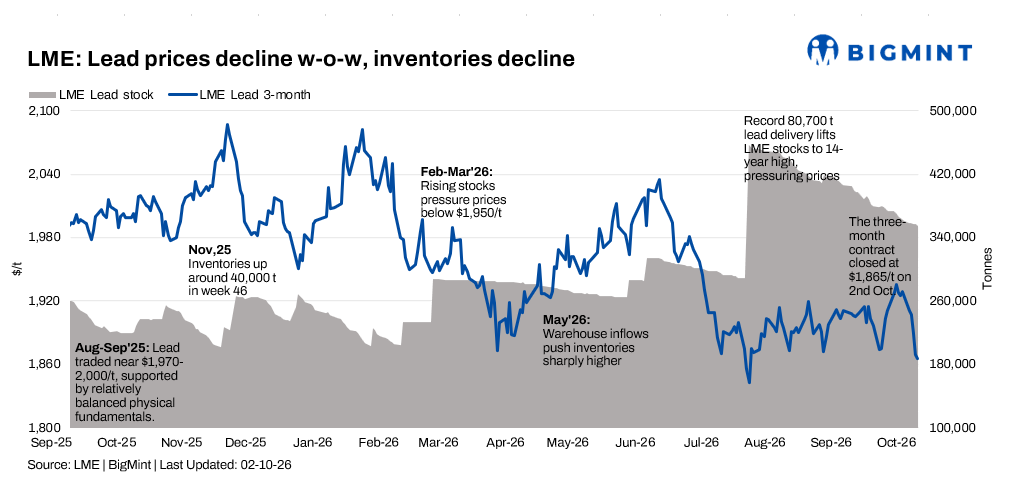
LME lead prices declined during the week ended 2 October as Chinese pre-holiday buying faded and market participants adopted a cautious stance ahead of the extended National Day holiday. The decline came despite another draw in LME warehouse stocks, with weaker downstream demand and continued contango in the LME structure limiting the impact of lower inventories.
LME cash lead settlement fell to $1,827/t on 2 October from $1,902.5/t on 25 September, down 4% w-o-w. Three-month lead declined 3.3% to $1,865/t from $1,929/t over the same period.
LME lead stocks declined by 8,350 t w-o-w to 354,175 t, following an 11,100-t draw in the previous week. Exchange inventories have therefore fallen by nearly 20,000 t over two weeks.
However, the inventory reduction has not translated into a tighter nearby market structure. Cash lead remained around $38/t below the three-month contract on 2 October, indicating continued contango.
The combination of elevated absolute inventories and weaker physical buying has limited the price impact of warehouse outflows.
Chinese buying slows after stocking
Chinese downstream buyers increased lead purchases ahead of the National Day holiday, supporting prices during the previous week. However, this stocking cycle was largely completed by the end of September.
Spot trading subsequently became more cautious, with buying shifting from premium transactions towards discounts. The closure of the Shanghai Futures Exchange during the holiday also reduced liquidity and immediate price discovery, with trading scheduled to resume on 8 October.
Battery demand loses momentum
Lead-acid battery producers reduced operating rates during the holiday-affected week after completing pre-holiday procurement.
Earlier in September, battery manufacturers had increased production as automotive and e-bike battery demand improved and dealer orders strengthened. However, the latest slowdown suggests that the improvement in operating rates has yet to translate into sustained spot lead demand.
Procurement is therefore increasingly focused on immediate requirements rather than inventory accumulation.
Secondary supply may improve
Secondary lead supply is expected to increase in October as some facilities resume operations following maintenance. This could improve refined lead availability in China after the holiday and add pressure to the physical market if downstream procurement remains cautious.
Secondary refined lead production was 165,500 t in August, down 2.33% m-o-m, indicating earlier supply pressure. Expected production recoveries in September and October could partly offset that constraint.
Concentrate market remains tight
Upstream raw-material availability continues to provide support to the lead market. Lead concentrate treatment charges were assessed at around -$185/dmt on 30 September, with a range of -$200 to -$170/dmt.
Negative treatment charges indicate tight concentrate availability and difficult processing economics for smelters. This contrasts with the prospect of improving secondary refined-lead supply and weaker downstream demand.
MCX lead tracks global weakness
India’s MCX lead market also weakened towards the end of September, reflecting the decline in international lead prices.
The September MCX lead contract settled at around INR 196.40/kg, while the October contract was around INR 196.05/kg on 30 September. The relatively close pricing between the two contracts indicated limited carry differential as the market approached the expiry of the September contract.
Domestic lead prices will continue to depend on LME movements, the rupee, local availability and battery-scrap costs. The sharp decline in LME lead therefore provides a weaker international price reference for Indian consumers, although currency and domestic supply conditions could moderate the impact.
Outlook
LME lead prices are likely to remain sensitive to Chinese demand after the National Day holiday, particularly as the market assesses the pace of battery-sector procurement and the return of secondary lead production.
The 8 October reopening of Chinese futures trading is likely to provide a clearer indication of post-holiday demand sentiment. Continued LME inventory draws and tight concentrate availability may limit downside, while elevated exchange stocks, contango and improving secondary supply could restrict recovery if physical buying remains subdued.
Leave a Reply