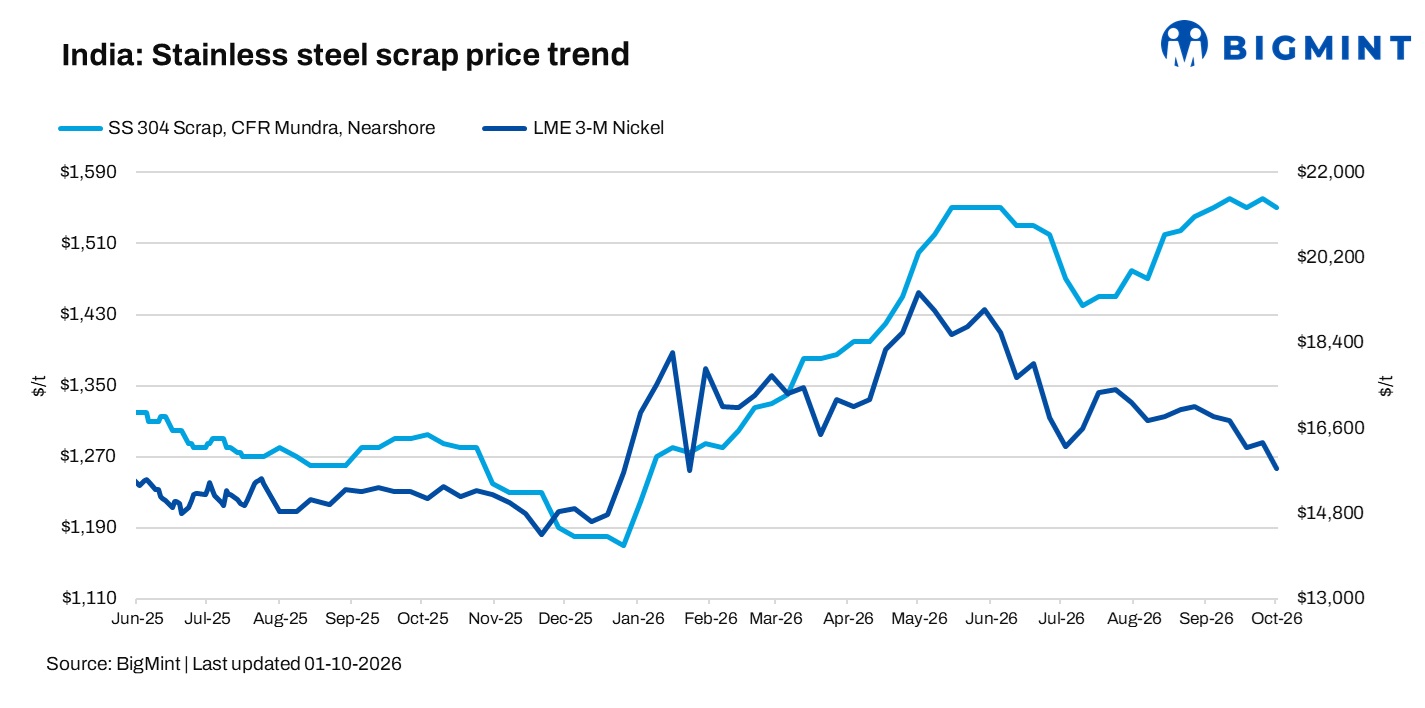
- 304 scrap prices fall INR 1,000/t w-o-w
- Tight 316 availability supports domestic prices
India’s stainless steel scrap market saw divergent price movements during the week ended 1 October 2026, with 304-grade prices correcting while 316 prices remained firm. Softer LME nickel prices and cautious buying weighed on 304, while tight 316 availability limited downside. Mills also explored billets, slabs and nickel pig iron (NPI) to manage raw-material costs amid continued PSIC-related uncertainty.
Prices
Domestic 304 scrap prices declined by INR 1,000/t w-o-w to INR 147,500/t DAP Delhi. Mumbai prices also fell by INR 1,000/t to INR 152,000/t DAP, with trading activity subdued during the festive period.
Domestic 316 scrap prices remained unchanged at INR 305,000/t DAP Mumbai and INR 295,000/t DAP Delhi, supported by tight availability.
Imported 304 scrap prices declined by $10/t w-o-w to $1,550/t CFR Mundra. Market indications were heard at $1,540-1,570/t.
Imported 316 scrap prices remained unchanged at $3,150/t CFR Mundra. Offers were heard at $3,100-3,200/t, while some deals were reported at around $3,050-3150/t.
Nickel and procurement
LME nickel was hovering around $15,755/t at the time of assessment, putting pressure on stainless steel scrap sentiment. Buyers remained cautious, focusing mainly on immediate requirements amid weaker nickel prices,and continued uncertainty around PSIC requirements.
Limited processing time following the government’s relaxation of PSIC requirements, along with additional import-related costs, continued to constrain procurement flexibility.
Some mills were increasingly evaluating billets, slabs and NPI as alternative raw materials. The shift reflects efforts to manage input costs while maintaining flexibility amid tight scrap availability and uncertainty around imported material.
A trader said a recovery in nickel prices could provide support to scrap values in the following week, while further weakness could lead to another minor correction.
Global sourcing concerns
The European Commission has proposed excluding India from countries eligible to receive EU metal waste under the new Waste Shipment Regulation (WSR), citing concerns over persistent and toxic heavy metals.
If implemented, the proposal could restrict India’s access to European scrap and reduce sourcing options for stainless steel recyclers. The Material Recycling Association of India has urged government intervention and proposed a separate HS code for processed secondary raw materials meeting end-of-waste criteria.
The WSR is scheduled to take effect in May 2027, with the first list of approved destination countries expected by year-end. As the proposal is not yet final, its impact on India’s scrap availability will depend on the final framework and the outcome of India-EU discussions.
Outlook
In the week ahead, 304 scrap prices could remain under pressure if LME nickel stays weak and buyers continue to restrict procurement to immediate requirements. A recovery in nickel would provide some support to 304 values.
The 316 market is likely to remain better supported while availability remains tight. PSIC developments, the relative economics of billets, slabs and NPI, and import costs will remain important for mill procurement decisions.
Developments around the EU’s WSR will be relevant to India’s scrap sourcing from 2027, particularly if European material becomes subject to additional destination restrictions.
Leave a Reply