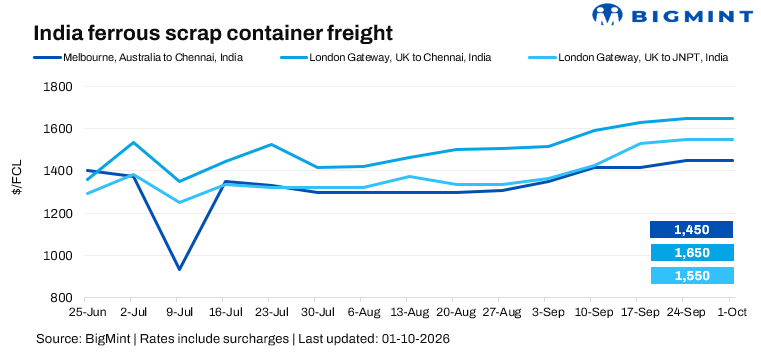
- Tight container availability, volatile bunker costs keep freight rates firm
- Weak Indian scrap demand, high import parity limit fresh bookings
India-bound ferrous scrap container freight rates remained stable w-o-w, supported by tight container and vessel space, elevated carrier costs and volatile bunker prices. However, firm freight levels continued to be driven by supply-side factors rather than stronger scrap demand.
India’s imported scrap market remained subdued, with buyers cautious amid weak downstream demand, adequate domestic availability, a weaker rupee and elevated landed costs. London Gateway congestion and equipment constraints at Indian ports were also limiting booking availability and supporting freight levels.
A market participant stated, “Higher freight is pressuring import parity, keeping buyers cautious, while Australia remains viable when domestic prices rise.”
A shipbroker informed, “Freight rates are being supported by tight container and vessel availability, along with elevated carrier and bunker costs, despite subdued scrap demand from India.”
“Freight rates are likely to remain around current levels in the near term, with limited scope for a decline. Rates could move higher in November if geopolitical tensions and war-related disruptions intensify. No significant vessel bookings have been heard recently”, another shipbroker told BigMint.
Meanwhile, freight rates remain at the higher end due to ongoing geopolitical disruptions and war-related uncertainty. At the same time, weak Indian scrap demand and limited port-side space are adding to the challenges for importers, sources mentioned.

Global freight indicators soften as pre-holiday activity slows
- SCFI eases as pre-Golden Week bookings slow: The Shanghai Containerized Freight Index (SCFI) declined by 24.32 points w-o-w to 3,662.3/twenty-foot equivalent unit (TEU) on 30 September, mainly reflecting softer freight rates on key export routes, as pre-Golden Week demand weakened and carriers faced easing booking momentum. Chinese exporters and shippers reduced fresh bookings ahead of the October 1-7 holiday, while relatively adequate vessel and container availability limited carriers’ pricing power. Cautious cargo demand and fading urgency for pre-holiday shipments also weighed on rates, resulting in the marginal weekly decline.
- Singapore bunker prices fall on weaker crude and demand: Singapore bunker prices declined by $42/tonne (t) w-o-w to $845/t on 30 September, mainly due to lower global crude oil prices and softer regional bunker demand. The decline was also supported by improved availability of prompt fuel supplies in Singapore, while relatively subdued shipping activity ahead of the Chinese Golden Week holiday reduced near-term buying interest. Lower crude and refined-product prices eased replacement costs for bunker suppliers, putting further downward pressure on spot bunker prices.
Outlook
India-bound scrap container freight rates are likely to remain firm in the near term, supported by tight container availability, elevated bunker costs and ongoing geopolitical disruptions. However, weak Indian scrap demand and high import parity are expected to keep bookings selective.
Freight could see further upward pressure if geopolitical tensions intensify or capacity constraints persist, while any rise in domestic scrap prices could improve import viability, particularly from Australia and other nearby origins.
Leave a Reply