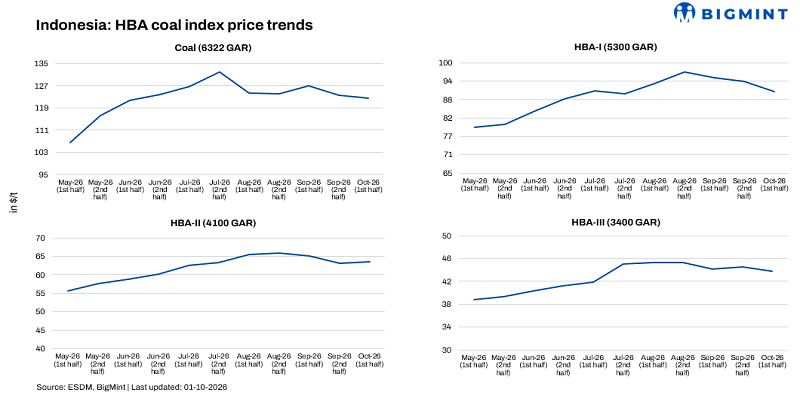
- 5,300 GAR drops by nearly 4%; only 4,100 GAR prices raised
- Prices may soften mildly, supply controls to cap downside
Indonesia’s Harga Batubara Acuan (HBA) thermal coal benchmark prices softened across most grades in the first half of October 2026, indicating a moderation in seaborne market fundamentals following the firmer price trend seen earlier in the year.
The movement reflects a combination of weaker import demand, improved supply expectations, and cautious buying from key Asian consumers. International thermal coal prices have also retreated from recent highs as expectations of improved supply, particularly from China, have weighed on market sentiment.
High-CV coal sees limited correction amid balanced demand
Indonesia’s 6,322 kcal/kg GAR HBA declined 0.8% to $122.52/t in H1 October from $123.54/t in H2 September. The relatively modest correction indicates that high-CV coal continues to receive comparatively stable support from utilities seeking higher-quality fuel, although buying interest has become more selective.
Mid-CV segment bears brunt of demand pressure
The 5,300 kcal/kg GAR HBA-I registered the sharpest decline, falling 3.6% to $90.6/t from $93.94/t in H2 September. The steeper correction reflects greater price sensitivity in the mid-CV segment, where competition with domestic coal and alternative imported origins remains significant.
China’s continued preference for domestic coal, alongside subdued seaborne import demand, has constrained demand for Indonesian thermal coal. China’s thermal coal imports were down slightly during January-August 2026, while higher domestic production has continued to weigh on import requirements.
Lower-CV grades show mixed but generally softer fundamentals
The 4,100 kcal/kg GAR HBA-II was relatively resilient, increasing marginally by 0.4% to $63.45/t from $63.17/t, while the 3,400 kcal/kg GAR HBA-III declined 1.5% to $43.84/t from $44.53/t. The mixed movement suggests that lower-CV prices are being influenced by competing factors: relatively constrained Indonesian export availability and domestic consumption provide some support, while weak buying interest from major importers limits upside potential.
Outlook
Indonesia’s thermal coal prices are likely to remain range-bound to mildly softer in the near term, with the mid-CV segment likely to remain more vulnerable to demand-side pressure. However, a sharp price correction may be limited by Indonesia’s efforts to manage production and exports, rising domestic coal consumption and the possibility of seasonal restocking by Asian utilities.
The market will therefore remain highly sensitive to Chinese import demand, Indian procurement, Indonesian production/export policies and regional power-sector demand. The broader seaborne market is expected to remain relatively balanced, with supply constraints providing some support even as structural demand pressures persist.
Leave a Reply