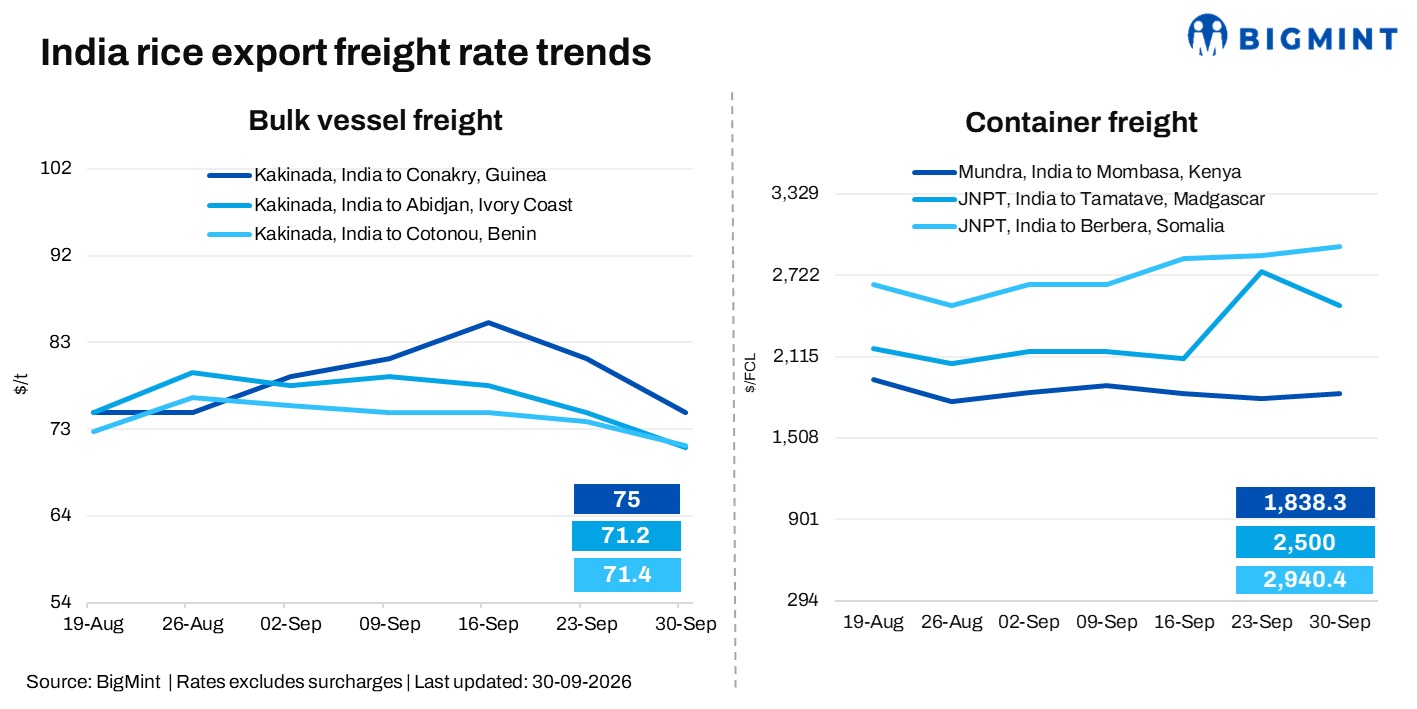
- Bulk fixing remains subdued amid cautious buying
- Containers gain favour as shipment flexibility takes priority
India’s rice freight market showed divergent trends in the week ended 30 September 2026, with bulk freight facing softer fixing interest while containerised cargoes remained relatively active. Operational disruptions at West African ports and shifting shipment preferences are increasingly influencing cargo flows.
A shipbroker told BigMint, “The Indian market remains firm, while demand across destinations is mixed. Vietnam is very weak and Thailand is currently out of season, but enquiry remains strong for Indian containerised cargo and shipments towards Mombasa, Tamatave and Maputo.”
Route wise updates

West African bulk trade turns cautious
Bulk fixing to West Africa remained selective as buyers assessed fresh requirements against prevailing destination prices. Port-related disruptions are adding another layer of uncertainty to vessel planning, particularly around Cotonou.
A shipbroker said, “There is a clear difference between the firm market at origin and softer conditions at destination. Buyers are cautious on fresh business, particularly where older, lower-priced cargo is still available.”
Cotonou has emerged as a key operational concern, with four vessels reportedly diverted amid congestion and price disparity.
A rice trader said, “We are looking at an October-end shipment to Cotonou, but the current situation warrants caution. Port delays and the price gap are making the economics of fresh arrivals more difficult.”
Containerisation gains ground
The changing logistics landscape is encouraging some traders to favour containers over conventional bulk and breakbulk shipments, particularly for smaller West African parcels.
A charterer mentioned, “We are seeing a growing shift from bulk and breakbulk towards containers for some West African cargoes. Congestion and operational issues at major ports are making flexibility increasingly important.”
Container availability remains a concern at major Indian export gateways, while higher logistics costs are squeezing freight margins. A trader said, “Despite these constraints, demand for containerised cargo towards East Africa and Madagascar remains healthy.”
Rice prices soften
BigMint’s assessment for non-basmati parboiled rice (IR-64 5% PB), FOB Kakinada, stood at $376/tonne (t) on 30 September 2026, a w-o-w drop of $4/t compared with $380/t in the previous week.
“The market is seeing gradual corrections, with buyers becoming more selective on price. The disparity between firm origin values and weaker destination markets is making new business more challenging,” a shipbroker said.
Outlook
The freight market is likely to remain route-specific, with bulk fixing dependent on fresh West African requirements and port conditions, while containerised cargoes could retain momentum as traders prioritise flexibility.
With freight costs, port reliability and shipment size increasingly influencing cargo decisions, the balance between bulk and container movement is likely to remain a key feature of the Indian rice export freight market in the near term.
Leave a Reply