- Long products weaken amid subdued buying
- Festive restocking may improve October demand
India’s stainless steel finished market recorded a mixed trend during the week ended 29 September, with flat products showing moderate buying while long products remained subdued. Tight availability of 316 material and higher molybdenum costs supported 316 prices despite softer nickel prices.
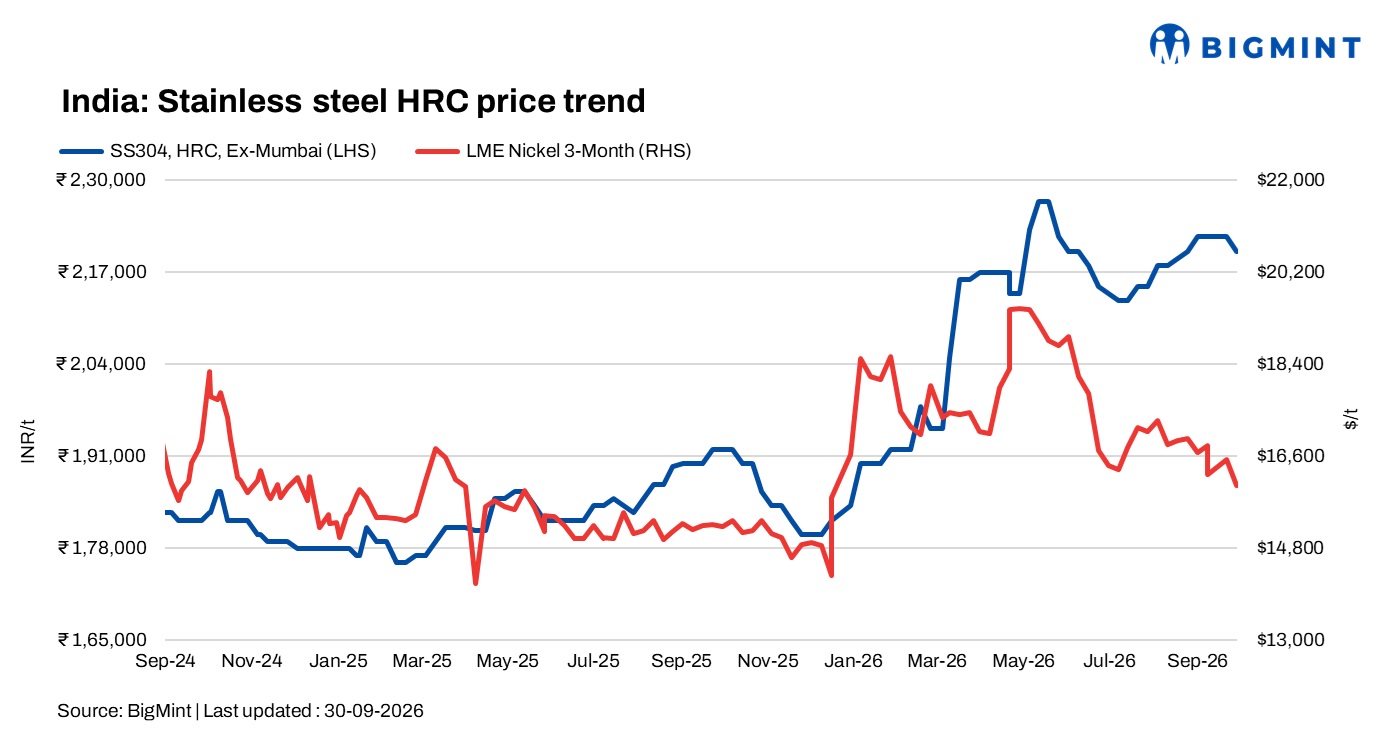
LME nickel cash settlement fell to $15,860/t on 29 September from $16,430/t on 23 September, while three-month nickel declined to $16,085/t from $16,600/t. LME nickel stocks increased to 284,898 t from 278,598 t during the same period.
In contrast, molybdenum prices increased to INR 4,400,000/t on 30 September from INR 4,336,000/t on 23 September, adding cost pressure to 316-grade stainless steel.
Market participants expect buying activity to gradually improve in October as downstream consumers begin replenishing inventories ahead of Diwali. However, uncertainty over raw-material and freight costs is likely to keep buyers focused on immediate requirements.
India has also extended by six months the statutory deadline for completing its anti-dumping investigation into imports of stainless steel cold-rolled flat products of 300 and 400 series from China, Indonesia and Vietnam. The revised deadline is 28 March 2027, compared with 28 September 2026 previously.
Finished flat
Demand for stainless steel flat products remained moderate during the week, with buyers largely restricting purchases to immediate requirements. Sellers continued to hold offers firm, supported by elevated scrap costs and tight 316 availability.
304 HR coil prices were assessed at INR 220,000/t exw-Mumbai a decline of INR 2,000/t.
Meanwhile, 316 HR coil prices increased by INR 10,000/t to INR 450,000/t. The increase came despite softer nickel prices, indicating that tight 316 availability and higher molybdenum costs were providing stronger support to the grade.
Vietnam-origin 304 CR was heard at INR 217,000-218,000/t on a landed-cost basis, while Indonesia-origin 304 HR coils were heard at $1,950-2,000/t.
Finished long
India’s domestic stainless steel long-products market weakened during the week despite tight scrap availability and firm alloy costs.
304 black bar prices declined by INR 5,000/t to INR 200,000/t exw-Mumbai, while 316 black bar prices decreased by INR 3,000/t to INR 367,000/t.
Export prices also softened in the week ended 29 September as overseas buying interest remained limited. Higher freight rates and tight scrap availability continued to weigh on export activity.
304 bright bars were assessed at $2,350/t FOB Nhava Sheva, down $30/t w-o-w, while 316 bright bars declined by $30/t to $4,300/t FOB Nhava Sheva.
China market
China’s stainless steel inventories in Wuxi and Foshan increased during the week, ending the recent destocking trend as weak end-user demand and higher arrivals weighed on the market.
Pre-holiday restocking remained limited, while firm futures and broadly stable spot prices failed to generate stronger transactions. With the National Day holiday approaching, inventory accumulation could continue to weigh on market sentiment.
304 CRC was reported at around RMB 14,950/t ($2,229/t) ex-Foshan.
Global developments
Japan’s Nippon Steel reduced its September-November contract prices for nickel-based stainless steel products, including SUS304 wire rod, amid changes in nickel and other alloy costs.
The company reduced its SUS304 wire rod contract price by JPY 25,000/t ($169/t) and SUS430 by JPY 5,000/t ($34/t) from the previous quarter.
European stainless steel producers have also reduced October alloy surcharges for several grades, with changes reflecting movements in nickel and molybdenum costs.
Raw material scenario

Outlook
India’s stainless steel finished market is likely to remain mixed through October. Festive inventory replenishment ahead of Diwali could improve buying activity, but buyers are likely to remain cautious while monitoring raw-material and freight costs.
For 316 products, tight availability and higher molybdenum costs could continue to provide price support despite the recent decline in nickel. In contrast, weaker overseas demand, rising inventories in China and subdued long-product buying could limit broader price gains.
Domestic festive procurement, 316 availability, scrap prices, nickel and molybdenum movements, freight costs and export demand will remain key indicators for the market in October.
Leave a Reply