- Higher non-basmati prices, tighter paddy availability eroding export competitiveness
- Exports remain below last year despite recovery in shipments during Feb-June
- Freight, long transit times, West African trade restrictions influencing delivered-cost economics
Morning Brief: India’s rice export market is entering a more challenging phase as firmer non-basmati prices coincide with tighter paddy availability and elevated logistics costs. Exports during October-July of MY 2025/26 fell to 18.8 mnt from 19.5 mnt a year earlier, despite a stronger shipment run between February and June.
The recent weakening suggests that India’s export competitiveness is increasingly being determined not only by the FOB price of rice, but by the total delivered cost, including freight, transit time, vessel availability and destination-market restrictions. This is particularly relevant in West Africa, a key market for Indian non-basmati rice.
Higher prices weigh on export momentum
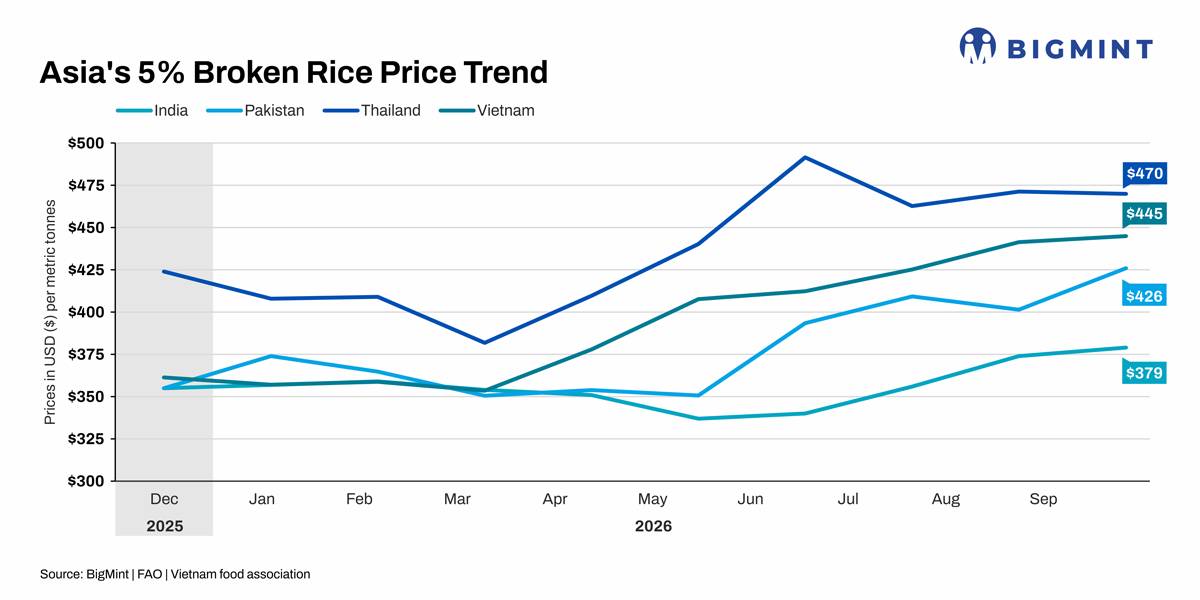
Non-basmati rice prices have strengthened as paddy availability has tightened. At Kakinada, IR-64 5% parboiled rice increased to around $370-380/t, from $320-330/t in May, while Kandla prices rose to around $390-400/t, from about $340/t in June.
Basmati prices have been comparatively stable, with 1121 Steam at around $1,050-1,100/t and 1509 Steam at $950-1,000/t. However, disruptions in West Asian markets have added pressure to the segment.
The rise in non-basmati prices has coincided with a renewed slowdown in exports. India shipped 18.8 mnt during October-July of MY 2025/26, down from 19.5 mnt in the corresponding period of MY 2024/25.
The export trajectory has been uneven. Shipments were below year-ago levels from October to February, before recovering during February-June as competitive Indian prices and adequate domestic supplies supported buying. January-June exports were estimated at 12.2 mnt, around 5% higher year-on-year.
The recovery lost momentum in July as higher rice prices and tighter paddy availability reduced the competitiveness of Indian cargoes.
Including estimated August-September shipments of 2.8 mnt, full-year exports are projected at around 21.6 mnt, below the 23 mnt recorded in MY 2024/25.

Freight becoming bigger part of the trade equation
The widening difference between FOB prices and delivered costs is becoming increasingly important for exporters and buyers.
Bulk freight to West Africa has eased from the $80-90/t range seen during the earlier period of volatility to around $70-75/t on the India-Cotonou route. Early-September indications were around $80/t from Kakinada to Conakry, $78/t to Abidjan and $75/t to Cotonou.
Container economics are less favourable. A 25-tonne container with freight of around $2,500 translates to more than $100/t, compared with bulk freight below $80/t. This is encouraging exporters to explore bulk vessels more actively for larger West African shipments.
Container freight, after initially easing as availability improved, has subsequently firmed with stronger inquiries and tighter availability. Early-September indications were around $1,900/FCL from Mundra to Mombasa, $2,150/FCL from JNPT to Tamatave and $2,650/FCL from JNPT to Berbera.
The implication is that a nominally competitive FOB offer does not necessarily translate into a competitive delivered price. Freight, transit time and execution reliability can materially alter the economics between competing origins.


West Africa adds another layer of uncertainty
Logistics are also being complicated by policy and trade restrictions across key West African markets, including Benin, Togo, Ivory Coast, Senegal and Burkina Faso. Changes involving import volumes, licences, storage and re-export channels can affect both shipment timing and the movement of cargo through regional hubs.
Benin is particularly significant because Cotonou functions as both a consumption market and a transit hub. Around 1.75 mnt of rice flows into Cotonou, with a significant portion moving onward to neighbouring markets.
This creates a logistical vulnerability. A surge in vessel arrivals can result in port congestion, while border restrictions can leave cargo accumulating at the port. In such circumstances, Lome can become an alternative outlet, allowing trade flows to be redirected when Cotonou becomes congested or operationally constrained.
For Indian exporters, this means destination selection is becoming an increasingly important component of shipment economics. The lowest FOB offer may not deliver the lowest landed cost once freight, port congestion, transit time, border restrictions and vessel availability are incorporated.
New crop could ease supply pressure
The next major variable is the arrival of the new crop from October-November. Uneven rainfall and weather conditions have raised concerns over productivity, with one estimate indicating around a 4% decline in output.
Despite the potential crop decline, India’s overall supply position remains relatively comfortable. The 2026/27 balance sheet estimates production at 147 mnt, with beginning stocks of 59.9 mnt, taking total supply to 206.9 mnt. Against this, exports are projected at 25 mnt, domestic consumption at 125 mnt and ending stocks at 56.9 mnt.
The relatively high stock base provides a cushion against weaker production and reduces the likelihood that a modest crop shortfall alone will create a severe supply deficit.
However, the balance between domestic availability and exports will depend on monsoon performance, crop yields, fertilizer availability, domestic consumption requirements and government policy.

Outlook
New-crop arrivals could ease the current paddy tightness and limit further increases in non-basmati rice prices. The extent of the correction, however, will depend on crop yields and the strength of demand from Africa.
For exporters, the bigger structural issue is logistics. Bulk vessels provide a freight advantage over containers for West African trade, but that advantage can be offset by congestion, vessel availability, longer transit times and changes in border or import policies.
India’s projected 25 mnt of rice exports in MY 2026/27 therefore represents more than a volume target. It implies that Indian cargoes will need to remain competitive on a delivered-cost basis, not simply at the FOB level.
As Cotonou and other West African hubs adjust to changing trade restrictions and congestion, cargo flows could increasingly shift between Cotonou, Lome and other regional gateways. At the same time, a more balanced domestic supply position after the new crop could provide exporters with greater flexibility on pricing.
The key variables to watch are therefore new-crop arrivals, non-basmati rice prices, West African demand, bulk freight rates and policy-related disruptions at major destination hubs.
Leave a Reply