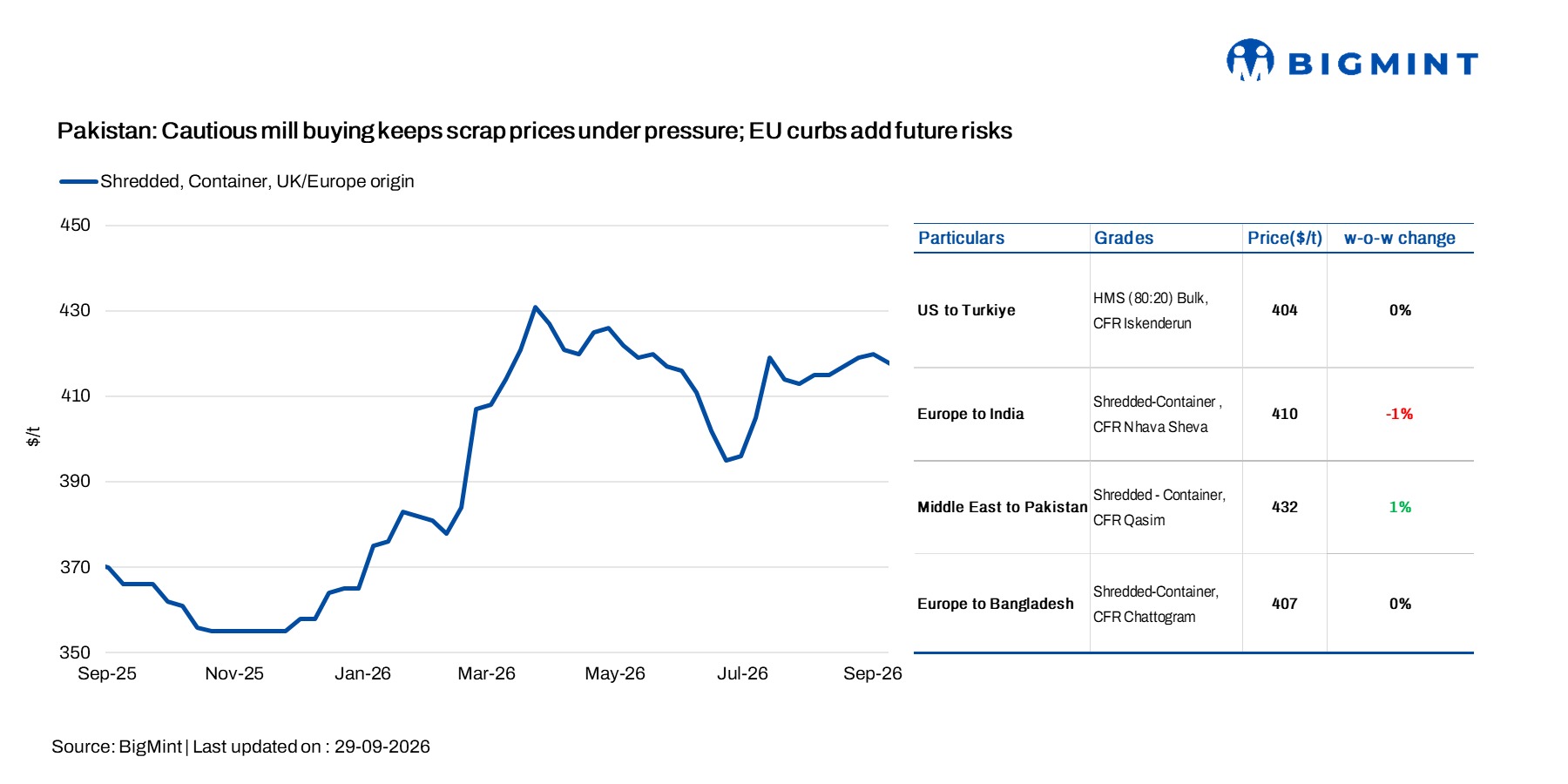
- Weak finished-steel demand limits scrap procurement
- Market participants expect scrap prices to recover in early October
Pakistan’s ferrous scrap market remained subdued during the week ending on 29 September, with weak finished steel demand and cautious mill buying limiting import activity. Buyers continued to resist higher prices, although firm overseas offers and recent transactions kept the market supported. Mills remained focused on securing competitively priced cargoes amid pressure on finished-steel margins.
BigMint assessed Europe-origin shredded scrap at $416/t CFR Qasim, down $2/t w-o-w.
Market scenario
UK/EU-origin shredded scrap offers were heard at $418-425/t CFR Qasim, with current market indications around $420/t. Imported shredded scrap was assessed at $416-418/t CFR Qasim/Karachi, while HMS 90:10 was around $390/t CFR Qasim/Karachi.
According to a major Peshawar region-based steelmaker, Pakistan’s market is currently buyer-driven, with suppliers holding cargoes already on the water while buyers remain largely inactive. This is keeping prices under short-term pressure, although market participants mostly expect a recovery in prices from the week of October.
“Buyers are currently staying on the sidelines as suppliers hold cargoes on the water. This is putting pressure on prices, but we expect buying activity to improve from the week of October,” the Peshawar-based steelmaker said.
A Europe-based trader said containerised shredded scrap offers were heard at $420-425/t CFR Qasim, while other market indications were around $415-418/t. Middle Eastern HMS sheared was heard at $410-412/t CFR Qasim, with offers around $415-418/t.
A UAE-based supplier source said Middle Eastern scrap was offered at a $10-15/t premium over UK-origin material, while UAE-origin shredded remained unworkable for Pakistani buyers at prevailing levels. Middle Eastern HMS was offered at $410-420/t CFR Qasim, with shipment subject to vessel availability.
Recent trades
- 500 t UK-origin shredded scrap: $418/t CFR Qasim
- 3,000 t UK-origin shredded scrap: $415-416/t CFR Qasim
- 1,500 t UK-origin shredded scrap: $423/t CFR Qasim (transit material)
- 500 t Middle East-origin compressor scrap: $415/t CFR Qasim
Domestic scrap prices remained at PKR 134,000-136,000/t ($484-491/t), while billet was assessed at PKR 214,000-216,000/t ($773-780/t) and rebar at PKR 235,000-237,000/t ($849-856/t) exw.
Lower finished-steel demand and tight margins continued to restrict mills’ purchasing appetite. Mill utilisation stood at around 35-40%, while mill sales were at approximately 30-35%.

EU scrap restrictions raise future supply concerns
Market discussions have resurfaced around a possible EU restriction on ferrous scrap exports to non-OECD countries.
On 18 September, the European Commission published draft lists covering countries that may be authorised to receive specified non-hazardous waste from the EU and those that may face restrictions. Bangladesh, India, and Pakistan could potentially face restrictions from May 2027 unless specific exemptions are granted.
The impact could be more visible in Pakistan given its historical dependence on European and UAE-origin scrap. However, buyers have diversified sourcing in recent months, with South Korea, Japan, the Philippines, Malaysia, and Hong Kong gaining relevance. South American suppliers have also emerged, while Pakistani mills have expanded their buying preferences to include various HMS grades, PNS, LMS, GI bundles, and busheling.
Outlook
Pakistan’s scrap market is expected to remain stable to firm over the coming week, as weak finished-steel demand and tight mill margins continue to limit aggressive buying. However, firm replacement costs and limited availability of competitively priced cargoes could provide support to imported scrap prices. Market participants largely expect buying activity and prices to recover from the week of October.
Over the medium term, any new EU restrictions on scrap exports to non-OECD destinations could increase competition among Pakistani mills for alternative supply and raise procurement costs. However, continued diversification towards the UK, Middle East, and other origins could partly offset the impact.
Leave a Reply