- SAIL, BCCL to develop two mines in West Bengal with 4 mnt/y capacity
- SAIL’s crude steel output rises 1% in FY’26; coking coal imports reach 14 mnt
Steel Authority of India Ltd (SAIL) has joined hands with Bharat Coking Coal Ltd (BCCL) to jointly develop and operate the Indikatta Ramnagore Coal Block of SAIL and the East of Damagoria (Kalyaneshwari) Coal Block of BCCL in West Bengal, adding a domestic sourcing component to its coking coal procurement strategy. The blocks have a combined Peak Rated Capacity (PRC) of 4 mnt/year.
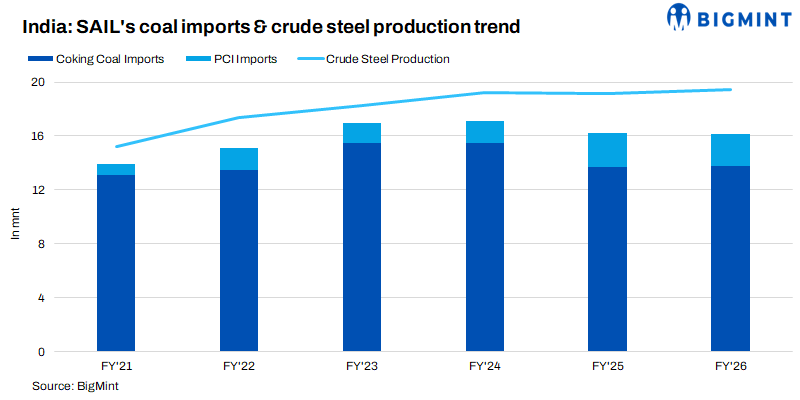
This move comes as rising steel sales and sustained blast furnace operations increase SAIL’s dependence on imported raw materials. The company’s crude steel production rose 1.4% y-o-y to 19.43 mnt in FY’26, while sales volumes increased 11.4%, indicating stronger steel dispatches relative to production growth. Considering SAIL’s hot metal output of 20.5 mnt in FY’26, its annual coking coal requirement stands around 12-12.5 mnt, as per BigMint estimates.
SAIL’s multi-layered procurement strategy
SAIL imported around 13.9 mnt of coking coal during FY’26, equivalent to nearly 22% of India’s estimated 64 mnt imports. It also imported around 2.5 mnt of pulverised coal injection (PCI) coal. The scale of these imports highlights the exposure of its steelmaking economics to international coal availability, prices, and freight.
Australia, the US, Russia, and Mozambique were among the company’s major coking coal sources in FY’26, while trial shipments from Mongolia indicate that the company is also examining additional origins.
Additionally, SAIL sources some volume of coking coal from the Indian domestic market, largely from BCCL via auction, sources said.
Notably, domestic development is being pursued alongside overseas opportunities. SAIL is exploring coking coal assets in Russia and already has coal assets in Mozambique’s Moatize Coal Basin.
Market implications
The combination of domestic coal-block development, overseas asset exploration, and diversified imports therefore represents a multi-layered supply strategy aimed at supply security rather than relying exclusively on spot or long-term imports from established suppliers.
Developing domestic coking coal resources could improve supply visibility and reduce dependence on imported material over time, although high ash content in domestic coal remains a concern. However, the impact on SAIL’s import requirement would depend on the development timeline, production scale, and quality of coal available from these blocks. Moreover, the initiative also reflects a broader industry requirement to expand access to domestic coking coal as India’s steelmaking capacity grows.
In the meantime, SAIL’s dependence on imports is set to continue. However, greater diversification is expected to provide procurement flexibility, although the commercial viability of each origin will depend on coal quality, landed cost, logistics, and supply reliability.
Key risks
The effectiveness of this strategy will depend on the pace of domestic coal-block development and the ability of overseas assets to provide commercially viable supplies. Coal quality requirements for blast furnace operations could also limit substitution between origins.
For imported coal, freight costs, geopolitical developments and availability from major exporting countries remain important variables. A sustained increase in SAIL’s steel output could amplify these exposures if additional secure supplies are not developed alongside production growth.
Leave a Reply