- Landed cost management is gaining greater importance
- Commodity and currency risks require separate strategies
India’s aluminium industry is entering a period of rapid growth, but rising price volatility is creating a new layer of risk for manufacturers, traders and consumers across the value chain. As aluminium prices respond to global market movements, premiums, currency fluctuations and supply-side developments, businesses are increasingly looking beyond price forecasting towards structured risk management.
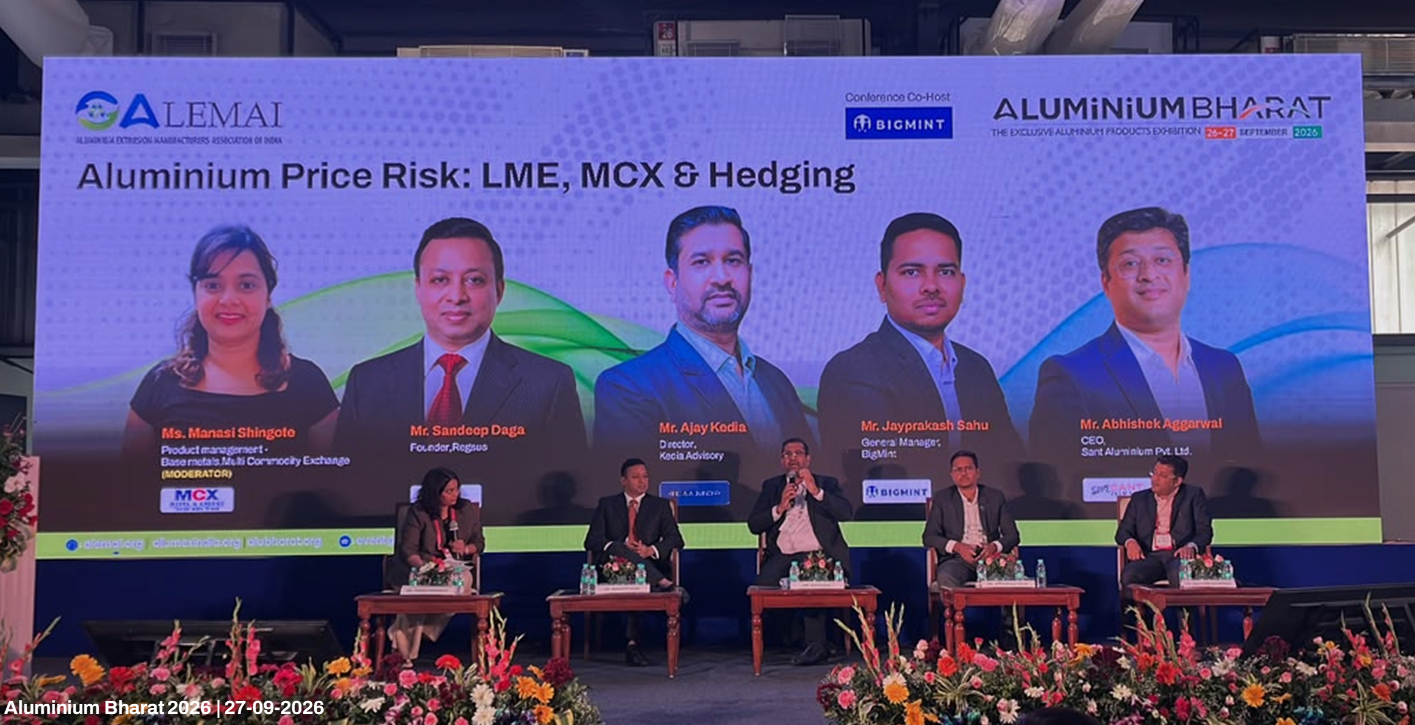
The “Aluminium Price Risk: LME, MCX & Hedging” session on Day 2 (27 September 2026) at Aluminium Bharat 2026, organised by the Aluminium Extrusion Manufacturers Association of India (ALEMAI) and conference co-hosted by BigMint, brought together industry experts to discuss practical approaches to managing commodity and currency exposure. The discussion covered LME and MCX benchmarks, landed-cost management, inventory risk, premiums, hedging strategies and the need for a more systematic risk-management framework.
Volatility is making risk management more important
According to Mr. Sandeep Daga, Founder, Regsus, aluminium price volatility has become an increasingly important business risk, particularly for manufacturers operating on fixed-price contracts. Since raw material costs form a significant portion of product costs, sudden changes in aluminium prices can directly affect margins.
Daga highlighted that businesses cannot control global aluminium prices, but they can control how they manage their exposure. “Let’s stop focusing on something that we cannot control; let’s focus on something that we can control,” he said, stressing the importance of moving from price prediction towards risk management.
He identified three broad areas of exposure for businesses: volume mismatch, timing mismatch and inventory risk. Understanding these exposures, he noted, is an important first step before deciding on an appropriate hedging strategy.
Businesses need to focus on actual margin impact
Mr. Ajay Kedia, Director, Kedia Advisory, emphasised that businesses should distinguish between market information that is relevant to their operations and market noise. With companies receiving constant updates on prices, geopolitical developments and market movements, reacting to every headline can lead to unnecessary decisions.
As per Kedia, businesses should first evaluate whether a particular market development has a direct impact on their margins. “Does this news impact my margin or not?” he asked, highlighting the importance of connecting market intelligence with actual business exposure.
Landed cost is becoming more important
According to Mr. Jayprakash Sahu, GM, BigMint, aluminium buyers are increasingly looking beyond the LME price and focusing on the complete landed cost of material. For primary aluminium, this includes the LME price, regional premiums, logistics and other associated costs, while secondary and alloy producers also need to consider scrap-to-alloy spreads.

“Buyers are moving away from LME cost risk management. They are moving more towards landed-cost management,” Sahu noted. This shift makes it important for businesses to assess their total procurement cost rather than relying only on movements in the benchmark aluminium price.
Premiums and currency add to the exposure
Mr. Abhishek Agarwal, CEO, Sant Aluminium Pvt. Ltd., highlighted the growing importance of physical premiums for downstream manufacturers. While LME provides a global benchmark, manufacturers ultimately have to manage the physical price they pay for aluminium. Changes in premiums can therefore affect margins even when the underlying LME price remains relatively stable.
The discussion also highlighted that commodity and currency risks should not necessarily be treated as a single exposure. Daga suggested separating the metal book from the dollar book, since aluminium prices and currency movements can follow different timelines and require different risk-management approaches.
Inventory management needs a risk perspective
Inventory was another important area of discussion. According to Sahu, the appropriate inventory level depends on factors such as plant requirements, procurement cycles, sourcing locations and logistics. However, inventory also creates price exposure when market prices move significantly.
Businesses therefore need to distinguish between hedged and unhedged inventory and understand how much of their physical stock is exposed to price fluctuations.
Hedging needs to become a regular business process
Kedia stressed that hedging should not be treated as an occasional reaction to sharp market movements. Instead, it needs to become part of the regular decision-making process.
“Hedging is a ritual which should be part of our business,” Kedia said, emphasising the need for businesses to establish defined processes rather than making ad-hoc decisions during periods of volatility.
For MSMEs, Daga noted that the need for risk management can be particularly important because thinner margins can leave businesses more vulnerable to price movements. “If your EBITDA is low, you need hedging even more,” he said, while also emphasising that businesses can gradually develop their hedging capabilities rather than attempting to hedge every exposure immediately.
Moving towards a structured risk-management culture
The discussion also highlighted the need for businesses to move from owner-driven commodity decisions towards a more structured risk-management function. Kedia described this as a transition from the traditional model to a professional approach, where procurement, finance, sales and risk-management teams work together.
For businesses where full hedging may not be practical, Sahu suggested that partial hedging and gradual adoption of best practices can provide a starting point. The broader message from the session was that effective risk management does not necessarily mean predicting the market correctly; rather, it involves identifying exposures, defining acceptable risks and protecting business margins through disciplined processes.
As Daga summed up, the focus should ultimately remain on building the underlying business rather than being dominated by short-term price movements: “Scale your business up, and celebrate the story of India.”
Leave a Reply